Journal: Br J Pharmacol / Year: 2026 Title: Chemoproteomic discovery of a brain-penetrant, covalent NLRP3 inhibitor that binds a novel allosteric pocket. Authors: Donald C Rogness / Evelyn P Sievert / Vincent F Vartabedian / Steffen M Bernard / Erick Aitchison / William Tao / Mikaela Lindvall / Jing Qian / Christie L Eissler / Brian E Nordin / ...Authors: Donald C Rogness / Evelyn P Sievert / Vincent F Vartabedian / Steffen M Bernard / Erick Aitchison / William Tao / Mikaela Lindvall / Jing Qian / Christie L Eissler / Brian E Nordin / Benjamin D Horning / Cian Kingston / Kelsey N Lamb / Joshua C Bell / Bingwen Lu / Jonathan Pollock / Jun Shi / Roli Khattri / David S Weinstein / Matthew P Patricelli / Brian N Cook / Gabriel M Simon / Abstract: BACKGROUND AND PURPOSE: The NLRP3 inflammasome is an attractive therapeutic target for multiple inflammatory conditions. Although inhibitors have been developed, their chemical diversity is limited, ...BACKGROUND AND PURPOSE: The NLRP3 inflammasome is an attractive therapeutic target for multiple inflammatory conditions. Although inhibitors have been developed, their chemical diversity is limited, and their properties are not ideal for brain penetrance, which is desirable for treating neuroinflammatory disorders. EXPERIMENTAL APPROACH: We applied our chemoproteomics platform to survey our electrophilic fragment collection to identify inhibitors of NLRP3. We focused our attention on compounds that bind Cys463, ...EXPERIMENTAL APPROACH: We applied our chemoproteomics platform to survey our electrophilic fragment collection to identify inhibitors of NLRP3. We focused our attention on compounds that bind Cys463, as this residue was identified as an allosteric sensor of NLRP3 function. KEY RESULTS: A novel inhibitor series was identified bearing a butynamide electrophile and a unique spirocyclic lactam core. Compounds from this series displayed mid-nanomolar potency and were found ...KEY RESULTS: A novel inhibitor series was identified bearing a butynamide electrophile and a unique spirocyclic lactam core. Compounds from this series displayed mid-nanomolar potency and were found to inhibit IL-1β secretion in a Cys463-dependent manner. Cryo-EM structures revealed that ligand binding to Cys463 stabilizes an inactive conformation, thereby preventing structural rearrangements required for inflammasome activation. These compounds displayed attractive pharmacokinetic properties and, notably, Kp,uu values >0.5, suggesting the potential to address neuroinflammatory disorders. Administration of a representative compound to humanized mice resulted in clear NLRP3 Cys463 target-engagement and profound suppression of LPS- and ATP-induced IL-1β secretion, demonstrating clear proof-of-concept in vivo. CONCLUSION AND IMPLICATIONS: Chemoproteomics-based ligand discovery is intrinsically function-agnostic and has the potential to identify novel pockets on even well-characterized protein targets. ...CONCLUSION AND IMPLICATIONS: Chemoproteomics-based ligand discovery is intrinsically function-agnostic and has the potential to identify novel pockets on even well-characterized protein targets. Here, optimization of ligands targeting Cys463 of NLRP3 within a previously uncharacterized allosteric pocket led to a unique and potent inhibitor series with attractive physicochemical and pharmacokinetic properties for the potential treatment of diseases involving aberrant innate immune activation in both central and peripheral tissues.
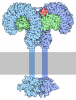
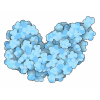
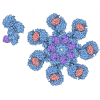
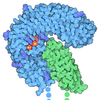
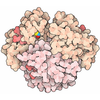
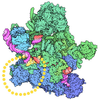
Macromolecule #1: NACHT, LRR and PYD domains-containing protein 3
Macromolecule
Name: NACHT, LRR and PYD domains-containing protein 3 / type: protein_or_peptide / ID: 1 / Number of copies: 1 / Enantiomer: LEVO EC number: Hydrolases; Acting on acid anhydrides; Acting on acid anhydrides to facilitate cellular and subcellular movement
In the structure databanks used in Yorodumi, some data are registered as the other names, "COVID-19 virus" and "2019-nCoV". Here are the details of the virus and the list of structure data.
Jan 31, 2019. EMDB accession codes are about to change! (news from PDBe EMDB page)
EMDB accession codes are about to change! (news from PDBe EMDB page)
The allocation of 4 digits for EMDB accession codes will soon come to an end. Whilst these codes will remain in use, new EMDB accession codes will include an additional digit and will expand incrementally as the available range of codes is exhausted. The current 4-digit format prefixed with “EMD-” (i.e. EMD-XXXX) will advance to a 5-digit format (i.e. EMD-XXXXX), and so on. It is currently estimated that the 4-digit codes will be depleted around Spring 2019, at which point the 5-digit format will come into force.
The EM Navigator/Yorodumi systems omit the EMD- prefix.
Related info.:Q: What is EMD? / ID/Accession-code notation in Yorodumi/EM Navigator
Yorodumi is a browser for structure data from EMDB, PDB, SASBDB, etc.
This page is also the successor to EM Navigator detail page, and also detail information page/front-end page for Omokage search.
The word "yorodu" (or yorozu) is an old Japanese word meaning "ten thousand". "mi" (miru) is to see.
Related info.:EMDB / PDB / SASBDB / Comparison of 3 databanks / Yorodumi Search / Aug 31, 2016. New EM Navigator & Yorodumi / Yorodumi Papers / Jmol/JSmol / Function and homology information / Changes in new EM Navigator and Yorodumi
 Movie
Movie Controller


 Open data
 Basic information
 Map data
 Sample
 Keywords
 Function and homology information
 Homo sapiens (human)
 Authors
 Citation
 Structure visualization
 Downloads & links
 emd_73688.png
 https://data.pdbj.org/pub/emdb/structures/EMD-73688

 Z (Sec.)
 Y (Row.)
 X (Col.)


 Sample components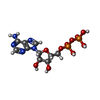
 Processing
 Electron microscopy
 FIELD EMISSION GUN

