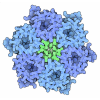
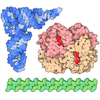
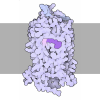
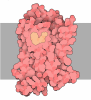
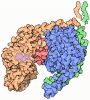
Journal: Nat Commun / Year: 2026 Title: Cryo-EM structure of the SRI-HtrI complex reveals the cytoplasmic coupling in an archaeal phototaxis system. Authors: Guo Zhen Lim / Yu-En Lin / Pei-Chun Chen / Hsu-Yuan Fu / Chii-Shen Yang / Abstract: Sensory rhodopsins (SRs) in haloarchaea form complexes with their cognate transducers (Htrs) to produce wavelength-specific phototactic responses, yet similar architectures mediate distinct behaviors: ...Sensory rhodopsins (SRs) in haloarchaea form complexes with their cognate transducers (Htrs) to produce wavelength-specific phototactic responses, yet similar architectures mediate distinct behaviors: SRI mediates attraction, SRII drives repulsion, whereas SRM modulates both responses. Until now, structural insight was limited to the Natronomonas pharaonis SRII-HtrII system in a truncated form, without a full-length counterpart for comparison. Moreover, NpHtrII is distinct among HtrII transducers in lacking the large periplasmic domain retained in homologs from Halobacterium salinarum, Haloarcula marismortui and Haloarcula taiwanensis, leaving the canonical SR-Htr architecture unknown. Here, we report the cryo-EM structure of the Haloarcula taiwanensis SRI-HtrI complex, providing a near native, non-crystallized view of a full-length SR-Htr dimer with the cytoplasmic HAMP1 domain resolved. The structure reveals the intact homodimeric receptor-transducer assembly and visualizes the interface between the helix G (Arg215), SRI E-F loop (Pro154), and HtrI HAMP1. These findings fill the long-standing structural gap for a canonical SR-Htr complex and establish a framework for conserved receptor-transducer coupling across archaeal phototaxis systems.
History
Deposition
Sep 25, 2025
Deposition site: PDBJ / Processing site: PDBJ
Revision 1.0
Apr 22, 2026
Provider: repository / Type: Initial release
Revision 1.0
Apr 22, 2026
Data content type: EM metadata / Data content type: EM metadata / Provider: repository / Type: Initial release
Revision 1.0
Apr 22, 2026
Data content type: FSC / Data content type: FSC / Provider: repository / Type: Initial release
Revision 1.0
Apr 22, 2026
Data content type: Half map / Part number: 1 / Data content type: Half map / Provider: repository / Type: Initial release
Revision 1.0
Apr 22, 2026
Data content type: Half map / Part number: 2 / Data content type: Half map / Provider: repository / Type: Initial release
Revision 1.0
Apr 22, 2026
Data content type: Image / Data content type: Image / Provider: repository / Type: Initial release
Revision 1.0
Apr 22, 2026
Data content type: Mask / Part number: 1 / Data content type: Mask / Provider: repository / Type: Initial release
Revision 1.0
Apr 22, 2026
Data content type: Primary map / Data content type: Primary map / Provider: repository / Type: Initial release
Data content type: EM metadata / Data content type: EM metadata / EM metadata / Group: Database references / Experimental summary / Data content type: EM metadata / EM metadata / EM metadata / Category: citation / citation_author / em_admin Data content type: EM metadata / EM metadata ...EM metadata / EM metadata / EM metadata / EM metadata / EM metadata / EM metadata / EM metadata / EM metadata / EM metadata / EM metadata Item: _citation.country / _citation.journal_abbrev ..._citation.country / _citation.journal_abbrev / _citation.journal_id_CSD / _citation.journal_id_ISSN / _citation.pdbx_database_id_DOI / _citation.pdbx_database_id_PubMed / _citation.title / _citation.year / _citation_author.identifier_ORCID / _em_admin.last_update
Data content type: EM metadata / Data content type: EM metadata / EM metadata / Group: Database references / Experimental summary / Data content type: EM metadata / EM metadata / EM metadata / Category: citation / citation_author / em_admin / Data content type: EM metadata / EM metadata / EM metadata Item: _citation.journal_volume / _citation_author.identifier_ORCID / _em_admin.last_update
In the structure databanks used in Yorodumi, some data are registered as the other names, "COVID-19 virus" and "2019-nCoV". Here are the details of the virus and the list of structure data.
Jan 31, 2019. EMDB accession codes are about to change! (news from PDBe EMDB page)
EMDB accession codes are about to change! (news from PDBe EMDB page)
The allocation of 4 digits for EMDB accession codes will soon come to an end. Whilst these codes will remain in use, new EMDB accession codes will include an additional digit and will expand incrementally as the available range of codes is exhausted. The current 4-digit format prefixed with “EMD-” (i.e. EMD-XXXX) will advance to a 5-digit format (i.e. EMD-XXXXX), and so on. It is currently estimated that the 4-digit codes will be depleted around Spring 2019, at which point the 5-digit format will come into force.
The EM Navigator/Yorodumi systems omit the EMD- prefix.
Related info.:Q: What is EMD? / ID/Accession-code notation in Yorodumi/EM Navigator
Yorodumi is a browser for structure data from EMDB, PDB, SASBDB, etc.
This page is also the successor to EM Navigator detail page, and also detail information page/front-end page for Omokage search.
The word "yorodu" (or yorozu) is an old Japanese word meaning "ten thousand". "mi" (miru) is to see.
Related info.:EMDB / PDB / SASBDB / Comparison of 3 databanks / Yorodumi Search / Aug 31, 2016. New EM Navigator & Yorodumi / Yorodumi Papers / Jmol/JSmol / Function and homology information / Changes in new EM Navigator and Yorodumi
 Movie
Movie Controller


 Open data
 Basic information
 Components
 Keywords
 Function and homology information
 Haloarcula taiwanensis (Halophile)
 Authors
 Citation
 Structure visualization
 Downloads & links
 Other downloads
 PDBj
PDBj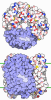
 Assembly

 Escherichia coli BL21(DE3) (bacteria) / Variant (production host): C43 / References: UniProt: A0A2H4ZVH1, UniProt: A0A2H4ZVF9
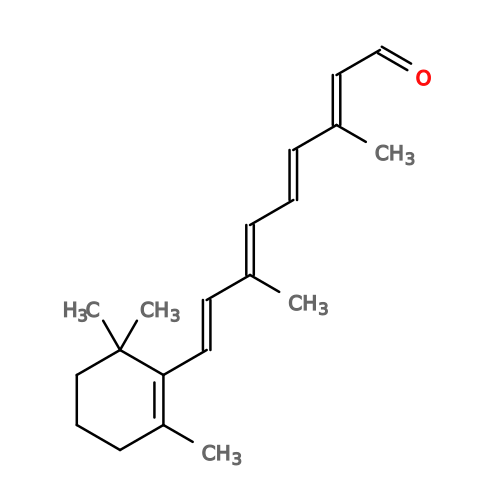 Mass: 284.436 Da / Num. of mol.: 2 / Source method: obtained synthetically / Formula: C20H28O / Feature type: SUBJECT OF INVESTIGATION
 Sample preparation
 Electron microscopy imaging
 FIELD EMISSION GUN / Accelerating voltage: 200 kV / Illumination mode: FLOOD BEAM
 Processing