[English] 日本語
Yorodumi
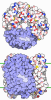
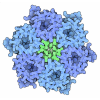
- EMDB-66355: sensory rhodopsin I with its cognate transducer HtrI -

+
Open data


ID or keywords:

Loading...

-
Basic information

Entry
Database: EMDB / ID: EMD-66355
Titlesensory rhodopsin I with its cognate transducer HtrI
Map data
Sample
  • Cell: Dimerized complex of HtSRI-HtrI fused with a linker peptide
    • Protein or peptide: Rhodopsin,Chemotaxis protein
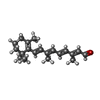
  • Ligand: RETINAL
Keywordssensory rhodopsin / transducer / HAMP domain / phototaxis / SIGNALING PROTEIN
Function / homology
Function and homology information


photoreceptor activity / phototransduction / monoatomic ion channel activity / chemotaxis / transmembrane signaling receptor activity / signal transduction / membrane
Similarity search - Function
Chemotaxis methyl-accepting receptor / Methyl-accepting chemotaxis protein (MCP) signalling domain / Methyl-accepting chemotaxis protein (MCP) signalling domain / Bacterial chemotaxis sensory transducers domain profile. / Methyl-accepting chemotaxis-like domains (chemotaxis sensory transducer). / HAMP domain / HAMP (Histidine kinases, Adenylyl cyclases, Methyl binding proteins, Phosphatases) domain / Bacterial rhodopsins retinal binding site. / HAMP domain profile. / HAMP domain ...Chemotaxis methyl-accepting receptor / Methyl-accepting chemotaxis protein (MCP) signalling domain / Methyl-accepting chemotaxis protein (MCP) signalling domain / Bacterial chemotaxis sensory transducers domain profile. / Methyl-accepting chemotaxis-like domains (chemotaxis sensory transducer). / HAMP domain / HAMP (Histidine kinases, Adenylyl cyclases, Methyl binding proteins, Phosphatases) domain / Bacterial rhodopsins retinal binding site. / HAMP domain profile. / HAMP domain / Bacterial rhodopsins signature 1. / Rhodopsin, retinal binding site / Bacteriorhodopsin-like protein / Archaeal/bacterial/fungal rhodopsins / Bacteriorhodopsin-like protein
Similarity search - Domain/homology
Chemotaxis protein / Rhodopsin
Similarity search - Component
Biological speciesHaloarcula taiwanensis (Halophile)
Methodsingle particle reconstruction / cryo EM / Resolution: 4.9 Å
AuthorsLim GZ / Lin YE / Wu YM / Chen PC / Fu HY / Yang CS
Funding support1 items
OrganizationGrant numberCountry
Not funded
CitationJournal: Nat Commun / Year: 2026
Title: Cryo-EM structure of the SRI-HtrI complex reveals the cytoplasmic coupling in an archaeal phototaxis system.
Authors: Guo Zhen Lim / Yu-En Lin / Pei-Chun Chen / Hsu-Yuan Fu / Chii-Shen Yang /
Abstract: Sensory rhodopsins (SRs) in haloarchaea form complexes with their cognate transducers (Htrs) to produce wavelength-specific phototactic responses, yet similar architectures mediate distinct behaviors: ...Sensory rhodopsins (SRs) in haloarchaea form complexes with their cognate transducers (Htrs) to produce wavelength-specific phototactic responses, yet similar architectures mediate distinct behaviors: SRI mediates attraction, SRII drives repulsion, whereas SRM modulates both responses. Until now, structural insight was limited to the Natronomonas pharaonis SRII-HtrII system in a truncated form, without a full-length counterpart for comparison. Moreover, NpHtrII is distinct among HtrII transducers in lacking the large periplasmic domain retained in homologs from Halobacterium salinarum, Haloarcula marismortui and Haloarcula taiwanensis, leaving the canonical SR-Htr architecture unknown. Here, we report the cryo-EM structure of the Haloarcula taiwanensis SRI-HtrI complex, providing a near native, non-crystallized view of a full-length SR-Htr dimer with the cytoplasmic HAMP1 domain resolved. The structure reveals the intact homodimeric receptor-transducer assembly and visualizes the interface between the helix G (Arg215), SRI E-F loop (Pro154), and HtrI HAMP1. These findings fill the long-standing structural gap for a canonical SR-Htr complex and establish a framework for conserved receptor-transducer coupling across archaeal phototaxis systems.
History
DepositionSep 25, 2025-
Header (metadata) releaseApr 22, 2026-
Map releaseApr 22, 2026-
UpdateApr 29, 2026-
Current statusApr 29, 2026Processing site: PDBj / Status: Released

-
Structure visualization

Supplemental images

Downloads & links

-
Map

FileDownload / File: emd_66355.map.gz / Format: CCP4 / Size: 347.6 MB / Type: IMAGE STORED AS FLOATING POINT NUMBER (4 BYTES)
Projections & slices

Image control

Size
Brightness
Contrast
Others
AxesZ (Sec.)Y (Row.)X (Col.)
0.74 Å/pix.
x 450 pix.
= 333. Å
0.74 Å/pix.
x 450 pix.
= 333. Å
0.74 Å/pix.
x 450 pix.
= 333. Å

Surface

Projections

Slices (1/3)

Slices (1/2)

Slices (2/3)

Images are generated by Spider.

Voxel sizeX=Y=Z: 0.74 Å
Density
Contour LevelBy AUTHOR: 0.0637
Minimum - Maximum-0.05100934 - 0.16877468
Average (Standard dev.)-0.0000028577315 (±0.0045516766)
SymmetrySpace group: 1
Details

EMDB XML:

Map geometry
Axis orderXYZ
Origin000
Dimensions450450450
Spacing450450450
CellA=B=C: 333.0 Å
α=β=γ: 90.0 °

-
Supplemental data

-
Mask #1

Fileemd_66355_msk_1.map
Projections & Slices
AxesZYX

Projections

Slices (1/2)
Density Histograms

-
Half map: #2

Fileemd_66355_half_map_1.map
Projections & Slices
AxesZYX

Projections

Slices (1/2)
Density Histograms

-
Half map: #1

Fileemd_66355_half_map_2.map
Projections & Slices
AxesZYX

Projections

Slices (1/2)
Density Histograms

-
Sample components

-
Entire : Dimerized complex of HtSRI-HtrI fused with a linker peptide

EntireName: Dimerized complex of HtSRI-HtrI fused with a linker peptide
Components
  • Cell: Dimerized complex of HtSRI-HtrI fused with a linker peptide
    • Protein or peptide: Rhodopsin,Chemotaxis protein
  • Ligand: RETINAL

-
Supramolecule #1: Dimerized complex of HtSRI-HtrI fused with a linker peptide

SupramoleculeName: Dimerized complex of HtSRI-HtrI fused with a linker peptide
type: cell / ID: 1 / Parent: 0 / Macromolecule list: #1
Source (natural)Organism: Haloarcula taiwanensis (Halophile)

-
Macromolecule #1: Rhodopsin,Chemotaxis protein

MacromoleculeName: Rhodopsin,Chemotaxis protein / type: protein_or_peptide / ID: 1 / Details: HtSRI-linker(ASASNGASAH)-HtrI fusion / Number of copies: 2 / Enantiomer: LEVO
Source (natural)Organism: Haloarcula taiwanensis (Halophile)
Molecular weightTheoretical: 38.762371 KDa
Recombinant expressionOrganism: Escherichia coli BL21(DE3) (bacteria)
SequenceString: MDAVSVVYGI TAAGFAVGVA IVGFLYASLE GSDERSVLGA LALIPAVAGL SYVAMAFGIG TVTIGETTLV GFRYLDWVVT TPLLVGFIG YTAGASRRAI VGVMAADALM ILAGVGAVVT AGTLKWALFG VSAMFHVSLF AYLYLVFPRS VPDDPQRIGL F SLLKNHVG ...String:
MDAVSVVYGI TAAGFAVGVA IVGFLYASLE GSDERSVLGA LALIPAVAGL SYVAMAFGIG TVTIGETTLV GFRYLDWVVT TPLLVGFIG YTAGASRRAI VGVMAADALM ILAGVGAVVT AGTLKWALFG VSAMFHVSLF AYLYLVFPRS VPDDPQRIGL F SLLKNHVG LLWIAYPLVW LAGPEGLGFA TYVGVSITYA FLDLLAKVPY VYFFYARRQV FATKLLRESG DATVTPADAS AS NGASAHM TVSSVKQSYG AKLGVGYIAT ATLLITVGVV TQDVASTVVA GIAGLLTLGS INAAETVASI TELSAQTQRV ADG DLDTEI VSTRTDEFGD LADSIEQMRV SLRDRLSEME AARADLEQAQ IDAN

UniProtKB: Rhodopsin, Chemotaxis protein

-
Macromolecule #2: RETINAL

MacromoleculeName: RETINAL / type: ligand / ID: 2 / Number of copies: 2 / Formula: RET
Molecular weightTheoretical: 284.436 Da
Chemical component information

ChemComp-RET:
RETINAL

-
Experimental details

-
Structure determination

Methodcryo EM
Processingsingle particle reconstruction
Aggregation stateparticle

-
Sample preparation

Concentration1.5 mg/mL
BufferpH: 6
Component:
ConcentrationFormulaName
100.0 mMNaClsodium chloride
50.0 mMC6H13NO4S2-(N-morpholino)ethanesulfonic acid
GridModel: Quantifoil R1.2/1.3 / Material: COPPER / Mesh: 300 / Support film - Material: CARBON / Support film - topology: HOLEY / Pretreatment - Type: GLOW DISCHARGE / Pretreatment - Time: 90 sec. / Pretreatment - Atmosphere: AIR
VitrificationCryogen name: ETHANE / Chamber humidity: 100 % / Chamber temperature: 277.15 K / Instrument: FEI VITROBOT MARK IV

-
Electron microscopy

MicroscopeTFS GLACIOS
SoftwareName: EPU
Image recordingFilm or detector model: TFS FALCON 4i (4k x 4k) / Average electron dose: 50.0 e/Å2
Electron beamAcceleration voltage: 200 kV / Electron source: FIELD EMISSION GUN
Electron opticsCalibrated defocus max: 1.4000000000000001 µm / Calibrated defocus min: 0.9 µm / Illumination mode: FLOOD BEAM / Imaging mode: BRIGHT FIELD / Cs: 2.7 mm / Nominal defocus max: 1.5 µm / Nominal defocus min: 1.0 µm / Nominal magnification: 190000
Sample stageSpecimen holder model: FEI TITAN KRIOS AUTOGRID HOLDER / Cooling holder cryogen: NITROGEN

+
Image processing

CTF correctionSoftware - Name: cryoSPARC (ver. 4.6.0) / Software - details: Ab-initio reconstruction / Type: PHASE FLIPPING AND AMPLITUDE CORRECTION
Startup modelType of model: INSILICO MODEL
Final reconstructionApplied symmetry - Point group: C2 (2 fold cyclic) / Resolution.type: BY AUTHOR / Resolution: 4.9 Å / Resolution method: FSC 0.143 CUT-OFF / Software - Name: cryoSPARC (ver. 4.6.0) / Number images used: 43979
Initial angle assignmentType: MAXIMUM LIKELIHOOD / Software - Name: cryoSPARC (ver. 4.6.0)
Final angle assignmentType: MAXIMUM LIKELIHOOD / Software - Name: cryoSPARC (ver. 4.6.0)
FSC plot (resolution estimation)

-
Atomic model buiding 1

Initial modelChain - Source name: AlphaFold / Chain - Initial model type: in silico model
SoftwareName: UCSF ChimeraX (ver. 1.10.1)
RefinementSpace: REAL / Protocol: RIGID BODY FIT
Output model

PDB-9wxr:
sensory rhodopsin I with its cognate transducer HtrI

+
About Yorodumi

-
News

-
Feb 9, 2022. New format data for meta-information of EMDB entries

New format data for meta-information of EMDB entries

  • Version 3 of the EMDB header file is now the official format.
  • The previous official version 1.9 will be removed from the archive.

Related info.:EMDB header

External links:wwPDB to switch to version 3 of the EMDB data model

-
Aug 12, 2020. Covid-19 info

Covid-19 info

URL: https://pdbj.org/emnavi/covid19.php

New page: Covid-19 featured information page in EM Navigator.

Related info.:Covid-19 info / Mar 5, 2020. Novel coronavirus structure data

+
Mar 5, 2020. Novel coronavirus structure data

Novel coronavirus structure data

Related info.:Yorodumi Speices / Aug 12, 2020. Covid-19 info

External links:COVID-19 featured content - PDBj / Molecule of the Month (242):Coronavirus Proteases

+
Jan 31, 2019. EMDB accession codes are about to change! (news from PDBe EMDB page)

EMDB accession codes are about to change! (news from PDBe EMDB page)

  • The allocation of 4 digits for EMDB accession codes will soon come to an end. Whilst these codes will remain in use, new EMDB accession codes will include an additional digit and will expand incrementally as the available range of codes is exhausted. The current 4-digit format prefixed with “EMD-” (i.e. EMD-XXXX) will advance to a 5-digit format (i.e. EMD-XXXXX), and so on. It is currently estimated that the 4-digit codes will be depleted around Spring 2019, at which point the 5-digit format will come into force.
  • The EM Navigator/Yorodumi systems omit the EMD- prefix.

Related info.:Q: What is EMD? / ID/Accession-code notation in Yorodumi/EM Navigator

External links:EMDB Accession Codes are Changing Soon! / Contact to PDBj

+
Jul 12, 2017. Major update of PDB

Major update of PDB

  • wwPDB released updated PDB data conforming to the new PDBx/mmCIF dictionary.
  • This is a major update changing the version number from 4 to 5, and with Remediation, in which all the entries are updated.
  • In this update, many items about electron microscopy experimental information are reorganized (e.g. em_software).
  • Now, EM Navigator and Yorodumi are based on the updated data.

External links:wwPDB Remediation / Enriched Model Files Conforming to OneDep Data Standards Now Available in the PDB FTP Archive

-
Yorodumi

Thousand views of thousand structures

  • Yorodumi is a browser for structure data from EMDB, PDB, SASBDB, etc.
  • This page is also the successor to EM Navigator detail page, and also detail information page/front-end page for Omokage search.
  • The word "yorodu" (or yorozu) is an old Japanese word meaning "ten thousand". "mi" (miru) is to see.

Related info.:EMDB / PDB / SASBDB / Comparison of 3 databanks / Yorodumi Search / Aug 31, 2016. New EM Navigator & Yorodumi / Yorodumi Papers / Jmol/JSmol / Function and homology information / Changes in new EM Navigator and Yorodumi

Read more