 Movie
Movie Controller

[English] 日本語
 Yorodumi
- PDB-9w50: MprF from Pseudomonas aeruginosa mutant- H386C/F389C in nanodisc,... -
+ Open data

- Basic information
| Entry | Database: PDB / ID: 9w50 | |||||||||||||||||||||||||||
|---|---|---|---|---|---|---|---|---|---|---|---|---|---|---|---|---|---|---|---|---|---|---|---|---|---|---|---|---|
| Title | MprF from Pseudomonas aeruginosa mutant- H386C/F389C in nanodisc, C2 symmetry | |||||||||||||||||||||||||||
 Components Components | Phosphatidylglycerol lysyltransferase | |||||||||||||||||||||||||||
 Keywords Keywords | MEMBRANE PROTEIN / Multiple peptide resistance factor / Membrane Enzyme / Synthase / Flippase / aminoacylated lipid | |||||||||||||||||||||||||||
| Function / homology |  Function and homology information Function and homology informationphosphatidylglycerol alanyltransferase activity / lysyltransferase / phosphatidylglycerol lysyltransferase activity / phospholipid homeostasis / lipid metabolic process / response to antibiotic / plasma membrane Similarity search - Function | |||||||||||||||||||||||||||
| Biological species |  Pseudomonas aeruginosa PAO1 (bacteria) Pseudomonas aeruginosa PAO1 (bacteria) | |||||||||||||||||||||||||||
| Method | ELECTRON MICROSCOPY / single particle reconstruction / cryo EM / Resolution: 3.3 Å | |||||||||||||||||||||||||||
 Authors Authors | Jha, S. / Vinothkumar, K.R. | |||||||||||||||||||||||||||
| Funding support |  India, 2items India, 2items
| |||||||||||||||||||||||||||
 Citation Citation | Journal: FEBS J / Year: 2026 Title: Cryo-EM structures of multiple-peptide resistance factor (MprF) from Pseudomonas aeruginosa. Authors: Shaileshanand Jha / Kutti R Vinothkumar / Abstract: Aminoacylation of the lipid head group in many bacteria is carried out by bi-functional enzymes called MprF, which encode a soluble synthase domain that typically transfers lysine or alanine from a ...Aminoacylation of the lipid head group in many bacteria is carried out by bi-functional enzymes called MprF, which encode a soluble synthase domain that typically transfers lysine or alanine from a tRNA to lipid head groups. The modified lipid is subsequently translocated across the leaflets by a transmembrane domain. This modification of lipids probably evolved to adapt to the environment where the microbes reside. Here, we describe the cryo-EM structures of MprF enzyme from Pseudomonas aeruginosa, revealing a dimeric enzyme with a distinct architecture when compared with the homologous Rhizobium enzymes, and validate this arrangement with biochemical analyses. The cryo-EM maps and the models in detergent micelle and nanodisc reveal a conformational change of the terminal helix of the synthase domain, highlighting the dynamic elements in the enzyme that might facilitate catalysis. Several lipid-like densities are observed in the cryo-EM maps, which might indicate the path taken by the lipids, coupling the function of the two domains. The structures allow postulation of the binding modes of tRNA and lipid transport, and suggest that the mobile secondary structural elements in the synthase domain might play a mechanistic role in these functions. | |||||||||||||||||||||||||||
| History |
|
- Structure visualization
| Structure viewer | Molecule: MolmilJmol/JSmol |
|---|
- Downloads & links
-Download
| PDBx/mmCIF format | 9w50.cif.gz | 323.3 KB | Display | PDBx/mmCIF format |
|---|---|---|---|---|
| PDB format | pdb9w50.ent.gz | 256.2 KB | Display | PDB format |
| PDBx/mmJSON format | 9w50.json.gz | Tree view | PDBx/mmJSON format | |
| Others |  Other downloads Other downloads |
-Validation report
| Arichive directory | https://data.pdbj.org/pub/pdb/validation_reports/w5/9w50ftp://data.pdbj.org/pub/pdb/validation_reports/w5/9w50 | HTTPS FTP |
|---|
-Related structure data
| Related structure data |  65648MC  9j8qC  9j8rC  9j8sC  9w51C C: citing same article ( M: map data used to model this data |
|---|---|
| Similar structure data |


-Links
 PDBj
PDBj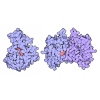
- Assembly
| Deposited unit | 
|
|---|---|
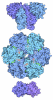
| 1 |
|
-Components
| #1: Protein | Mass: 98251.414 Da / Num. of mol.: 2 / Mutation: H386C/F389C Source method: isolated from a genetically manipulated source Details: 1-9: MWSHPQFEK - (Strep Tag II), 10-13: GGSG - (Linker), 14-894: PaMprF, 895-899 - Additional residues, 900-903 - VDAL - (N terminus of CPD), 1-32, 716-722, 805-833, 871-881 - Not modelled ...Details: 1-9: MWSHPQFEK - (Strep Tag II), 10-13: GGSG - (Linker), 14-894: PaMprF, 895-899 - Additional residues, 900-903 - VDAL - (N terminus of CPD), 1-32, 716-722, 805-833, 871-881 - Not modelled in MprF. Residues H386 and F389 have been mutated to cysteine, (numbering based on Uniprot and doesn't include the fusion construct) Source: (gene. exp.) Pseudomonas aeruginosa PAO1 (bacteria) / Gene: PA0920 / Production host:  Escherichia coli (E. coli) / References: UniProt: Q9I537, lysyltransferase Escherichia coli (E. coli) / References: UniProt: Q9I537, lysyltransferase#2: Chemical | ChemComp-PGT / (  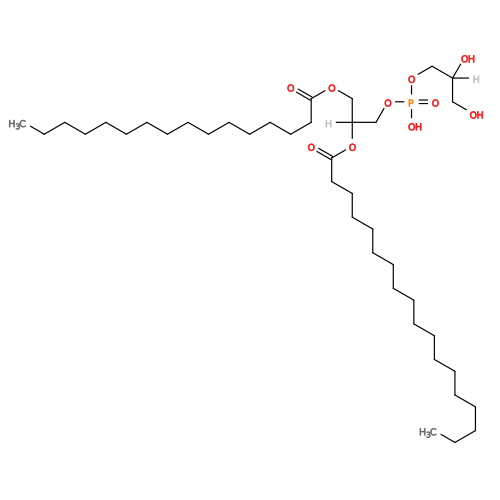 Mass: 751.023 Da / Num. of mol.: 4 / Source method: obtained synthetically / Formula: C40H79O10P / Feature type: SUBJECT OF INVESTIGATION / Comment: phospholipid*YM Mass: 751.023 Da / Num. of mol.: 4 / Source method: obtained synthetically / Formula: C40H79O10P / Feature type: SUBJECT OF INVESTIGATION / Comment: phospholipid*YMHas ligand of interest | Y | Has protein modification | Y | |
|---|
-Experimental details
-Experiment
| Experiment | Method: ELECTRON MICROSCOPY |
|---|---|
| EM experiment | Aggregation state: PARTICLE / 3D reconstruction method: single particle reconstruction |
- Sample preparation
| Component | Name: MprF dimer / Type: COMPLEX / Entity ID: #1 / Source: RECOMBINANT | |||||||||||||||
|---|---|---|---|---|---|---|---|---|---|---|---|---|---|---|---|---|
| Molecular weight | Value: 0.18 MDa / Experimental value: NO | |||||||||||||||
| Source (natural) | Organism: Pseudomonas aeruginosa PAO1 (bacteria) / Cellular location: Cell Membrane | |||||||||||||||
| Source (recombinant) | Organism: Escherichia coli (E. coli) / Strain: BL21 (DE3) C41 / Plasmid: pET22b-CPD | |||||||||||||||
| Buffer solution | pH: 8 | |||||||||||||||
| Buffer component |
| |||||||||||||||
| Specimen | Conc.: 2.3 mg/ml / Embedding applied: NO / Shadowing applied: NO / Staining applied: NO / Vitrification applied: YES | |||||||||||||||
| Specimen support | Details: Glow discharge was performed at 25 mA with PELCO easyglow Grid material: GOLD / Grid mesh size: 300 divisions/in. / Grid type: Quantifoil R1/1 | |||||||||||||||
| Vitrification | Instrument: FEI VITROBOT MARK IV / Cryogen name: ETHANE / Humidity: 100 % / Chamber temperature: 289 K |
- Electron microscopy imaging
| Experimental equipment |  Model: Titan Krios / Image courtesy: FEI Company |
|---|---|
| Microscopy | Model: TFS KRIOS |
| Electron gun | Electron source:  FIELD EMISSION GUN / Accelerating voltage: 300 kV / Illumination mode: FLOOD BEAM FIELD EMISSION GUN / Accelerating voltage: 300 kV / Illumination mode: FLOOD BEAM |
| Electron lens | Mode: BRIGHT FIELD / Nominal magnification: 75000 X / Calibrated magnification: 130481 X / Nominal defocus max: 3000 nm / Nominal defocus min: 1500 nm / Cs: 2.7 mm / C2 aperture diameter: 50 µm / Alignment procedure: COMA FREE |
| Specimen holder | Cryogen: NITROGEN / Specimen holder model: FEI TITAN KRIOS AUTOGRID HOLDER |
| Image recording | Average exposure time: 60 sec. / Electron dose: 26.7 e/Å2 / Detector mode: COUNTING / Film or detector model: FEI FALCON III (4k x 4k) / Num. of grids imaged: 1 / Num. of real images: 2389 Details: Images were collected in movie-mode at 40 frames per second |
| Image scans | Width: 4096 / Height: 4096 |
- Processing
| EM software |
| ||||||||||||||||||||||||||||||||||||||||||||||||||||||||||||||||||||||||||||||||||||||||||||||||||||||||||
|---|---|---|---|---|---|---|---|---|---|---|---|---|---|---|---|---|---|---|---|---|---|---|---|---|---|---|---|---|---|---|---|---|---|---|---|---|---|---|---|---|---|---|---|---|---|---|---|---|---|---|---|---|---|---|---|---|---|---|---|---|---|---|---|---|---|---|---|---|---|---|---|---|---|---|---|---|---|---|---|---|---|---|---|---|---|---|---|---|---|---|---|---|---|---|---|---|---|---|---|---|---|---|---|---|---|---|---|
| CTF correction | Type: PHASE FLIPPING AND AMPLITUDE CORRECTION | ||||||||||||||||||||||||||||||||||||||||||||||||||||||||||||||||||||||||||||||||||||||||||||||||||||||||||
| Particle selection | Num. of particles selected: 892429 | ||||||||||||||||||||||||||||||||||||||||||||||||||||||||||||||||||||||||||||||||||||||||||||||||||||||||||
| Symmetry | Point symmetry: C2 (2 fold cyclic) | ||||||||||||||||||||||||||||||||||||||||||||||||||||||||||||||||||||||||||||||||||||||||||||||||||||||||||
| 3D reconstruction | Resolution: 3.3 Å / Resolution method: FSC 0.143 CUT-OFF / Num. of particles: 104195 / Algorithm: BACK PROJECTION / Num. of class averages: 1 / Symmetry type: POINT | ||||||||||||||||||||||||||||||||||||||||||||||||||||||||||||||||||||||||||||||||||||||||||||||||||||||||||
| Atomic model building | B value: 142.6 / Protocol: OTHER | ||||||||||||||||||||||||||||||||||||||||||||||||||||||||||||||||||||||||||||||||||||||||||||||||||||||||||
| Atomic model building | Accession code: D_1300050528 / Chain residue range: 33-870 Details: The model from GDN was rigid body fit and manually adjusted for nanodisc map Source name: Other / Type: experimental model | ||||||||||||||||||||||||||||||||||||||||||||||||||||||||||||||||||||||||||||||||||||||||||||||||||||||||||
| Refinement | Resolution: 3.3→128.4 Å / Cor.coef. Fo:Fc: 0.934 / SU B: 14.252 / SU ML: 0.24 / ESU R: 0.492 Stereochemistry target values: MAXIMUM LIKELIHOOD WITH PHASES Details: HYDROGENS HAVE BEEN USED IF PRESENT IN THE INPUT
| ||||||||||||||||||||||||||||||||||||||||||||||||||||||||||||||||||||||||||||||||||||||||||||||||||||||||||
| Solvent computation | Solvent model: PARAMETERS FOR MASK CACLULATION | ||||||||||||||||||||||||||||||||||||||||||||||||||||||||||||||||||||||||||||||||||||||||||||||||||||||||||
| Displacement parameters | Biso mean: 140.952 Å2 | ||||||||||||||||||||||||||||||||||||||||||||||||||||||||||||||||||||||||||||||||||||||||||||||||||||||||||
| Refinement step | Cycle: 1 / Total: 12502 | ||||||||||||||||||||||||||||||||||||||||||||||||||||||||||||||||||||||||||||||||||||||||||||||||||||||||||
| Refine LS restraints |
|