 Movie
Movie Controller


+ Open data

- Basic information
| Entry | Database: PDB / ID: 9w33 | |||||||||||||||||||||||||||
|---|---|---|---|---|---|---|---|---|---|---|---|---|---|---|---|---|---|---|---|---|---|---|---|---|---|---|---|---|
| Title | S5A1-bound inactive SSTR5 structure | |||||||||||||||||||||||||||
 Components Components | Somatostatin receptor type 5,Soluble cytochrome b562 | |||||||||||||||||||||||||||
 Keywords Keywords | STRUCTURAL PROTEIN / GPCR / antagonist / inactive structure / SSTR5 | |||||||||||||||||||||||||||
| Function / homology |  Function and homology information Function and homology informationsomatostatin receptor activity / neuropeptide binding / cellular response to glucocorticoid stimulus / positive regulation of cytokinesis / regulation of insulin secretion / G protein-coupled receptor signaling pathway, coupled to cyclic nucleotide second messenger / Peptide ligand-binding receptors / neuropeptide signaling pathway / electron transport chain / glucose homeostasis ...somatostatin receptor activity / neuropeptide binding / cellular response to glucocorticoid stimulus / positive regulation of cytokinesis / regulation of insulin secretion / G protein-coupled receptor signaling pathway, coupled to cyclic nucleotide second messenger / Peptide ligand-binding receptors / neuropeptide signaling pathway / electron transport chain / glucose homeostasis / G alpha (i) signalling events / periplasmic space / electron transfer activity / neuron projection / iron ion binding / G protein-coupled receptor signaling pathway / negative regulation of cell population proliferation / heme binding / plasma membrane Similarity search - Function | |||||||||||||||||||||||||||
| Biological species |  Homo sapiens (human) Homo sapiens (human)  Escherichia coli (E. coli) Escherichia coli (E. coli) | |||||||||||||||||||||||||||
| Method | ELECTRON MICROSCOPY / single particle reconstruction / cryo EM / Resolution: 2.69 Å | |||||||||||||||||||||||||||
 Authors Authors | Li, Y. / Xing, Z. / Zhao, L. / Xu, H.E. | |||||||||||||||||||||||||||
| Funding support |  China, 4items China, 4items
| |||||||||||||||||||||||||||
 Citation Citation | Journal: Proc Natl Acad Sci U S A / Year: 2025 Title: Structural insights into nonpeptide antagonist inhibition of somatostatin receptor subtype 5. Authors: Yang Li / Zhongliang Xing / Wen Hu / Kai Wu / H Eric Xu / Li-Hua Zhao / Abstract: The somatostatin receptor subtype 5 (SSTR5) is a critical pharmacological target involved in neuroendocrine signaling, metabolic regulation, and tumorigenesis. Despite its therapeutic potential, the ...The somatostatin receptor subtype 5 (SSTR5) is a critical pharmacological target involved in neuroendocrine signaling, metabolic regulation, and tumorigenesis. Despite its therapeutic potential, the structural mechanisms underlying SSTR5 inhibition by nonpeptide antagonists remain largely unresolved. In this study, we present high-resolution cryoelectron microscopy structures of human SSTR5 in complex with two selective small-molecule antagonists, antagonist 1 and S5A1, revealing the receptor's inactive conformation. Both antagonists induce a unique remodeling of extracellular loop 2, which adopts a capping architecture that sterically occludes the orthosteric site, thus preventing agonist access and stabilizing receptor inactivation. Structural analyses and functional experiments elucidate how distinct molecular moieties of the antagonists differentially contribute to inhibitory efficacy, and subtype selectivity. Furthermore, we delineate rational avenues for molecular optimization to enhance therapeutic index and mitigate off-target liabilities. These findings, complementing our previous agonist-bound structures, establish a comprehensive structural foundation for developing improved nonpeptidic SSTR5 antagonists with potential therapeutic applications for type 2 diabetes and related endocrine disorders. | |||||||||||||||||||||||||||
| History |
|
- Structure visualization
| Structure viewer | Molecule: MolmilJmol/JSmol |
|---|
- Downloads & links
-Download
| PDBx/mmCIF format | 9w33.cif.gz | 160.5 KB | Display | PDBx/mmCIF format |
|---|---|---|---|---|
| PDB format | pdb9w33.ent.gz | Display | PDB format | |
| PDBx/mmJSON format | 9w33.json.gz | Tree view | PDBx/mmJSON format | |
| Others |  Other downloads Other downloads |
-Validation report
| Arichive directory | https://data.pdbj.org/pub/pdb/validation_reports/w3/9w33ftp://data.pdbj.org/pub/pdb/validation_reports/w3/9w33 | HTTPS FTP |
|---|
-Related structure data
| Related structure data |  65589MC  9w32C C: citing same article ( M: map data used to model this data |
|---|---|
| Similar structure data |

-Links
 PDBj
PDBj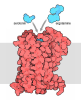
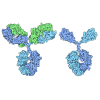
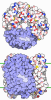
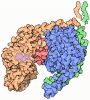
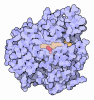
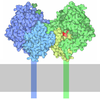
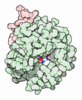
- Assembly
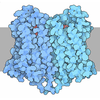
| Deposited unit | 
|
|---|---|
| 1 |
|
-Components
| #1: Protein | Mass: 42680.105 Da / Num. of mol.: 2 Source method: isolated from a genetically manipulated source Source: (gene. exp.) Homo sapiens (human), (gene. exp.) Escherichia coli (E. coli)Gene: SSTR5, cybC / Plasmid: pFast / Production host:  Trichoplusia ni (cabbage looper) / References: UniProt: P35346, UniProt: P0ABE7 Trichoplusia ni (cabbage looper) / References: UniProt: P35346, UniProt: P0ABE7#2: Chemical | Mass: 463.569 Da / Num. of mol.: 2 / Source method: obtained synthetically / Formula: C27H33N3O4 / Feature type: SUBJECT OF INVESTIGATION Has ligand of interest | Y | Has protein modification | Y | |
|---|
-Experimental details
-Experiment
| Experiment | Method: ELECTRON MICROSCOPY |
|---|---|
| EM experiment | Aggregation state: PARTICLE / 3D reconstruction method: single particle reconstruction |
- Sample preparation
| Component | Name: SSTR5 S5A1 / Type: COMPLEX / Details: small molecule, antagonist / Entity ID: #1 / Source: RECOMBINANT | ||||||||||||||||||||||||||||||
|---|---|---|---|---|---|---|---|---|---|---|---|---|---|---|---|---|---|---|---|---|---|---|---|---|---|---|---|---|---|---|---|
| Molecular weight | Value: 0.18 MDa / Experimental value: YES | ||||||||||||||||||||||||||||||
| Source (natural) |
| ||||||||||||||||||||||||||||||
| Source (recombinant) | Organism: Trichoplusia ni (cabbage looper) | ||||||||||||||||||||||||||||||
| Buffer solution | pH: 7.4 | ||||||||||||||||||||||||||||||
| Buffer component |
| ||||||||||||||||||||||||||||||
| Specimen | Conc.: 13.2 mg/ml / Embedding applied: NO / Shadowing applied: NO / Staining applied: NO / Vitrification applied: YES / Details: 13.2 mg/ml of the protein in a liquid buffer | ||||||||||||||||||||||||||||||
| Specimen support | Grid material: GOLD / Grid mesh size: 300 divisions/in. / Grid type: Quantifoil | ||||||||||||||||||||||||||||||
| Vitrification | Instrument: FEI VITROBOT MARK II / Cryogen name: ETHANE / Humidity: 100 % / Chamber temperature: 277 K |
- Electron microscopy imaging
| Experimental equipment |  Model: Titan Krios / Image courtesy: FEI Company |
|---|---|
| Microscopy | Model: TFS KRIOS |
| Electron gun | Electron source:  FIELD EMISSION GUN / Accelerating voltage: 300 kV / Illumination mode: SPOT SCAN FIELD EMISSION GUN / Accelerating voltage: 300 kV / Illumination mode: SPOT SCAN |
| Electron lens | Mode: BRIGHT FIELD / Nominal magnification: 165000 X / Nominal defocus max: 1800 nm / Nominal defocus min: 800 nm |
| Image recording | Electron dose: 50 e/Å2 / Film or detector model: GATAN K3 BIOCONTINUUM (6k x 4k) / Num. of grids imaged: 1 / Num. of real images: 3172 |
- Processing
| EM software |
| ||||||||||||||||||||||||||||||||||||
|---|---|---|---|---|---|---|---|---|---|---|---|---|---|---|---|---|---|---|---|---|---|---|---|---|---|---|---|---|---|---|---|---|---|---|---|---|---|
| CTF correction | Type: PHASE FLIPPING AND AMPLITUDE CORRECTION | ||||||||||||||||||||||||||||||||||||
| Particle selection | Num. of particles selected: 2376565 | ||||||||||||||||||||||||||||||||||||
| 3D reconstruction | Resolution: 2.69 Å / Resolution method: FSC 0.143 CUT-OFF / Num. of particles: 107138 / Algorithm: BACK PROJECTION / Num. of class averages: 1 / Symmetry type: POINT | ||||||||||||||||||||||||||||||||||||
| Atomic model building | Protocol: RIGID BODY FIT | ||||||||||||||||||||||||||||||||||||
| Atomic model building | Details: AlphaFold3 predicted / Source name: AlphaFold / Type: in silico model |
