 Movie
Movie Controller

[English] 日本語
 Yorodumi
- PDB-9vek: Structural basis for the assembly and translocation of the Vip1-V... -
+ Open data

- Basic information
| Entry | Database: PDB / ID: 9vek | ||||||||||||||||||||||||
|---|---|---|---|---|---|---|---|---|---|---|---|---|---|---|---|---|---|---|---|---|---|---|---|---|---|
| Title | Structural basis for the assembly and translocation of the Vip1-Vip2 insecticidal binary toxin from Bacillus thuringiensis | ||||||||||||||||||||||||
 Components Components | Vip1 | ||||||||||||||||||||||||
 Keywords Keywords | TOXIN / binary toxin / biopesticide | ||||||||||||||||||||||||
| Function / homology |  Function and homology information Function and homology information | ||||||||||||||||||||||||
| Biological species |   Bacillus thuringiensis (bacteria) Bacillus thuringiensis (bacteria) | ||||||||||||||||||||||||
| Method | ELECTRON MICROSCOPY / single particle reconstruction / cryo EM / Resolution: 3.31 Å | ||||||||||||||||||||||||
 Authors Authors | Chen, P. / Zhao, T. | ||||||||||||||||||||||||
| Funding support |  China, 1items China, 1items
| ||||||||||||||||||||||||
 Citation Citation | Journal: Nat Commun / Year: 2026 Title: Structural basis for the assembly and translocation of the Vip1-Vip2 insecticidal toxin from Bacillus thuringiensis. Authors: Ting Zhao / Zeyu Wang / Jing Ren / Xianle Han / Linpeng Li / Zheng Liu / Jie Zhang / Peng Chen / Abstract: Insecticidal toxins from Bacillus thuringiensis (Bt) have been extensively and successfully used in genetically engineered crops for decades but continue to face challenges from the adaptive ...Insecticidal toxins from Bacillus thuringiensis (Bt) have been extensively and successfully used in genetically engineered crops for decades but continue to face challenges from the adaptive resistance in the insect population. The Bt binary toxin Vip1Ad1(Vip1) and Vip2Ag1(Vip2), a promising next-generation candidate gene combination for transgenic crops, have demonstrated high efficacy against the destructive coleopteran pest white grubs, however, their mode of action remains largely elusive. In this study, we report cryo-EM structures of the heptameric Vip1-pore and Vip2-bound Vip1-pore complex, capturing a series of putative assembly-related intermediates that suggest a binary toxin assembly and translocation pathway. Together with structure-guided mutagenesis, these data provide insights into a sequential assembly of binary complex and a sequence-independent translocation mechanism. Proof-of-principle experiments showed successful delivery of a desired protein cargo into host cells based on the mini-Vip2-Vip1 pore system, paving the way for developing much needed extracellular pesticidal protein delivery platforms. These findings not only clarify the assembly and translocation mechanism of the binary insecticidal toxin pair but also offer an excellent alternative model to investigate human-pathogenic pore-forming toxins because of its similarity and biosafety. | ||||||||||||||||||||||||
| History |
|
- Structure visualization
| Structure viewer | Molecule: MolmilJmol/JSmol |
|---|
- Downloads & links
-Download
| PDBx/mmCIF format | 9vek.cif.gz | 718.9 KB | Display | PDBx/mmCIF format |
|---|---|---|---|---|
| PDB format | pdb9vek.ent.gz | 592 KB | Display | PDB format |
| PDBx/mmJSON format | 9vek.json.gz | Tree view | PDBx/mmJSON format | |
| Others |  Other downloads Other downloads |
-Validation report
| Arichive directory | https://data.pdbj.org/pub/pdb/validation_reports/ve/9vekftp://data.pdbj.org/pub/pdb/validation_reports/ve/9vek | HTTPS FTP |
|---|
-Related structure data
| Related structure data |  65010MC  9vegC  9vejC M: map data used to model this data C: citing same article ( |
|---|---|
| Similar structure data |


-Links
 PDBj
PDBj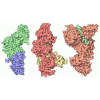
- Assembly
| Deposited unit | 
|
|---|---|
| 1 |
|
-Components
| #1: Protein | Mass: 72654.477 Da / Num. of mol.: 7 Source method: isolated from a genetically manipulated source Source: (gene. exp.) Bacillus thuringiensis (bacteria) / Gene: vip1 / Production host: Bacillus thuringiensis (bacteria) / References: UniProt: A0A075BFL2#2: Chemical | ChemComp-CA /   Mass: 40.078 Da / Num. of mol.: 21 / Source method: obtained synthetically / Formula: Ca / Feature type: SUBJECT OF INVESTIGATION Mass: 40.078 Da / Num. of mol.: 21 / Source method: obtained synthetically / Formula: Ca / Feature type: SUBJECT OF INVESTIGATIONHas ligand of interest | Y | Has protein modification | N | |
|---|
-Experimental details
-Experiment
| Experiment | Method: ELECTRON MICROSCOPY |
|---|---|
| EM experiment | Aggregation state: PARTICLE / 3D reconstruction method: single particle reconstruction |
- Sample preparation
| Component | Name: Vip1Ad1 heptamer / Type: COMPLEX / Entity ID: #1 / Source: RECOMBINANT |
|---|---|
| Source (natural) | Organism: Bacillus thuringiensis (bacteria) |
| Source (recombinant) | Organism: Bacillus thuringiensis (bacteria) |
| Buffer solution | pH: 8 |
| Specimen | Embedding applied: NO / Shadowing applied: NO / Staining applied: NO / Vitrification applied: YES |
| Vitrification | Cryogen name: ETHANE |
- Electron microscopy imaging
| Microscopy | Model: TFS GLACIOS |
|---|---|
| Electron gun | Electron source:  FIELD EMISSION GUN / Accelerating voltage: 200 kV / Illumination mode: FLOOD BEAM FIELD EMISSION GUN / Accelerating voltage: 200 kV / Illumination mode: FLOOD BEAM |
| Electron lens | Mode: BRIGHT FIELD / Nominal defocus max: 1600 nm / Nominal defocus min: 1300 nm |
| Image recording | Electron dose: 50 e/Å2 / Film or detector model: FEI FALCON IV (4k x 4k) |
- Processing
| EM software |
| ||||||||||||||||||||||||
|---|---|---|---|---|---|---|---|---|---|---|---|---|---|---|---|---|---|---|---|---|---|---|---|---|---|
| CTF correction | Type: PHASE FLIPPING AND AMPLITUDE CORRECTION | ||||||||||||||||||||||||
| 3D reconstruction | Resolution: 3.31 Å / Resolution method: FSC 0.143 CUT-OFF / Num. of particles: 43696 / Symmetry type: POINT | ||||||||||||||||||||||||
| Refinement | Highest resolution: 3.31 Å Stereochemistry target values: REAL-SPACE (WEIGHTED MAP SUM AT ATOM CENTERS) | ||||||||||||||||||||||||
| Refine LS restraints |
|
