National Natural Science Foundation of China (NSFC)
China
Citation
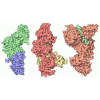
Journal: Nat Commun / Year: 2026 Title: Structural basis for the assembly and translocation of the Vip1-Vip2 insecticidal toxin from Bacillus thuringiensis. Authors: Ting Zhao / Zeyu Wang / Jing Ren / Xianle Han / Linpeng Li / Zheng Liu / Jie Zhang / Peng Chen / Abstract: Insecticidal toxins from Bacillus thuringiensis (Bt) have been extensively and successfully used in genetically engineered crops for decades but continue to face challenges from the adaptive ...Insecticidal toxins from Bacillus thuringiensis (Bt) have been extensively and successfully used in genetically engineered crops for decades but continue to face challenges from the adaptive resistance in the insect population. The Bt binary toxin Vip1Ad1(Vip1) and Vip2Ag1(Vip2), a promising next-generation candidate gene combination for transgenic crops, have demonstrated high efficacy against the destructive coleopteran pest white grubs, however, their mode of action remains largely elusive. In this study, we report cryo-EM structures of the heptameric Vip1-pore and Vip2-bound Vip1-pore complex, capturing a series of putative assembly-related intermediates that suggest a binary toxin assembly and translocation pathway. Together with structure-guided mutagenesis, these data provide insights into a sequential assembly of binary complex and a sequence-independent translocation mechanism. Proof-of-principle experiments showed successful delivery of a desired protein cargo into host cells based on the mini-Vip2-Vip1 pore system, paving the way for developing much needed extracellular pesticidal protein delivery platforms. These findings not only clarify the assembly and translocation mechanism of the binary insecticidal toxin pair but also offer an excellent alternative model to investigate human-pathogenic pore-forming toxins because of its similarity and biosafety.
In the structure databanks used in Yorodumi, some data are registered as the other names, "COVID-19 virus" and "2019-nCoV". Here are the details of the virus and the list of structure data.
Jan 31, 2019. EMDB accession codes are about to change! (news from PDBe EMDB page)
EMDB accession codes are about to change! (news from PDBe EMDB page)
The allocation of 4 digits for EMDB accession codes will soon come to an end. Whilst these codes will remain in use, new EMDB accession codes will include an additional digit and will expand incrementally as the available range of codes is exhausted. The current 4-digit format prefixed with “EMD-” (i.e. EMD-XXXX) will advance to a 5-digit format (i.e. EMD-XXXXX), and so on. It is currently estimated that the 4-digit codes will be depleted around Spring 2019, at which point the 5-digit format will come into force.
The EM Navigator/Yorodumi systems omit the EMD- prefix.
Related info.:Q: What is EMD? / ID/Accession-code notation in Yorodumi/EM Navigator
Yorodumi is a browser for structure data from EMDB, PDB, SASBDB, etc.
This page is also the successor to EM Navigator detail page, and also detail information page/front-end page for Omokage search.
The word "yorodu" (or yorozu) is an old Japanese word meaning "ten thousand". "mi" (miru) is to see.
Related info.:EMDB / PDB / SASBDB / Comparison of 3 databanks / Yorodumi Search / Aug 31, 2016. New EM Navigator & Yorodumi / Yorodumi Papers / Jmol/JSmol / Function and homology information / Changes in new EM Navigator and Yorodumi
 Movie
Movie Controller

 Yorodumi
 Open data
 Basic information
 Map data
 Sample
 Keywords
 Function and homology information
 Bacillus thuringiensis (bacteria)
 Authors
 China, 1 items
  Citation
 Structure visualization
 Downloads & links
 emd_65007.png
 http://ftp.pdbj.org/pub/emdb/structures/EMD-65007


 Z (Sec.)
 Y (Row.)
 X (Col.)


 Sample components
 Processing
 Electron microscopy
 FIELD EMISSION GUN

