 Movie
Movie Controller

[English] 日本語
 Yorodumi
- PDB-9sr9: P. abyssi hibernation factor Hib bound to ATP (Hib-PTC conformation) -
+ Open data

- Basic information
| Entry | Database: PDB / ID: 9sr9 | ||||||||||||||||||||||||
|---|---|---|---|---|---|---|---|---|---|---|---|---|---|---|---|---|---|---|---|---|---|---|---|---|---|
| Title | P. abyssi hibernation factor Hib bound to ATP (Hib-PTC conformation) | ||||||||||||||||||||||||
 Components Components | Dehydrogenase | ||||||||||||||||||||||||
 Keywords Keywords | RIBOSOME / 70S / Hibernation / Pyrococcus abyssi | ||||||||||||||||||||||||
| Function / homology |  Function and homology information Function and homology informationUncharacterised conserved protein, 2xCBS, MJ1404 type / Hibernation factor Hib, C-terminal domain / : / Domain in cystathionine beta-synthase and other proteins. / CBS domain superfamily / CBS domain / CBS domain / CBS domain profile. Similarity search - Domain/homology | ||||||||||||||||||||||||
| Biological species |   Pyrococcus abyssi GE5 (archaea) Pyrococcus abyssi GE5 (archaea) | ||||||||||||||||||||||||
| Method | ELECTRON MICROSCOPY / single particle reconstruction / cryo EM / Resolution: 2.5 Å | ||||||||||||||||||||||||
 Authors Authors | Madru, C.M. / Bourgeois, G.B. / Mechulam, Y.M. / Schmitt, E.S. | ||||||||||||||||||||||||
| Funding support |  France, 1items France, 1items
| ||||||||||||||||||||||||
 Citation Citation | Journal: Nat Commun / Year: 2026 Title: A family of ribosome hibernation factors widespread in Archaea. Authors: Clément Madru / Gabrielle Bourgeois / Rémi Dulermo / Régine Capeyrou / Gwendoline Joncour / Karima Figuigui / Magalie Duchateau / Julia Chamot-Rooke / Claire Duboc / Stéphane l'Haridon / ...Authors: Clément Madru / Gabrielle Bourgeois / Rémi Dulermo / Régine Capeyrou / Gwendoline Joncour / Karima Figuigui / Magalie Duchateau / Julia Chamot-Rooke / Claire Duboc / Stéphane l'Haridon / Logan Mc Teer / Marta Kwapisz / Béatrice Clouet-d'Orval / Marie Bouvier / Yves Mechulam / Guillaume Borrel / Emmanuelle Schmitt / Didier Flament / Abstract: Ribosome hibernation preserves translation machinery during stress, yet its mechanisms in Archaea remain poorly defined. Using cryo-EM analysis, we studied hibernation pathways in Pyrococcus abyssi ...Ribosome hibernation preserves translation machinery during stress, yet its mechanisms in Archaea remain poorly defined. Using cryo-EM analysis, we studied hibernation pathways in Pyrococcus abyssi stressed cells. We identified HibA, a previously unrecognized family of hibernation factors widespread in Archaea. HibA consists of a bacterial-like HPF/RaiA domain fused to a Cystathionine Beta Synthase module. Unexpectedly, HibA binds to the ribosome in three different conformations, occupying the A, P and E sites of tRNAs, as well as that of mRNA, enhancing its ability to protect the ribosome from degradation. Idle ribosomes also frequently accumulate the archaeal homolog of eukaryotic ribosome maturation protein SBDS (aSBDS), suggesting that stressed archaeal cells may engage parallel hibernation routes in which aSBDS can complement HibA. Deletion of hibA in Thermococcus barophilus delays recovery from stationary phase and reduces 70S ribosome pools, establishing its role in ribosome preservation. Taxonomic profiling shows that many archaeal lineages encode distinct repertoires of ribosome-associated protection factors, underscoring the modular and multi-layered nature of archaeal hibernation systems. In addition, a comprehensive phylogenetic analysis highlights the evolutionary relationships between prevalent ribosome hibernation factors across Bacteria and Archaea. | ||||||||||||||||||||||||
| History |
|
- Structure visualization
| Structure viewer | Molecule: MolmilJmol/JSmol |
|---|
- Downloads & links
-Download
| PDBx/mmCIF format | 9sr9.cif.gz | 108 KB | Display | PDBx/mmCIF format |
|---|---|---|---|---|
| PDB format | pdb9sr9.ent.gz | 66 KB | Display | PDB format |
| PDBx/mmJSON format | 9sr9.json.gz | Tree view | PDBx/mmJSON format | |
| Others |  Other downloads Other downloads |
-Validation report
| Arichive directory | https://data.pdbj.org/pub/pdb/validation_reports/sr/9sr9ftp://data.pdbj.org/pub/pdb/validation_reports/sr/9sr9 | HTTPS FTP |
|---|
-Related structure data
| Related structure data |  55134MC  9sraC  9srbC 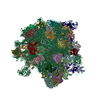 9srcC  9srdC  9sreC  9srfC  9t7hC M: map data used to model this data C: citing same article ( |
|---|---|
| Similar structure data |


-Links
 PDBj
PDBj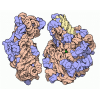
- Assembly
| Deposited unit | 
|
|---|---|
| 1 |
|
-Components
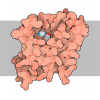
| #1: Protein | Mass: 44583.812 Da / Num. of mol.: 1 Source method: isolated from a genetically manipulated source Source: (gene. exp.) Pyrococcus abyssi GE5 (archaea) / Gene: PAB0961 / Production host:   Escherichia coli (E. coli) / References: UniProt: Q9UYR4 Escherichia coli (E. coli) / References: UniProt: Q9UYR4 |
|---|---|
| #2: Chemical | ChemComp-ATP / 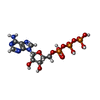 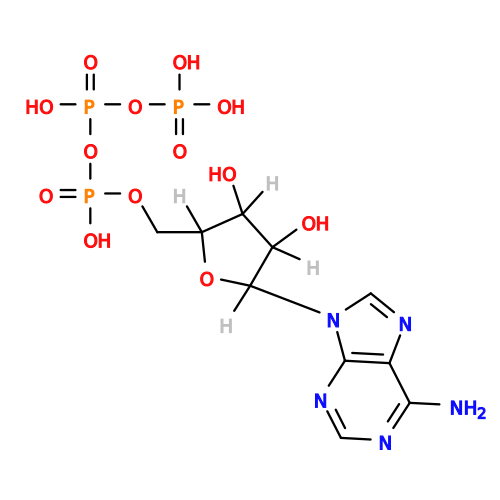 Mass: 507.181 Da / Num. of mol.: 1 / Source method: obtained synthetically / Formula: C10H16N5O13P3 / Feature type: SUBJECT OF INVESTIGATION / Comment: ATP, energy-carrying molecule*YM Mass: 507.181 Da / Num. of mol.: 1 / Source method: obtained synthetically / Formula: C10H16N5O13P3 / Feature type: SUBJECT OF INVESTIGATION / Comment: ATP, energy-carrying molecule*YM |
| Has ligand of interest | Y |
| Has protein modification | N |
-Experimental details
-Experiment
| Experiment | Method: ELECTRON MICROSCOPY |
|---|---|
| EM experiment | Aggregation state: PARTICLE / 3D reconstruction method: single particle reconstruction |
- Sample preparation
| Component | Name: P. abyssi hibernation factor Hib bound to ATP (Hib-PTC conformation) Type: COMPLEX / Entity ID: #1 / Source: NATURAL |
|---|---|
| Molecular weight | Experimental value: NO |
| Source (natural) | Organism: Pyrococcus abyssi GE5 (archaea) |
| Buffer solution | pH: 7.5 |
| Specimen | Embedding applied: NO / Shadowing applied: NO / Staining applied: NO / Vitrification applied: YES |
| Vitrification | Cryogen name: ETHANE |
- Electron microscopy imaging
| Experimental equipment |  Model: Titan Krios / Image courtesy: FEI Company |
|---|---|
| Microscopy | Model: TFS KRIOS |
| Electron gun | Electron source:  FIELD EMISSION GUN / Accelerating voltage: 300 kV / Illumination mode: FLOOD BEAM FIELD EMISSION GUN / Accelerating voltage: 300 kV / Illumination mode: FLOOD BEAM |
| Electron lens | Mode: BRIGHT FIELD / Nominal defocus max: 2500 nm / Nominal defocus min: 800 nm |
| Image recording | Electron dose: 40 e/Å2 / Film or detector model: GATAN K3 BIOQUANTUM (6k x 4k) |
- Processing
| EM software |
| ||||||||||||||||||||||||
|---|---|---|---|---|---|---|---|---|---|---|---|---|---|---|---|---|---|---|---|---|---|---|---|---|---|
| CTF correction | Type: PHASE FLIPPING AND AMPLITUDE CORRECTION | ||||||||||||||||||||||||
| 3D reconstruction | Resolution: 2.5 Å / Resolution method: FSC 0.143 CUT-OFF / Num. of particles: 20409 / Symmetry type: POINT | ||||||||||||||||||||||||
| Refinement | Cross valid method: NONE Stereochemistry target values: GeoStd + Monomer Library + CDL v1.2 | ||||||||||||||||||||||||
| Displacement parameters | Biso mean: 73.18 Å2 | ||||||||||||||||||||||||
| Refine LS restraints |
|
