 Movie
Movie Controller

[English] 日本語
 Yorodumi
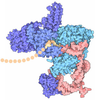
- PDB-9spf: CRYO-EM STRUCTURE OF HUMAN 80S RIBOSOME WITH A/P/E-SITE TRNA AND ... -
+ Open data

- Basic information
| Entry | Database: PDB / ID: 9spf | |||||||||||||||||||||||||||
|---|---|---|---|---|---|---|---|---|---|---|---|---|---|---|---|---|---|---|---|---|---|---|---|---|---|---|---|---|
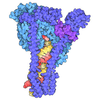
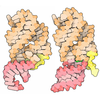
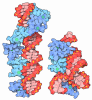
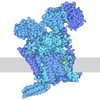
| Title | CRYO-EM STRUCTURE OF HUMAN 80S RIBOSOME WITH A/P/E-SITE TRNA AND MRNA CONTAINING N1-METHYLPSEUDOURIDINE | |||||||||||||||||||||||||||
 Components Components |
| |||||||||||||||||||||||||||
 Keywords Keywords | RIBOSOME / CRYO-EM STRUCTURE / HUMAN / 80S / N1-METHYLPSEUDOURIDINE | |||||||||||||||||||||||||||
| Function / homology |  Function and homology information Function and homology informationembryonic brain development / translation at presynapse / response to insecticide / negative regulation of endoplasmic reticulum unfolded protein response / eukaryotic 80S initiation complex / ribosomal protein import into nucleus / regulation of G1 to G0 transition / oxidized pyrimidine DNA binding / response to TNF agonist / positive regulation of base-excision repair ...embryonic brain development / translation at presynapse / response to insecticide / negative regulation of endoplasmic reticulum unfolded protein response / eukaryotic 80S initiation complex / ribosomal protein import into nucleus / regulation of G1 to G0 transition / oxidized pyrimidine DNA binding / response to TNF agonist / positive regulation of base-excision repair / positive regulation of intrinsic apoptotic signaling pathway in response to DNA damage / positive regulation of respiratory burst involved in inflammatory response / positive regulation of gastrulation / regulation of adenylate cyclase-activating G protein-coupled receptor signaling pathway / protein tyrosine kinase inhibitor activity / IRE1-RACK1-PP2A complex / TNFR1-mediated ceramide production / positive regulation of Golgi to plasma membrane protein transport / G1 to G0 transition / negative regulation of formation of translation preinitiation complex / nucleolus organization / positive regulation of ubiquitin-protein transferase activity / positive regulation of DNA-templated transcription initiation / negative regulation of RNA splicing / GAIT complex / negative regulation of DNA repair / TORC2 complex binding / erythrocyte homeostasis / supercoiled DNA binding / regulation of establishment of cell polarity / rRNA modification in the nucleus and cytosol / oxidized purine DNA binding / NF-kappaB complex / negative regulation of intrinsic apoptotic signaling pathway in response to hydrogen peroxide / negative regulation of phagocytosis / ubiquitin-like protein conjugating enzyme binding / cytoplasmic translational initiation / cytoplasmic side of rough endoplasmic reticulum membrane / regulation of translation involved in cellular response to UV / A band / Formation of the ternary complex, and subsequently, the 43S complex / laminin receptor activity / ion channel inhibitor activity / positive regulation of intrinsic apoptotic signaling pathway in response to DNA damage by p53 class mediator / response to aldosterone / negative regulation of myoblast fusion / protein-DNA complex disassembly / Ribosomal scanning and start codon recognition / protein kinase A binding / Translation initiation complex formation / negative regulation of Wnt signaling pathway / positive regulation of DNA damage response, signal transduction by p53 class mediator / fibroblast growth factor binding / BH3 domain binding / Protein hydroxylation / TOR signaling / mTORC1-mediated signalling / negative regulation of translational frameshifting / monocyte chemotaxis / PELO:HBS1L and ABCE1 dissociate a ribosome on a non-stop mRNA / SRC activates STAT3 in a quantitative manner, through Cadherin-11 (CDH11), RAC1 and gp130 (IL6ST) / SARS-CoV-1 modulates host translation machinery / regulation of cell division / positive regulation of GTPase activity / protein localization to nucleus / Peptide chain elongation / Selenocysteine synthesis / negative regulation of protein binding / Formation of a pool of free 40S subunits / negative regulation of respiratory burst involved in inflammatory response / positive regulation of intrinsic apoptotic signaling pathway by p53 class mediator / protein targeting / protein serine/threonine kinase inhibitor activity / Eukaryotic Translation Termination / Dengue Virus Attachment and Entry / SRP-dependent cotranslational protein targeting to membrane / Response of EIF2AK4 (GCN2) to amino acid deficiency / ubiquitin ligase inhibitor activity / Viral mRNA Translation / endonucleolytic cleavage to generate mature 3'-end of SSU-rRNA from (SSU-rRNA, 5.8S rRNA, LSU-rRNA) / Nonsense Mediated Decay (NMD) independent of the Exon Junction Complex (EJC) / positive regulation of signal transduction by p53 class mediator / GTP hydrolysis and joining of the 60S ribosomal subunit / embryo implantation / L13a-mediated translational silencing of Ceruloplasmin expression / cleavage in ITS2 between 5.8S rRNA and LSU-rRNA of tricistronic rRNA transcript (SSU-rRNA, 5.8S rRNA, LSU-rRNA) / regulation of translational fidelity / Major pathway of rRNA processing in the nucleolus and cytosol / spindle assembly / positive regulation of microtubule polymerization / phagocytic cup / Nonsense Mediated Decay (NMD) enhanced by the Exon Junction Complex (EJC) / maturation of LSU-rRNA / negative regulation of ubiquitin-dependent protein catabolic process / Protein methylation / positive regulation of cell cycle / endonucleolytic cleavage in ITS1 to separate SSU-rRNA from 5.8S rRNA and LSU-rRNA from tricistronic rRNA transcript (SSU-rRNA, 5.8S rRNA, LSU-rRNA) / translation regulator activity / Nuclear events stimulated by ALK signaling in cancer / DNA-(apurinic or apyrimidinic site) endonuclease activity Similarity search - Function | |||||||||||||||||||||||||||
| Biological species |  Homo sapiens (human) Homo sapiens (human) | |||||||||||||||||||||||||||
| Method | ELECTRON MICROSCOPY / single particle reconstruction / cryo EM / Resolution: 2.4 Å | |||||||||||||||||||||||||||
 Authors Authors | Rajan, K.S. / Yonath, A. | |||||||||||||||||||||||||||
| Funding support |  Israel, 1items Israel, 1items
| |||||||||||||||||||||||||||
 Citation Citation | Journal: Nature / Year: 2026 Title: N-Methylpseudouridine directly modulates translation dynamics. Authors: Batsheva Rozman / Karin Broennimann / K Shanmugha Rajan / Aharon Nachshon / Chiranjeet Saha / Tamar Arazi / Vishnu Mohan / Tamar Geiger / Clayton J Wollner / Justin M Richner / Eric Westhof ...Authors: Batsheva Rozman / Karin Broennimann / K Shanmugha Rajan / Aharon Nachshon / Chiranjeet Saha / Tamar Arazi / Vishnu Mohan / Tamar Geiger / Clayton J Wollner / Justin M Richner / Eric Westhof / Ada Yonath / Anat Bashan / Noam Stern-Ginossar /    Abstract: The considerable success of mRNA vaccines against SARS-CoV-2 has underscored the potential of synthetic mRNA as a transformative biomedical technology. A critical feature of this approach is the ...The considerable success of mRNA vaccines against SARS-CoV-2 has underscored the potential of synthetic mRNA as a transformative biomedical technology. A critical feature of this approach is the incorporation of the modified nucleoside N-methylpseudouridine (mΨ), which enhances antigen expression while reducing immunogenicity. However, a comprehensive understanding of how mΨ influences translation remains incomplete. Here we use ribosome profiling at the subcodon resolution to show that mΨ increases ribosome density on synthetic mRNAs, leading to higher protein production independent of innate immune activation or eIF2α phosphorylation. We find that mΨ directly slows ribosome movement in defined sequence contexts while simultaneously promoting translation initiation. Structural studies using cryo-electron microscopy reveal that mΨ alters interactions within the ribosomal decoding centre, providing a mechanistic basis for slowed elongation. Furthermore, by introducing synonymous recoding that disrupts the modification-mediated changes in elongation, we show that the mΨ-dependent enhancement of protein output is modulated by codon composition, and that mΨ impact is strongest in mRNAs containing non-optimal codons with uridines at the wobble position. Together, these findings demonstrate that mΨ directly modulates translation dynamics, thereby increasing protein yield from synthetic mRNAs in specific sequence contexts. | |||||||||||||||||||||||||||
| History |
|
- Structure visualization
| Structure viewer | Molecule: MolmilJmol/JSmol |
|---|
- Downloads & links
-Download
| PDBx/mmCIF format | 9spf.cif.gz | 5.3 MB | Display | PDBx/mmCIF format |
|---|---|---|---|---|
| PDB format | pdb9spf.ent.gz | Display | PDB format | |
| PDBx/mmJSON format | 9spf.json.gz | Tree view | PDBx/mmJSON format | |
| Others |  Other downloads Other downloads |
-Validation report
| Arichive directory | https://data.pdbj.org/pub/pdb/validation_reports/sp/9spfftp://data.pdbj.org/pub/pdb/validation_reports/sp/9spf | HTTPS FTP |
|---|
-Related structure data
| Related structure data |  55083MC  9spiC C: citing same article ( M: map data used to model this data |
|---|---|
| Similar structure data |


-Links
 PDBj
PDBj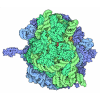
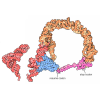
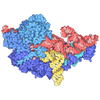
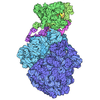

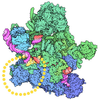
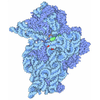
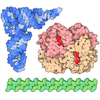
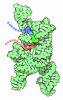
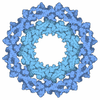
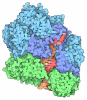
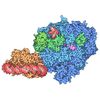
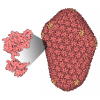
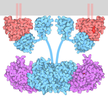
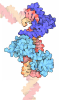
- Assembly
| Deposited unit | 
|
|---|---|
| 1 |
|
-Components
-RNA chain , 8 types, 8 molecules AtEtL5L7L8MrPtS2
| #1: RNA chain | Mass: 24794.680 Da / Num. of mol.: 1 / Source method: isolated from a natural source / Source: (natural) Homo sapiens (human) |
|---|---|
| #2: RNA chain | Mass: 24231.510 Da / Num. of mol.: 1 / Source method: isolated from a natural source / Source: (natural) Homo sapiens (human) / References: GenBank: 174924 |
| #3: RNA chain | Mass: 1640856.500 Da / Num. of mol.: 1 / Source method: isolated from a natural source / Source: (natural) Homo sapiens (human) |
| #4: RNA chain | Mass: 38691.914 Da / Num. of mol.: 1 / Source method: isolated from a natural source / Source: (natural) Homo sapiens (human) / References: GenBank: 23898 |
| #5: RNA chain | Mass: 50171.703 Da / Num. of mol.: 1 / Source method: isolated from a natural source / Source: (natural) Homo sapiens (human) |
| #46: RNA chain | Mass: 2185.385 Da / Num. of mol.: 1 / Source method: isolated from a natural source / Source: (natural) Homo sapiens (human) |
| #47: RNA chain | Mass: 24579.697 Da / Num. of mol.: 1 / Source method: isolated from a natural source / Source: (natural) Homo sapiens (human) |
| #48: RNA chain | Mass: 603566.125 Da / Num. of mol.: 1 / Source method: isolated from a natural source / Source: (natural) Homo sapiens (human) |
-Large ribosomal subunit protein ... , 9 types, 9 molecules LBLELFLLLaLbLoLALj
| #6: Protein | Mass: 46224.133 Da / Num. of mol.: 1 / Source method: isolated from a natural source / Source: (natural) Homo sapiens (human) / References: UniProt: P39023 |
|---|---|
| #9: Protein | Mass: 32810.176 Da / Num. of mol.: 1 / Source method: isolated from a natural source / Source: (natural) Homo sapiens (human) / References: UniProt: Q02878 |
| #10: Protein | Mass: 29290.973 Da / Num. of mol.: 1 / Source method: isolated from a natural source / Source: (natural) Homo sapiens (human) / References: UniProt: P18124 |
| #15: Protein | Mass: 24321.682 Da / Num. of mol.: 1 / Source method: isolated from a natural source / Source: (natural) Homo sapiens (human) / References: UniProt: P26373 |
| #30: Protein | Mass: 16619.527 Da / Num. of mol.: 1 / Source method: isolated from a natural source / Source: (natural) Homo sapiens (human) / References: UniProt: P46776 |
| #31: Protein | Mass: 17817.295 Da / Num. of mol.: 1 / Source method: isolated from a natural source / Source: (natural) Homo sapiens (human) / References: UniProt: P47914 |
| #43: Protein | Mass: 12489.991 Da / Num. of mol.: 1 / Source method: isolated from a natural source / Source: (natural) Homo sapiens (human) / References: UniProt: P83881 |
| #80: Protein | Mass: 28103.855 Da / Num. of mol.: 1 / Source method: isolated from a natural source / Source: (natural) Homo sapiens (human) / References: UniProt: P62917 |
| #83: Protein | Mass: 11111.032 Da / Num. of mol.: 1 / Source method: isolated from a natural source / Source: (natural) Homo sapiens (human) / References: UniProt: P61927 |
+60S ribosomal protein ... , 32 types, 32 molecules LCLDLGLHLILJLMLNLOLPLQLRLSLTLULVLWLXLYLZLcLdLeLfLgLhLiLkLlLnLpLr
-Protein , 4 types, 4 molecules LmSeSfSg
| #41: Protein | Mass: 14800.474 Da / Num. of mol.: 1 / Source method: isolated from a natural source / Source: (natural) Homo sapiens (human) / References: UniProt: P62987 |
|---|---|
| #77: Protein | Mass: 14415.724 Da / Num. of mol.: 1 / Source method: isolated from a natural source / Source: (natural) Homo sapiens (human) / References: UniProt: P62861 |
| #78: Protein | Mass: 18004.041 Da / Num. of mol.: 1 / Source method: isolated from a natural source / Source: (natural) Homo sapiens (human) / References: UniProt: P62979 |
| #79: Protein | Mass: 35115.652 Da / Num. of mol.: 1 / Source method: isolated from a natural source / Source: (natural) Homo sapiens (human) / References: UniProt: P63244 |
+40S ribosomal protein ... , 28 types, 28 molecules SBSCSDSFSGSHSISJSKSLSMSNSOSPSQSRSSSTSUSVSWSYSZSaSbScSdSX
-Small ribosomal subunit protein ... , 2 types, 2 molecules SESA
| #52: Protein | Mass: 29654.869 Da / Num. of mol.: 1 / Source method: isolated from a natural source / Source: (natural) Homo sapiens (human) / References: UniProt: P62701 |
|---|---|
| #81: Protein | Mass: 32778.777 Da / Num. of mol.: 1 / Source method: isolated from a natural source / Source: (natural) Homo sapiens (human) / References: UniProt: P08865 |
-Non-polymers , 8 types, 964 molecules 


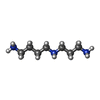
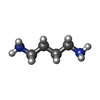



| #84: Chemical | ChemComp-K /  Mass: 39.098 Da / Num. of mol.: 151 / Source method: obtained synthetically / Formula: K Mass: 39.098 Da / Num. of mol.: 151 / Source method: obtained synthetically / Formula: K#85: Chemical | ChemComp-MG /  Mass: 24.305 Da / Num. of mol.: 225 / Source method: obtained synthetically / Formula: Mg Mass: 24.305 Da / Num. of mol.: 225 / Source method: obtained synthetically / Formula: Mg#86: Chemical | ChemComp-NA /  Mass: 22.990 Da / Num. of mol.: 35 / Source method: obtained synthetically / Formula: Na Mass: 22.990 Da / Num. of mol.: 35 / Source method: obtained synthetically / Formula: Na#87: Chemical | ChemComp-SPD / 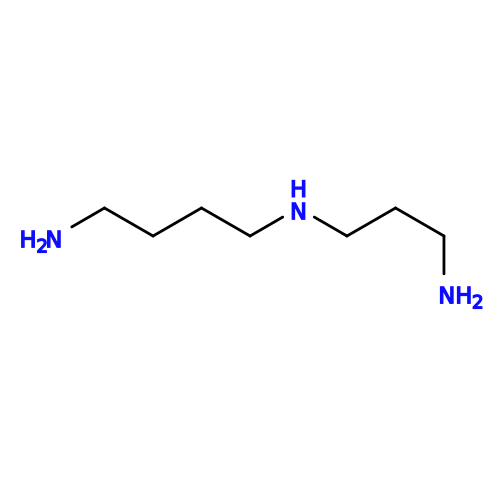 Mass: 145.246 Da / Num. of mol.: 19 / Source method: obtained synthetically / Formula: C7H19N3 Mass: 145.246 Da / Num. of mol.: 19 / Source method: obtained synthetically / Formula: C7H19N3#88: Chemical | ChemComp-PUT / 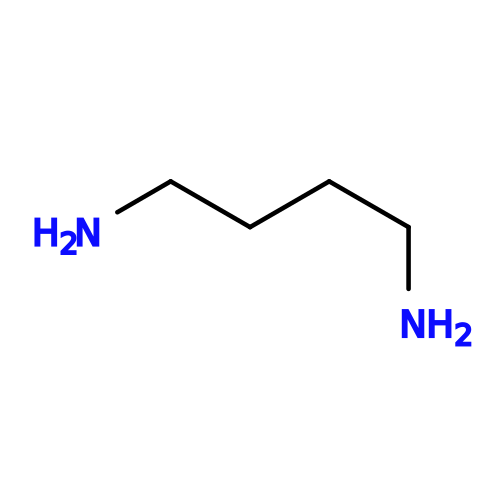 Mass: 88.151 Da / Num. of mol.: 9 / Source method: obtained synthetically / Formula: C4H12N2 Mass: 88.151 Da / Num. of mol.: 9 / Source method: obtained synthetically / Formula: C4H12N2#89: Chemical | ChemComp-ZN /  Mass: 65.409 Da / Num. of mol.: 7 / Source method: obtained synthetically / Formula: Zn Mass: 65.409 Da / Num. of mol.: 7 / Source method: obtained synthetically / Formula: Zn#90: Chemical | ChemComp-HYG / |  Mass: 527.520 Da / Num. of mol.: 1 / Source method: obtained synthetically / Formula: C20H37N3O13 / Feature type: SUBJECT OF INVESTIGATION / Comment: antibiotic*YM Mass: 527.520 Da / Num. of mol.: 1 / Source method: obtained synthetically / Formula: C20H37N3O13 / Feature type: SUBJECT OF INVESTIGATION / Comment: antibiotic*YM#91: Water | ChemComp-HOH / | Mass: 18.015 Da / Num. of mol.: 517 / Source method: isolated from a natural source / Formula: H2O |
|---|
-Details
| Has ligand of interest | Y |
|---|---|
| Has protein modification | Y |
-Experimental details
-Experiment
| Experiment | Method: ELECTRON MICROSCOPY |
|---|---|
| EM experiment | Aggregation state: PARTICLE / 3D reconstruction method: single particle reconstruction |
- Sample preparation
| Component | Name: CRYO-EM STRUCTURE OF HUMAN 80S RIBOSOME WITH A/P/E-SITE TRNA AND MRNA CONTAINING N1-METHYLPSEUDOURIDINE Type: RIBOSOME Details: CRYO-EM STRUCTURE OF HUMAN 80S RIBOSOME WITH A/P/E-SITE TRNA AND MRNA CONTAINING N1-METHYLPSEUDOURIDINE Entity ID: #1-#83 / Source: NATURAL |
|---|---|
| Source (natural) | Organism: Homo sapiens (human) |
| Buffer solution | pH: 7.6 |
| Specimen | Embedding applied: NO / Shadowing applied: NO / Staining applied: NO / Vitrification applied: YES |
| Vitrification | Cryogen name: ETHANE |
- Electron microscopy imaging
| Experimental equipment |  Model: Titan Krios / Image courtesy: FEI Company |
|---|---|
| Microscopy | Model: TFS KRIOS |
| Electron gun | Electron source:  FIELD EMISSION GUN / Accelerating voltage: 300 kV / Illumination mode: FLOOD BEAM FIELD EMISSION GUN / Accelerating voltage: 300 kV / Illumination mode: FLOOD BEAM |
| Electron lens | Mode: BRIGHT FIELD / Nominal defocus max: 1700 nm / Nominal defocus min: 600 nm |
| Image recording | Electron dose: 1.077 e/Å2 / Film or detector model: GATAN K3 BIOQUANTUM (6k x 4k) |
- Processing
| EM software |
| |||||||||
|---|---|---|---|---|---|---|---|---|---|---|
| CTF correction | Type: PHASE FLIPPING AND AMPLITUDE CORRECTION | |||||||||
| 3D reconstruction | Resolution: 2.4 Å / Resolution method: FSC 0.143 CUT-OFF / Num. of particles: 121901 / Symmetry type: POINT | |||||||||
| Refinement | Cross valid method: NONE |
