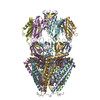
Movie
Movie Controller


+ Open data

- Basic information
| Entry | Database: PDB / ID: 9sdt | |||||||||||||||
|---|---|---|---|---|---|---|---|---|---|---|---|---|---|---|---|---|
| Title | mechanosensitive channel MscS from Francisella tularensis in DM | |||||||||||||||
 Components Components | Small-conductance mechanosensitive channel | |||||||||||||||
 Keywords Keywords | MEMBRANE PROTEIN / mechanosensitive channel / lipid interaction / bacteria | |||||||||||||||
| Function / homology |  Function and homology information Function and homology information | |||||||||||||||
| Biological species |  Francisella tularensis (bacteria) Francisella tularensis (bacteria) | |||||||||||||||
| Method | ELECTRON MICROSCOPY / single particle reconstruction / cryo EM / Resolution: 2.3 Å | |||||||||||||||
 Authors Authors | Rasmussen, A. / Hemmelmann, N. / Hove, T.T. / Flegler, V.J. / Rasmussen, T. / Bottcher, B. | |||||||||||||||
| Funding support |  Germany, 4items Germany, 4items
| |||||||||||||||
 Citation Citation | Journal: to be published Title: An asymmetric gate in the homoheptameric mechanosensitive channel MscS from Francisella tularensis Authors: Rasmussen, A. / Hemmelmann, N. / Bahner, J. / Hove, T.T. / Flegler, V.J. / Kraft, C. / Hedrich, R. / Rasmussen, T. / Bottcher, B. | |||||||||||||||
| History |
|
- Structure visualization
| Structure viewer | Molecule: MolmilJmol/JSmol |
|---|
- Downloads & links
-Download
| PDBx/mmCIF format | 9sdt.cif.gz | 230.7 KB | Display | PDBx/mmCIF format |
|---|---|---|---|---|
| PDB format | pdb9sdt.ent.gz | 186.8 KB | Display | PDB format |
| PDBx/mmJSON format | 9sdt.json.gz | Tree view | PDBx/mmJSON format | |
| Others |  Other downloads Other downloads |
-Validation report
| Arichive directory | https://data.pdbj.org/pub/pdb/validation_reports/sd/9sdtftp://data.pdbj.org/pub/pdb/validation_reports/sd/9sdt | HTTPS FTP |
|---|
-Related structure data
| Related structure data |  54792MC  9sdbC  9sdgC  9sdoC  9secC  9sedC C: citing same article ( M: map data used to model this data |
|---|---|
| Similar structure data |


-Links
 PDBj
PDBj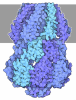
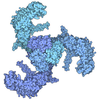
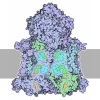
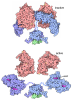
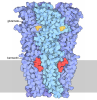
- Assembly
| Deposited unit | 
|
|---|---|
| 1 |
|
-Components
-Protein , 1 types, 7 molecules ABCDEFG
| #1: Protein | Mass: 18658.873 Da / Num. of mol.: 7 Source method: isolated from a genetically manipulated source Details: C-terminal His6-tag / Source: (gene. exp.) Francisella tularensis (bacteria) / Gene: FWI86_02060, FWJ04_01320 / Production host:  Escherichia coli (E. coli) / References: UniProt: A0A0B3VCY4 Escherichia coli (E. coli) / References: UniProt: A0A0B3VCY4 |
|---|
-Non-polymers , 5 types, 63 molecules 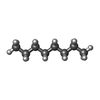
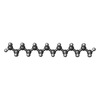
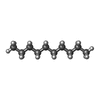
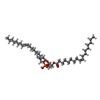
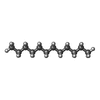
| #2: Chemical | ChemComp-OCT / 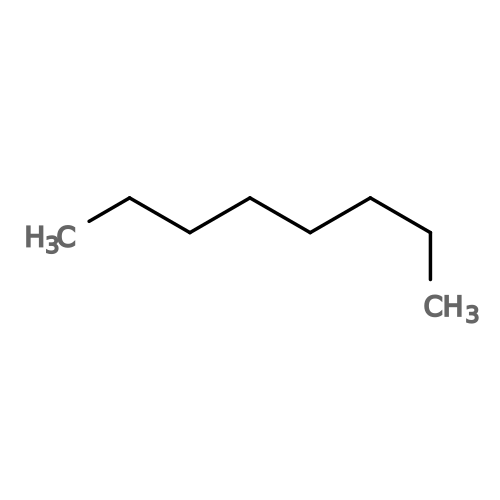 Mass: 114.229 Da / Num. of mol.: 14 / Source method: obtained synthetically / Formula: C8H18 / Feature type: SUBJECT OF INVESTIGATION Mass: 114.229 Da / Num. of mol.: 14 / Source method: obtained synthetically / Formula: C8H18 / Feature type: SUBJECT OF INVESTIGATION#3: Chemical | ChemComp-C14 / 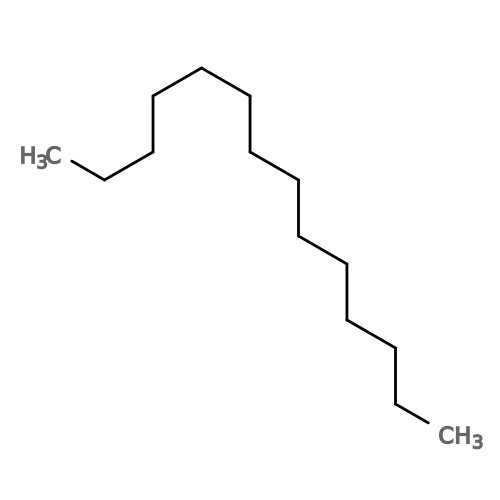 Mass: 198.388 Da / Num. of mol.: 21 / Source method: obtained synthetically / Formula: C14H30 / Feature type: SUBJECT OF INVESTIGATION Mass: 198.388 Da / Num. of mol.: 21 / Source method: obtained synthetically / Formula: C14H30 / Feature type: SUBJECT OF INVESTIGATION#4: Chemical | ChemComp-D10 / 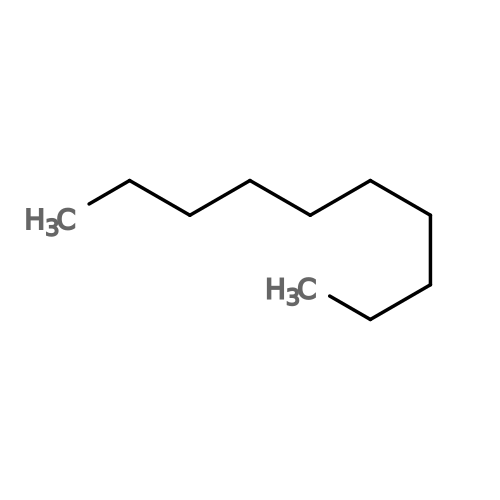 Mass: 142.282 Da / Num. of mol.: 14 / Source method: obtained synthetically / Formula: C10H22 / Feature type: SUBJECT OF INVESTIGATION Mass: 142.282 Da / Num. of mol.: 14 / Source method: obtained synthetically / Formula: C10H22 / Feature type: SUBJECT OF INVESTIGATION#5: Chemical | ChemComp-PEE / 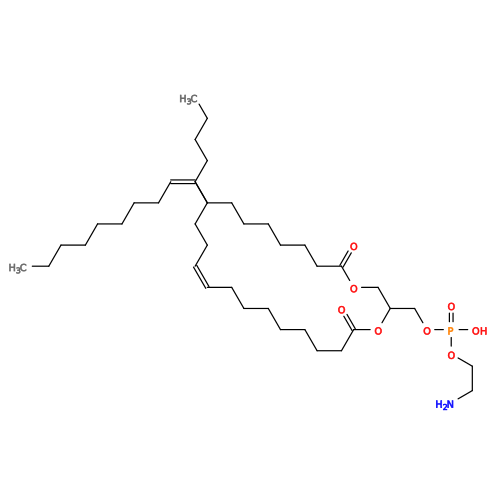 Mass: 744.034 Da / Num. of mol.: 7 / Source method: obtained synthetically / Formula: C41H78NO8P / Feature type: SUBJECT OF INVESTIGATION / Comment: DOPE, phospholipid*YM Mass: 744.034 Da / Num. of mol.: 7 / Source method: obtained synthetically / Formula: C41H78NO8P / Feature type: SUBJECT OF INVESTIGATION / Comment: DOPE, phospholipid*YM#6: Chemical | ChemComp-D12 / 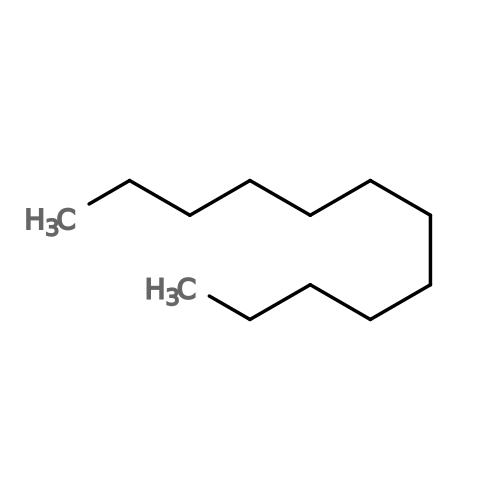 Mass: 170.335 Da / Num. of mol.: 7 / Source method: obtained synthetically / Formula: C12H26 / Feature type: SUBJECT OF INVESTIGATION Mass: 170.335 Da / Num. of mol.: 7 / Source method: obtained synthetically / Formula: C12H26 / Feature type: SUBJECT OF INVESTIGATION |
|---|
-Details
| Has ligand of interest | Y |
|---|---|
| Has protein modification | N |
-Experimental details
-Experiment
| Experiment | Method: ELECTRON MICROSCOPY |
|---|---|
| EM experiment | Aggregation state: PARTICLE / 3D reconstruction method: single particle reconstruction |
- Sample preparation
| Component | Name: homoheptameric complex of detergent solubilised MscS / Type: COMPLEX / Entity ID: #1 / Source: RECOMBINANT | |||||||||||||||||||||||||
|---|---|---|---|---|---|---|---|---|---|---|---|---|---|---|---|---|---|---|---|---|---|---|---|---|---|---|
| Molecular weight | Value: 0.13 MDa / Experimental value: NO | |||||||||||||||||||||||||
| Source (natural) | Organism: Francisella tularensis (bacteria) | |||||||||||||||||||||||||
| Source (recombinant) | Organism: Escherichia coli (E. coli) | |||||||||||||||||||||||||
| Buffer solution | pH: 7.5 | |||||||||||||||||||||||||
| Buffer component |
| |||||||||||||||||||||||||
| Specimen | Conc.: 3 mg/ml / Embedding applied: NO / Shadowing applied: NO / Staining applied: NO / Vitrification applied: YES | |||||||||||||||||||||||||
| Specimen support | Grid material: GOLD / Grid mesh size: 300 divisions/in. / Grid type: Quantifoil R0.6/1 | |||||||||||||||||||||||||
| Vitrification | Instrument: FEI VITROBOT MARK IV / Cryogen name: ETHANE / Humidity: 90 % / Chamber temperature: 277 K |
- Electron microscopy imaging
| Experimental equipment |  Model: Titan Krios / Image courtesy: FEI Company |
|---|---|
| Microscopy | Model: TFS KRIOS |
| Electron gun | Electron source:  FIELD EMISSION GUN / Accelerating voltage: 300 kV / Illumination mode: FLOOD BEAM FIELD EMISSION GUN / Accelerating voltage: 300 kV / Illumination mode: FLOOD BEAM |
| Electron lens | Mode: BRIGHT FIELD / Nominal magnification: 130000 X / Nominal defocus max: 1600 nm / Nominal defocus min: 600 nm / Cs: 2.7 mm / C2 aperture diameter: 70 µm / Alignment procedure: ZEMLIN TABLEAU |
| Specimen holder | Cryogen: NITROGEN / Specimen holder model: FEI TITAN KRIOS AUTOGRID HOLDER |
| Image recording | Average exposure time: 6.06 sec. / Electron dose: 70 e/Å2 / Film or detector model: FEI FALCON IV (4k x 4k) / Num. of grids imaged: 1 / Num. of real images: 9222 |
| EM imaging optics | Energyfilter name: TFS Selectris / Energyfilter slit width: 5 eV |
- Processing
| EM software |
| ||||||||||||||||||||||||||||||||||||||||
|---|---|---|---|---|---|---|---|---|---|---|---|---|---|---|---|---|---|---|---|---|---|---|---|---|---|---|---|---|---|---|---|---|---|---|---|---|---|---|---|---|---|
| CTF correction | Type: PHASE FLIPPING AND AMPLITUDE CORRECTION | ||||||||||||||||||||||||||||||||||||||||
| Particle selection | Num. of particles selected: 1950485 | ||||||||||||||||||||||||||||||||||||||||
| Symmetry | Point symmetry: C7 (7 fold cyclic) | ||||||||||||||||||||||||||||||||||||||||
| 3D reconstruction | Resolution: 2.3 Å / Resolution method: FSC 0.143 CUT-OFF / Num. of particles: 336790 / Algorithm: FOURIER SPACE / Symmetry type: POINT | ||||||||||||||||||||||||||||||||||||||||
| Atomic model building | B value: 12 / Protocol: AB INITIO MODEL / Space: REAL | ||||||||||||||||||||||||||||||||||||||||
| Atomic model building | PDB-ID: 6RLD Accession code: 6RLD / Source name: PDB / Type: experimental model | ||||||||||||||||||||||||||||||||||||||||
| Refinement | Highest resolution: 2.3 Å Stereochemistry target values: REAL-SPACE (WEIGHTED MAP SUM AT ATOM CENTERS) | ||||||||||||||||||||||||||||||||||||||||
| Refine LS restraints |
|