 Movie
Movie Controller

[English] 日本語
 Yorodumi
- PDB-9s3r: Ternary complex structure of compound 1 bound to SMARCA2 bromodom... -
+ Open data

- Basic information
| Entry | Database: PDB / ID: 9s3r | |||||||||||||||||||||||||||||||||||||||
|---|---|---|---|---|---|---|---|---|---|---|---|---|---|---|---|---|---|---|---|---|---|---|---|---|---|---|---|---|---|---|---|---|---|---|---|---|---|---|---|---|
| Title | Ternary complex structure of compound 1 bound to SMARCA2 bromodomain and DCAF16:DDB1deltaBPB | |||||||||||||||||||||||||||||||||||||||
 Components Components |
| |||||||||||||||||||||||||||||||||||||||
 Keywords Keywords | TRANSCRIPTION / Protein complex / covalent degrader / targeted protein degradation / E3 ligase | |||||||||||||||||||||||||||||||||||||||
| Function / homology |  Function and homology information Function and homology informationnBAF complex / npBAF complex / Formation of the canonical BAF (cBAF) complex / Formation of the polybromo-BAF (pBAF) complex / Formation of neuronal progenitor and neuronal BAF (npBAF and nBAF) / Formation of the non-canonical BAF (ncBAF) complex / nucleosome array spacer activity / regulation of G0 to G1 transition / positive regulation by virus of viral protein levels in host cell / SWI/SNF complex ...nBAF complex / npBAF complex / Formation of the canonical BAF (cBAF) complex / Formation of the polybromo-BAF (pBAF) complex / Formation of neuronal progenitor and neuronal BAF (npBAF and nBAF) / Formation of the non-canonical BAF (ncBAF) complex / nucleosome array spacer activity / regulation of G0 to G1 transition / positive regulation by virus of viral protein levels in host cell / SWI/SNF complex / spindle assembly involved in female meiosis / epigenetic programming in the zygotic pronuclei / UV-damage excision repair / regulation of mitotic metaphase/anaphase transition / positive regulation of T cell differentiation / biological process involved in interaction with symbiont / regulation of nucleotide-excision repair / regulation of mitotic cytokinesis / regulation of mitotic cell cycle phase transition / regulation of miRNA-mediated gene silencing / regulation of natural killer cell activation / WD40-repeat domain binding / positive regulation of stem cell population maintenance / regulation of cell cycle phase transition / Cul4A-RING E3 ubiquitin ligase complex / Cul4-RING E3 ubiquitin ligase complex / regulation of stem cell population maintenance / Cul4B-RING E3 ubiquitin ligase complex / positive regulation of double-strand break repair / Regulation of MITF-M-dependent genes involved in pigmentation / negative regulation of cell differentiation / ubiquitin ligase complex scaffold activity / negative regulation of adipose tissue development / RUNX1 interacts with co-factors whose precise effect on RUNX1 targets is not known / regulation of cellular response to stress / viral release from host cell / cullin family protein binding / positive regulation of myoblast differentiation / ATP-dependent activity, acting on DNA / regulation of DNA-templated DNA replication initiation / positive regulation of viral genome replication / positive regulation of gluconeogenesis / regulation of G1/S transition of mitotic cell cycle / regulation of embryonic development / replication fork processing / helicase activity / positive regulation of cell differentiation / proteasomal protein catabolic process / Regulation of endogenous retroelements by Piwi-interacting RNAs (piRNAs) / epigenetic regulation of gene expression / negative regulation of cell growth / nucleotide-excision repair / regulation of autophagy / Recognition of DNA damage by PCNA-containing replication complex / regulation of circadian rhythm / cell population proliferation / DNA Damage Recognition in GG-NER / Hydrolases; Acting on acid anhydrides; Acting on acid anhydrides to facilitate cellular and subcellular movement / Dual Incision in GG-NER / Transcription-Coupled Nucleotide Excision Repair (TC-NER) / Formation of TC-NER Pre-Incision Complex / protein polyubiquitination / Formation of Incision Complex in GG-NER / RMTs methylate histone arginines / positive regulation of protein catabolic process / cellular response to UV / Dual incision in TC-NER / Gap-filling DNA repair synthesis and ligation in TC-NER / positive regulation of proteasomal ubiquitin-dependent protein catabolic process / rhythmic process / regulation of cell population proliferation / site of double-strand break / nervous system development / Neddylation / heterochromatin formation / spermatogenesis / ubiquitin-dependent protein catabolic process / histone binding / damaged DNA binding / proteasome-mediated ubiquitin-dependent protein catabolic process / regulation of apoptotic process / protein-macromolecule adaptor activity / chromosome, telomeric region / transcription coactivator activity / transcription cis-regulatory region binding / protein ubiquitination / chromatin remodeling / negative regulation of cell population proliferation / negative regulation of DNA-templated transcription / DNA repair / positive regulation of cell population proliferation / chromatin binding / regulation of transcription by RNA polymerase II / DNA damage response / nucleolus / regulation of DNA-templated transcription / positive regulation of DNA-templated transcription / protein-containing complex binding / chromatin / negative regulation of transcription by RNA polymerase II Similarity search - Function | |||||||||||||||||||||||||||||||||||||||
| Biological species |  Homo sapiens (human) Homo sapiens (human) | |||||||||||||||||||||||||||||||||||||||
| Method | ELECTRON MICROSCOPY / single particle reconstruction / cryo EM / Resolution: 3.3 Å | |||||||||||||||||||||||||||||||||||||||
 Authors Authors | Spiteri, V.A. / Nakasone, M.A. / Casement, R. / Iso, K. / Cowan, A.D. / Ciulli, A. | |||||||||||||||||||||||||||||||||||||||
| Funding support |  Japan, Japan,  United Kingdom, European Union, United Kingdom, European Union,  Austria, Austria,  Switzerland, Switzerland,  Spain, 12items Spain, 12items
| |||||||||||||||||||||||||||||||||||||||
 Citation Citation | Journal: Nat Chem Biol / Year: 2026 Title: Dual E3 ligase recruitment by monovalent degraders for tunable SMARCA 2/4 degradation. Authors: Valentina A Spiteri / Dmitri Segal / Alejandro Correa-Sáez / Kentaro Iso / Ryan Casement / Miquel Muñoz I Ordoño / Mark A Nakasone / Gajanan Sathe / Caroline Schätz / Hannah E Peters / ...Authors: Valentina A Spiteri / Dmitri Segal / Alejandro Correa-Sáez / Kentaro Iso / Ryan Casement / Miquel Muñoz I Ordoño / Mark A Nakasone / Gajanan Sathe / Caroline Schätz / Hannah E Peters / Mark Doward / Lisa Kainacher / Angus D Cowan / Alessio Ciulli / Georg E Winter / Abstract: Proteolysis-targeting chimeras (PROTACs) and molecular glue degraders (MGDs) target proteins for degradation by co-opting an E3 ligase. While heterotrivalent PROTACs that can recruit multiple E3 ...Proteolysis-targeting chimeras (PROTACs) and molecular glue degraders (MGDs) target proteins for degradation by co-opting an E3 ligase. While heterotrivalent PROTACs that can recruit multiple E3 ligases have been described, all MGDs reported to date depend on a single E3. Using orthogonal genetic screening, biophysical and structural analyses, we show that a monovalent MGD can recruit CUL4 and CRL1 in parallel to degrade SMARCA2/4. Deep mutational scanning identifies C173 in DCAF16 as essential for degrader activity and intact protein mass spectrometry confirms covalent modification at this site. Elucidating the ternary complex structure reveals a unique binding mode and a distinct interface of neointeractions that underlie degrader specificity. We demonstrate that ligase dependency is chemically and genetically tunable. Minimal compound modifications shift preference from DCAF16 to FBXO22, while a single substitution boosts degrader dependency on DCAF16. These results establish a framework for designing tunable dual E3 ligase degraders to mitigate potential resistance mechanisms. | |||||||||||||||||||||||||||||||||||||||
| History |
|
- Structure visualization
| Structure viewer | Molecule: MolmilJmol/JSmol |
|---|
- Downloads & links
-Download
| PDBx/mmCIF format | 9s3r.cif.gz | 438.3 KB | Display | PDBx/mmCIF format |
|---|---|---|---|---|
| PDB format | pdb9s3r.ent.gz | Display | PDB format | |
| PDBx/mmJSON format | 9s3r.json.gz | Tree view | PDBx/mmJSON format | |
| Others |  Other downloads Other downloads |
-Validation report
| Arichive directory | https://data.pdbj.org/pub/pdb/validation_reports/s3/9s3rftp://data.pdbj.org/pub/pdb/validation_reports/s3/9s3r | HTTPS FTP |
|---|
-Related structure data
| Related structure data |  54549MC M: map data used to model this data C: citing same article ( |
|---|---|
| Similar structure data |
-Links
 PDBj
PDBj

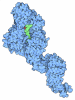
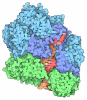
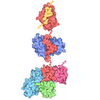
- Assembly
| Deposited unit | 
|
|---|---|
| 1 |
|
-Components
-Protein , 4 types, 4 molecules ABCD
| #1: Protein | Mass: 127097.469 Da / Num. of mol.: 1 Source method: isolated from a genetically manipulated source Source: (gene. exp.) Homo sapiens (human) / Gene: DDB1, XAP1 / Production host:  Trichoplusia ni (cabbage looper) / References: UniProt: Q16531 Trichoplusia ni (cabbage looper) / References: UniProt: Q16531 |
|---|---|
| #2: Protein | Mass: 24333.449 Da / Num. of mol.: 1 Source method: isolated from a genetically manipulated source Source: (gene. exp.) Homo sapiens (human) / Gene: DCAF16, C4orf30 / Production host: Trichoplusia ni (cabbage looper) / References: UniProt: Q9NXF7 |
| #3: Protein | Mass: 14380.542 Da / Num. of mol.: 1 Source method: isolated from a genetically manipulated source Source: (gene. exp.) Homo sapiens (human) / Gene: SMARCA2, BAF190B, BRM, SNF2A, SNF2L2 / Production host:   Escherichia coli BL21(DE3) (bacteria) Escherichia coli BL21(DE3) (bacteria)References: UniProt: P51531, Hydrolases; Acting on acid anhydrides; Acting on acid anhydrides to facilitate cellular and subcellular movement |
| #4: Protein | Mass: 11855.297 Da / Num. of mol.: 1 Source method: isolated from a genetically manipulated source Source: (gene. exp.) Homo sapiens (human) / Gene: DDA1, C19orf58, PCIA1 / Production host: Trichoplusia ni (cabbage looper) / References: UniProt: Q9BW61 |
-Non-polymers , 2 types, 2 molecules 
| #5: Chemical | ChemComp-ZN /  Mass: 65.409 Da / Num. of mol.: 1 / Source method: obtained synthetically / Formula: Zn Mass: 65.409 Da / Num. of mol.: 1 / Source method: obtained synthetically / Formula: Zn |
|---|---|
| #6: Chemical | ChemComp-A1JLV / Mass: 511.661 Da / Num. of mol.: 1 / Source method: obtained synthetically / Formula: C30H37N7O / Feature type: SUBJECT OF INVESTIGATION |
-Details
| Has ligand of interest | Y |
|---|---|
| Has protein modification | N |
-Experimental details
-Experiment
| Experiment | Method: ELECTRON MICROSCOPY |
|---|---|
| EM experiment | Aggregation state: PARTICLE / 3D reconstruction method: single particle reconstruction |
- Sample preparation
| Component | Name: Ternary complex structure of compound 1 bound to SMARCA2 bromodomain and DCAF16:DDB1deltaBPB Type: COMPLEX / Entity ID: #4, #3, #1-#2 / Source: RECOMBINANT | |||||||||||||||||||||||||
|---|---|---|---|---|---|---|---|---|---|---|---|---|---|---|---|---|---|---|---|---|---|---|---|---|---|---|
| Source (natural) | Organism: Homo sapiens (human) | |||||||||||||||||||||||||
| Source (recombinant) | Organism: Trichoplusia ni (cabbage looper) | |||||||||||||||||||||||||
| Buffer solution | pH: 7.5 | |||||||||||||||||||||||||
| Buffer component |
| |||||||||||||||||||||||||
| Specimen | Embedding applied: NO / Shadowing applied: NO / Staining applied: NO / Vitrification applied: YES Details: Final complex component concentrations applied to the grid after incubation: 20 uM DCAF16:DDB1 (delta BPB): DDA1 50 uM SMARCA2 60 uM GNE58 | |||||||||||||||||||||||||
| Specimen support | Grid material: COPPER / Grid mesh size: 400 divisions/in. / Grid type: Quantifoil R1.2/1.3 | |||||||||||||||||||||||||
| Vitrification | Instrument: FEI VITROBOT MARK IV / Cryogen name: ETHANE / Humidity: 100 % / Chamber temperature: 277.15 K Details: Applied 3.5 uL of sample to grid. wait = 10 sec, drain = 0 sec, blot = 4 sec, blotForce = 4 |
- Electron microscopy imaging
| Experimental equipment |  Model: Titan Krios / Image courtesy: FEI Company |
|---|---|
| Microscopy | Model: TFS KRIOS |
| Electron gun | Electron source:  FIELD EMISSION GUN / Accelerating voltage: 300 kV / Illumination mode: FLOOD BEAM FIELD EMISSION GUN / Accelerating voltage: 300 kV / Illumination mode: FLOOD BEAM |
| Electron lens | Mode: BRIGHT FIELD / Nominal defocus max: 2800 nm / Nominal defocus min: 1000 nm |
| Specimen holder | Cryogen: NITROGEN / Specimen holder model: FEI TITAN KRIOS AUTOGRID HOLDER |
| Image recording | Electron dose: 60 e/Å2 / Film or detector model: TFS FALCON 4i (4k x 4k) |
- Processing
| EM software |
| ||||||||||||||||
|---|---|---|---|---|---|---|---|---|---|---|---|---|---|---|---|---|---|
| CTF correction | Type: PHASE FLIPPING AND AMPLITUDE CORRECTION | ||||||||||||||||
| 3D reconstruction | Resolution: 3.3 Å / Resolution method: FSC 0.143 CUT-OFF / Num. of particles: 40820 / Symmetry type: POINT |
