 Movie
Movie Controller


+ Open data

- Basic information
| Entry | Database: PDB / ID: 9s1l | |||||||||||||||
|---|---|---|---|---|---|---|---|---|---|---|---|---|---|---|---|---|
| Title | Cryo-EM structure of Posidonia oceanica PSI-LHCI supercomplex | |||||||||||||||
 Components Components |
| |||||||||||||||
 Keywords Keywords | PHOTOSYNTHESIS / Photosystem I / PSI-LHCI / Posidonia oceanica | |||||||||||||||
| Function / homology |  Function and homology information Function and homology informationBETA-CAROTENE / CHLOROPHYLL B / CHLOROPHYLL A / DIGALACTOSYL DIACYL GLYCEROL (DGDG) / 1,2-DIPALMITOYL-PHOSPHATIDYL-GLYCEROLE / 1,2-DISTEAROYL-MONOGALACTOSYL-DIGLYCERIDE / Chem-LUT / PHYLLOQUINONE / IRON/SULFUR CLUSTER / Chem-XAT Similarity search - Component | |||||||||||||||
| Biological species |  Posidonia oceanica (plant) Posidonia oceanica (plant) | |||||||||||||||
| Method | ELECTRON MICROSCOPY / single particle reconstruction / cryo EM / Resolution: 2.83 Å | |||||||||||||||
 Authors Authors | Capaldi, S. / Amelii, A. / Sanita, G. / Esposito, M. / Bassi, R. | |||||||||||||||
| Funding support | European Union, 1items
| |||||||||||||||
 Citation Citation | Journal: Nat Commun / Year: 2026 Title: Structural and spectral adaptation of the seagrass Posidonia oceanica photosystem I to seabed light. Authors: Antonello Amelii / Stefano Capaldi / Mattia Russo / Zeno Guardini / Gennaro Sanità / Emanuela Esposito / Irene Olivé / Margherita Maiuri / Luca Dall'Osto / Giulio Cerullo / Gabriele ...Authors: Antonello Amelii / Stefano Capaldi / Mattia Russo / Zeno Guardini / Gennaro Sanità / Emanuela Esposito / Irene Olivé / Margherita Maiuri / Luca Dall'Osto / Giulio Cerullo / Gabriele Procaccini / Roberto Bassi /  Abstract: Seagrasses are marine angiosperms re-adapted to underwater life, forming productive ecosystems and long-term carbon sinks. Posidonia oceanica thrives up to 50 m depth, where light is scarce and ...Seagrasses are marine angiosperms re-adapted to underwater life, forming productive ecosystems and long-term carbon sinks. Posidonia oceanica thrives up to 50 m depth, where light is scarce and spectrally shifted; yet, the molecular basis of its photosynthetic adaptation remains unclear. Here, we report that P. oceanica genetically adapts for highly efficient photon use under dim light by enhancing photosystem antenna size and reducing exciton trapping time. We determine the structures of P. oceanica PSI supercomplexes by cryo-electron microscopy, revealing an expanded antenna system composed of PSI-LHCI, a trimeric phospho-LHCII, and an additional LHCI heterodimer. Low-energy chlorophyll forms associated with LHCI are lost. Ultrafast spectroscopy shows that this loss correlates with faster exciton trapping, which compensates for antenna expansion and enhances light-use efficiency under dim light. We identify key residues responsible for the loss of low-energy forms. Reversion to land-plant ortholog sequences restores red-shifted emission, providing strategies to enhance light-use efficiency in crops. | |||||||||||||||
| History |
|
- Structure visualization
| Structure viewer | Molecule: MolmilJmol/JSmol |
|---|
- Downloads & links
-Download
| PDBx/mmCIF format | 9s1l.cif.gz | 1.1 MB | Display | PDBx/mmCIF format |
|---|---|---|---|---|
| PDB format | pdb9s1l.ent.gz | 785.9 KB | Display | PDB format |
| PDBx/mmJSON format | 9s1l.json.gz | Tree view | PDBx/mmJSON format | |
| Others |  Other downloads Other downloads |
-Validation report
| Arichive directory | https://data.pdbj.org/pub/pdb/validation_reports/s1/9s1lftp://data.pdbj.org/pub/pdb/validation_reports/s1/9s1l | HTTPS FTP |
|---|
-Related structure data
| Related structure data |  54455MC  9s1mC C: citing same article ( M: map data used to model this data |
|---|---|
| Similar structure data |


-Links
 PDBj
PDBj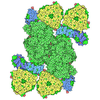
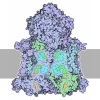
- Assembly
| Deposited unit | 
|
|---|---|
| 1 |
|
-Components
-Chlorophyll a-b binding protein ... , 2 types, 2 molecules 14
| #1: Protein | Mass: 21878.111 Da / Num. of mol.: 1 / Source method: isolated from a natural source / Source: (natural) Posidonia oceanica (plant) |
|---|---|
| #4: Protein | Mass: 22158.150 Da / Num. of mol.: 1 / Source method: isolated from a natural source / Source: (natural) Posidonia oceanica (plant) |
-Photosystem I chlorophyll a/b-binding protein ... , 2 types, 2 molecules 23
| #2: Protein | Mass: 23094.199 Da / Num. of mol.: 1 / Source method: isolated from a natural source / Source: (natural) Posidonia oceanica (plant) |
|---|---|
| #3: Protein | Mass: 25149.672 Da / Num. of mol.: 1 / Source method: isolated from a natural source / Source: (natural) Posidonia oceanica (plant) |
-Photosystem I P700 chlorophyll a apoprotein ... , 2 types, 2 molecules AB
| #5: Protein | Mass: 83217.234 Da / Num. of mol.: 1 / Source method: isolated from a natural source / Source: (natural) Posidonia oceanica (plant) |
|---|---|
| #6: Protein | Mass: 82521.711 Da / Num. of mol.: 1 / Source method: isolated from a natural source / Source: (natural) Posidonia oceanica (plant) |
-Protein , 1 types, 1 molecules C
| #7: Protein | Mass: 9040.499 Da / Num. of mol.: 1 / Source method: isolated from a natural source / Source: (natural) Posidonia oceanica (plant) |
|---|
-Photosystem I reaction center subunit ... , 9 types, 9 molecules DEFGHIJKL
| #8: Protein | Mass: 17169.596 Da / Num. of mol.: 1 / Source method: isolated from a natural source / Source: (natural) Posidonia oceanica (plant) |
|---|---|
| #9: Protein | Mass: 10392.691 Da / Num. of mol.: 1 / Source method: isolated from a natural source / Source: (natural) Posidonia oceanica (plant) |
| #10: Protein | Mass: 17759.670 Da / Num. of mol.: 1 / Source method: isolated from a natural source / Source: (natural) Posidonia oceanica (plant) |
| #11: Protein | Mass: 11023.403 Da / Num. of mol.: 1 / Source method: isolated from a natural source / Source: (natural) Posidonia oceanica (plant) |
| #12: Protein | Mass: 10508.876 Da / Num. of mol.: 1 / Source method: isolated from a natural source / Source: (natural) Posidonia oceanica (plant) |
| #13: Protein/peptide | Mass: 3940.820 Da / Num. of mol.: 1 / Source method: isolated from a natural source / Source: (natural) Posidonia oceanica (plant) |
| #14: Protein/peptide | Mass: 4777.646 Da / Num. of mol.: 1 / Source method: isolated from a natural source / Source: (natural) Posidonia oceanica (plant) |
| #15: Protein | Mass: 8471.875 Da / Num. of mol.: 1 / Source method: isolated from a natural source / Source: (natural) Posidonia oceanica (plant) |
| #16: Protein | Mass: 18128.881 Da / Num. of mol.: 1 / Source method: isolated from a natural source / Source: (natural) Posidonia oceanica (plant) |
-Sugars , 2 types, 5 molecules 
| #24: Sugar | ChemComp-LMT / 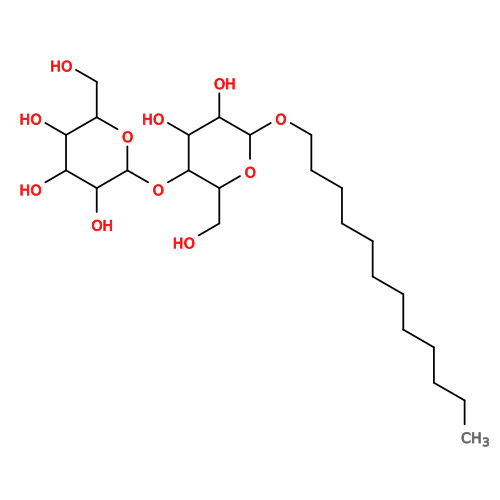 Type: D-saccharide / Mass: 510.615 Da / Num. of mol.: 4 / Source method: obtained synthetically / Formula: C24H46O11 / Comment: detergent*YM Type: D-saccharide / Mass: 510.615 Da / Num. of mol.: 4 / Source method: obtained synthetically / Formula: C24H46O11 / Comment: detergent*YM#27: Sugar | ChemComp-DGD / |  Type: saccharide / Mass: 949.299 Da / Num. of mol.: 1 / Source method: obtained synthetically / Formula: C51H96O15 / Feature type: SUBJECT OF INVESTIGATION Type: saccharide / Mass: 949.299 Da / Num. of mol.: 1 / Source method: obtained synthetically / Formula: C51H96O15 / Feature type: SUBJECT OF INVESTIGATION |
|---|
-Non-polymers , 9 types, 210 molecules 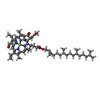
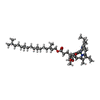
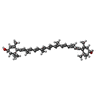
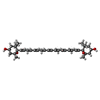
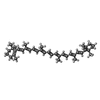
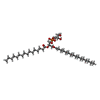
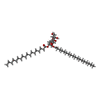
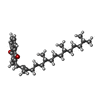
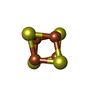
| #17: Chemical | ChemComp-CHL /  Mass: 907.472 Da / Num. of mol.: 12 / Source method: obtained synthetically / Formula: C55H70MgN4O6 / Feature type: SUBJECT OF INVESTIGATION Mass: 907.472 Da / Num. of mol.: 12 / Source method: obtained synthetically / Formula: C55H70MgN4O6 / Feature type: SUBJECT OF INVESTIGATION#18: Chemical | ChemComp-CLA / 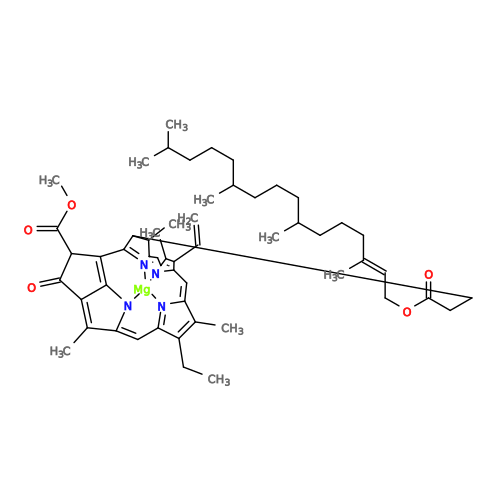 Mass: 893.489 Da / Num. of mol.: 143 / Source method: obtained synthetically / Formula: C55H72MgN4O5 / Feature type: SUBJECT OF INVESTIGATION Mass: 893.489 Da / Num. of mol.: 143 / Source method: obtained synthetically / Formula: C55H72MgN4O5 / Feature type: SUBJECT OF INVESTIGATION#19: Chemical | ChemComp-LUT / ( 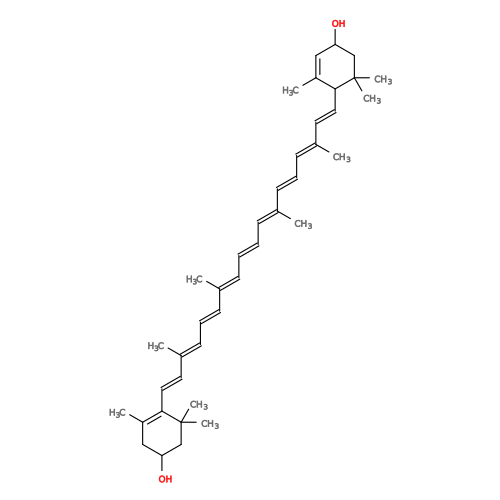 Mass: 568.871 Da / Num. of mol.: 5 / Source method: obtained synthetically / Formula: C40H56O2 / Feature type: SUBJECT OF INVESTIGATION Mass: 568.871 Da / Num. of mol.: 5 / Source method: obtained synthetically / Formula: C40H56O2 / Feature type: SUBJECT OF INVESTIGATION#20: Chemical | ChemComp-XAT / ( 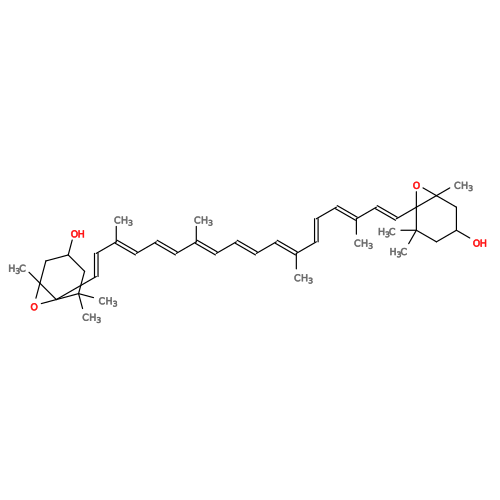 Mass: 600.870 Da / Num. of mol.: 4 / Source method: obtained synthetically / Formula: C40H56O4 / Feature type: SUBJECT OF INVESTIGATION Mass: 600.870 Da / Num. of mol.: 4 / Source method: obtained synthetically / Formula: C40H56O4 / Feature type: SUBJECT OF INVESTIGATION#21: Chemical | ChemComp-BCR / 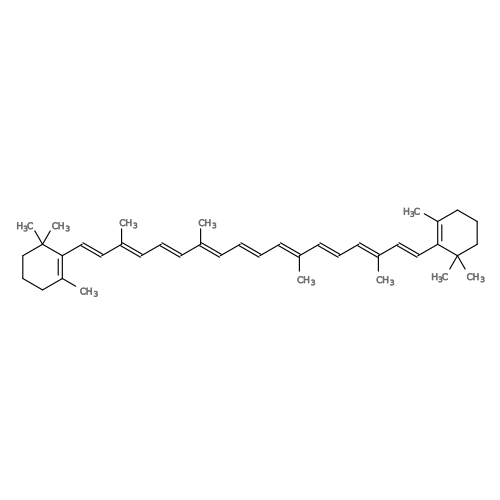 Mass: 536.873 Da / Num. of mol.: 28 / Source method: obtained synthetically / Formula: C40H56 / Feature type: SUBJECT OF INVESTIGATION Mass: 536.873 Da / Num. of mol.: 28 / Source method: obtained synthetically / Formula: C40H56 / Feature type: SUBJECT OF INVESTIGATION#22: Chemical | ChemComp-LHG / 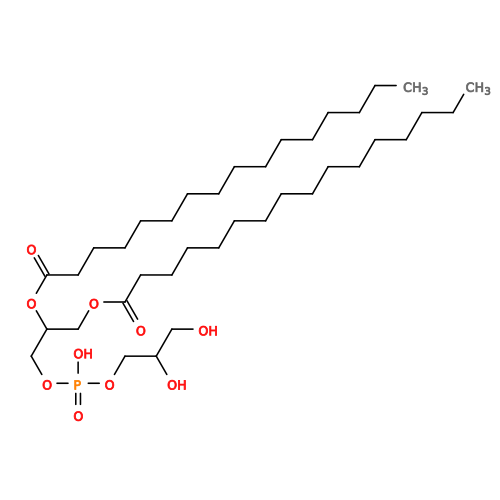 Mass: 722.970 Da / Num. of mol.: 6 / Source method: obtained synthetically / Formula: C38H75O10P / Feature type: SUBJECT OF INVESTIGATION / Comment: phospholipid*YM Mass: 722.970 Da / Num. of mol.: 6 / Source method: obtained synthetically / Formula: C38H75O10P / Feature type: SUBJECT OF INVESTIGATION / Comment: phospholipid*YM#23: Chemical | ChemComp-LMG / 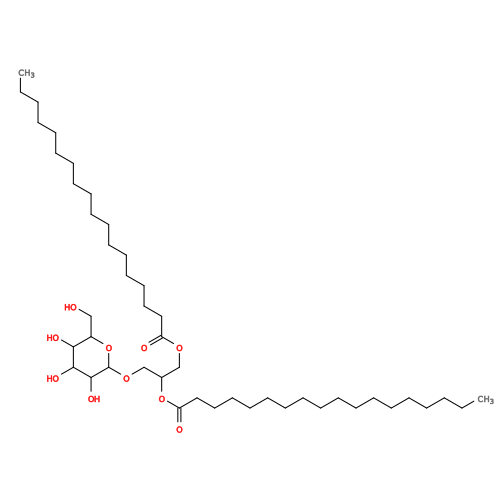 Mass: 787.158 Da / Num. of mol.: 7 / Source method: obtained synthetically / Formula: C45H86O10 / Feature type: SUBJECT OF INVESTIGATION Mass: 787.158 Da / Num. of mol.: 7 / Source method: obtained synthetically / Formula: C45H86O10 / Feature type: SUBJECT OF INVESTIGATION#25: Chemical | 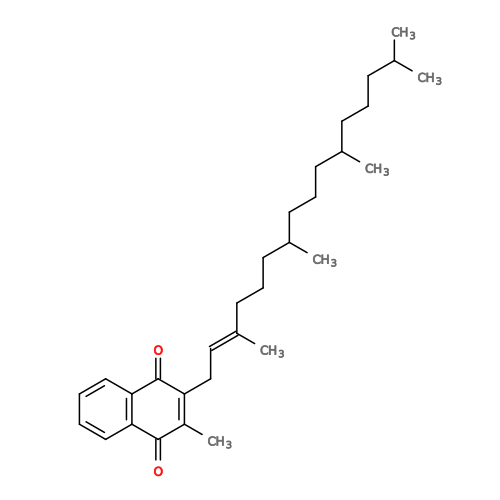 Mass: 450.696 Da / Num. of mol.: 2 / Source method: obtained synthetically / Formula: C31H46O2 / Feature type: SUBJECT OF INVESTIGATION Mass: 450.696 Da / Num. of mol.: 2 / Source method: obtained synthetically / Formula: C31H46O2 / Feature type: SUBJECT OF INVESTIGATION#26: Chemical | 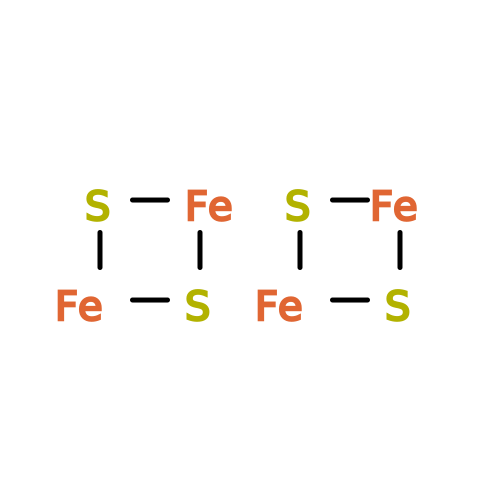 Mass: 351.640 Da / Num. of mol.: 3 / Source method: obtained synthetically / Formula: Fe4S4 / Feature type: SUBJECT OF INVESTIGATION Mass: 351.640 Da / Num. of mol.: 3 / Source method: obtained synthetically / Formula: Fe4S4 / Feature type: SUBJECT OF INVESTIGATION |
|---|
-Details
| Has ligand of interest | Y |
|---|---|
| Has protein modification | Y |
-Experimental details
-Experiment
| Experiment | Method: ELECTRON MICROSCOPY |
|---|---|
| EM experiment | Aggregation state: PARTICLE / 3D reconstruction method: single particle reconstruction |
- Sample preparation
| Component | Name: Photosystem I (PSI-LHCI) / Type: COMPLEX / Entity ID: #1-#16 / Source: NATURAL | |||||||||||||||
|---|---|---|---|---|---|---|---|---|---|---|---|---|---|---|---|---|
| Molecular weight | Experimental value: NO | |||||||||||||||
| Source (natural) | Organism: Posidonia oceanica (plant) | |||||||||||||||
| Buffer solution | pH: 7.5 | |||||||||||||||
| Buffer component |
| |||||||||||||||
| Specimen | Embedding applied: NO / Shadowing applied: NO / Staining applied: NO / Vitrification applied: YES | |||||||||||||||
| Specimen support | Grid material: GOLD / Grid mesh size: 300 divisions/in. / Grid type: Quantifoil R1.2/1.3 | |||||||||||||||
| Vitrification | Instrument: FEI VITROBOT MARK IV / Cryogen name: ETHANE / Humidity: 100 % / Chamber temperature: 298 K |
- Electron microscopy imaging
| Microscopy | Model: TFS GLACIOS |
|---|---|
| Electron gun | Electron source:  FIELD EMISSION GUN / Accelerating voltage: 200 kV / Illumination mode: FLOOD BEAM FIELD EMISSION GUN / Accelerating voltage: 200 kV / Illumination mode: FLOOD BEAM |
| Electron lens | Mode: BRIGHT FIELD / Nominal magnification: 130000 X / Nominal defocus max: 2500 nm / Nominal defocus min: 750 nm / Alignment procedure: COMA FREE |
| Specimen holder | Cryogen: NITROGEN |
| Image recording | Electron dose: 50 e/Å2 / Film or detector model: FEI FALCON IV (4k x 4k) |
| EM imaging optics | Energyfilter name: TFS Selectris X / Energyfilter slit width: 10 eV |
- Processing
| EM software |
| ||||||||||||||||||||||||
|---|---|---|---|---|---|---|---|---|---|---|---|---|---|---|---|---|---|---|---|---|---|---|---|---|---|
| CTF correction | Type: PHASE FLIPPING AND AMPLITUDE CORRECTION | ||||||||||||||||||||||||
| 3D reconstruction | Resolution: 2.83 Å / Resolution method: FSC 0.143 CUT-OFF / Num. of particles: 120603 / Symmetry type: POINT | ||||||||||||||||||||||||
| Atomic model building | Protocol: RIGID BODY FIT / Space: REAL | ||||||||||||||||||||||||
| Atomic model building | PDB-ID: 5ZJI Accession code: 5ZJI / Source name: PDB / Type: experimental model | ||||||||||||||||||||||||
| Refinement | Cross valid method: NONE Stereochemistry target values: GeoStd + Monomer Library + CDL v1.2 | ||||||||||||||||||||||||
| Displacement parameters | Biso mean: 66.87 Å2 | ||||||||||||||||||||||||
| Refine LS restraints |
|

