 Movie
Movie Controller


+ Open data

- Basic information
| Entry | Database: PDB / ID: 9r2h | ||||||||||||||||||||||||
|---|---|---|---|---|---|---|---|---|---|---|---|---|---|---|---|---|---|---|---|---|---|---|---|---|---|
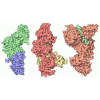
| Title | Tau filaments seeded by AD homogenate using 0N3R C322S | ||||||||||||||||||||||||
 Components Components | Isoform Tau-D of Microtubule-associated protein tau | ||||||||||||||||||||||||
 Keywords Keywords | PROTEIN FIBRIL / MAPT / Tau / Alzheimer's Disease / RT-QuiC | ||||||||||||||||||||||||
| Function / homology |  Function and homology information Function and homology informationplus-end-directed organelle transport along microtubule / histone-dependent DNA binding / microtubule stabilizing activity / neurofibrillary tangle / microtubule lateral binding / axonal transport / tubulin complex / positive regulation of protein localization to synapse / phosphatidylinositol bisphosphate binding / generation of neurons ...plus-end-directed organelle transport along microtubule / histone-dependent DNA binding / microtubule stabilizing activity / neurofibrillary tangle / microtubule lateral binding / axonal transport / tubulin complex / positive regulation of protein localization to synapse / phosphatidylinositol bisphosphate binding / generation of neurons / axonal transport of mitochondrion / axon development / rRNA metabolic process / central nervous system neuron development / regulation of microtubule-based movement / negative regulation of protein localization to mitochondrion / regulation of mitochondrial fission / regulation of chromosome organization / intracellular distribution of mitochondria / minor groove of adenine-thymine-rich DNA binding / lipoprotein particle binding / negative regulation of mitochondrial membrane potential / microtubule polymerization / regulation of microtubule polymerization / dynactin binding / apolipoprotein binding / regulation of calcium-mediated signaling / main axon / Caspase-mediated cleavage of cytoskeletal proteins / glial cell projection / regulation of microtubule polymerization or depolymerization / neurofibrillary tangle assembly / negative regulation of mitochondrial fission / protein polymerization / positive regulation of axon extension / axolemma / regulation of cellular response to heat / positive regulation of microtubule polymerization / positive regulation of superoxide anion generation / Activation of AMPK downstream of NMDARs / cytoplasmic microtubule organization / cellular response to brain-derived neurotrophic factor stimulus / regulation of long-term synaptic depression / axon cytoplasm / positive regulation of protein localization / supramolecular fiber organization / synapse assembly / somatodendritic compartment / astrocyte activation / nuclear periphery / phosphatidylinositol binding / protein phosphatase 2A binding / stress granule assembly / enzyme inhibitor activity / SH3 domain binding / cellular response to reactive oxygen species / regulation of microtubule cytoskeleton organization / memory / microtubule cytoskeleton organization / microglial cell activation / cellular response to nerve growth factor stimulus / regulation of synaptic plasticity / Hsp90 protein binding / regulation of autophagy / protein homooligomerization / synapse organization / PKR-mediated signaling / response to lead ion / neuron projection development / cytoplasmic ribonucleoprotein granule / microtubule cytoskeleton / cell-cell signaling / cellular response to heat / single-stranded DNA binding / actin binding / protein-folding chaperone binding / growth cone / double-stranded DNA binding / cell body / sequence-specific DNA binding / microtubule binding / amyloid fibril formation / dendritic spine / learning or memory / protein-macromolecule adaptor activity / membrane raft / negative regulation of gene expression / axon / neuronal cell body / DNA damage response / dendrite / protein kinase binding / enzyme binding / mitochondrion / DNA binding / RNA binding / extracellular region / identical protein binding / nucleus / plasma membrane Similarity search - Function | ||||||||||||||||||||||||
| Biological species |  Homo sapiens (human) Homo sapiens (human) | ||||||||||||||||||||||||
| Method | ELECTRON MICROSCOPY / helical reconstruction / cryo EM / Resolution: 2.6 Å | ||||||||||||||||||||||||
 Authors Authors | Lovestam, S. / Scheres, H.W.S. | ||||||||||||||||||||||||
| Funding support |  United Kingdom, 1items United Kingdom, 1items
| ||||||||||||||||||||||||
 Citation Citation | Journal: FEBS Lett / Year: 2025 Title: Serial amplification of tau filaments using Alzheimer's brain homogenates and C322A or C322S recombinant tau. Authors: Alessia Santambrogio / Sofia Lövestam / Michael A Metrick / Thomas Löhr / Peifeng Xu / Nicholas C T Gallagher / Bernardino Ghetti / Byron Caughey / Sjors H W Scheres / Michele Vendruscolo /  Abstract: The assembly of tau into amyloid filaments is a hallmark of Alzheimer's disease (AD) and other tauopathies. Cryo-EM revealed the existence of disease-specific tau folds, which are challenging to ...The assembly of tau into amyloid filaments is a hallmark of Alzheimer's disease (AD) and other tauopathies. Cryo-EM revealed the existence of disease-specific tau folds, which are challenging to replicate in vitro. We studied three full-length recombinant 0N3R tau forms (the wild-type and the C322A and C322S variants) using an RT-QuIC assay with brain homogenate seeding. C322A tau formed filaments resembling AD paired helical filaments (PHFs) but with a more open C-shaped core. C322S tau yielded structurally distinct filaments with an ordered C-terminal region. Both mutants seeded further aggregation, whereas the wild-type showed poor reproducibility and mainly unfolded aggregates. These results highlight the importance of optimised conditions to produce disease-relevant tau filaments and aid the development of targeted therapies. Impact statement We investigated the seeded assembly of 0N3R tau and its two mutational variants C322A and C322S, using Alzheimer's disease brain homogenates in a real-time quaking-induced conversion (RT-QuIC) assay. The C322A variant formed filaments partially resembling the AD PHF structure, showing the importance of optimised conditions to produce disease-relevant tau filaments. | ||||||||||||||||||||||||
| History |
|
- Structure visualization
| Structure viewer | Molecule: MolmilJmol/JSmol |
|---|
- Downloads & links
-Download
| PDBx/mmCIF format | 9r2h.cif.gz | 120.9 KB | Display | PDBx/mmCIF format |
|---|---|---|---|---|
| PDB format | pdb9r2h.ent.gz | 95.1 KB | Display | PDB format |
| PDBx/mmJSON format | 9r2h.json.gz | Tree view | PDBx/mmJSON format | |
| Others |  Other downloads Other downloads |
-Validation report
| Arichive directory | https://data.pdbj.org/pub/pdb/validation_reports/r2/9r2hftp://data.pdbj.org/pub/pdb/validation_reports/r2/9r2h | HTTPS FTP |
|---|
-Related structure data
| Related structure data |  53530MC  9r2fC M: map data used to model this data C: citing same article ( |
|---|---|
| Similar structure data |

-Links
 PDBj
PDBj
- Assembly
| Deposited unit | 
|
|---|---|
| 1 |
|
-Components
| #1: Protein | Mass: 14452.269 Da / Num. of mol.: 3 Source method: isolated from a genetically manipulated source Source: (gene. exp.) Homo sapiens (human) / Gene: MAPT, MAPTL, MTBT1, TAU / Production host:   Escherichia coli (E. coli) / References: UniProt: P10636 Escherichia coli (E. coli) / References: UniProt: P10636Has protein modification | N | |
|---|
-Experimental details
-Experiment
| Experiment | Method: ELECTRON MICROSCOPY |
|---|---|
| EM experiment | Aggregation state: FILAMENT / 3D reconstruction method: helical reconstruction |
- Sample preparation
| Component | Name: Microtubule associate tau protein assembled into an amyloid filament Type: COMPLEX / Entity ID: all / Source: RECOMBINANT |
|---|---|
| Source (natural) | Organism: Homo sapiens (human) |
| Source (recombinant) | Organism: Escherichia coli (E. coli) |
| Buffer solution | pH: 7.2 |
| Specimen | Embedding applied: NO / Shadowing applied: NO / Staining applied: NO / Vitrification applied: YES |
| Specimen support | Grid type: Quantifoil |
| Vitrification | Instrument: FEI VITROBOT MARK III / Cryogen name: ETHANE / Humidity: 100 % |
- Electron microscopy imaging
| Experimental equipment |  Model: Titan Krios / Image courtesy: FEI Company |
|---|---|
| Microscopy | Model: TFS KRIOS |
| Electron gun | Electron source:  FIELD EMISSION GUN / Accelerating voltage: 300 kV / Illumination mode: FLOOD BEAM FIELD EMISSION GUN / Accelerating voltage: 300 kV / Illumination mode: FLOOD BEAM |
| Electron lens | Mode: BRIGHT FIELD / Nominal defocus max: 3000 nm / Nominal defocus min: 500 nm |
| Image recording | Electron dose: 40 e/Å2 / Film or detector model: FEI FALCON IV (4k x 4k) |
- Processing
| EM software |
| ||||||||||||
|---|---|---|---|---|---|---|---|---|---|---|---|---|---|
| CTF correction | Type: PHASE FLIPPING AND AMPLITUDE CORRECTION | ||||||||||||
| Helical symmerty | Angular rotation/subunit: -0.93 ° / Axial rise/subunit: 4.78 Å / Axial symmetry: C1 | ||||||||||||
| 3D reconstruction | Resolution: 2.6 Å / Resolution method: FSC 0.143 CUT-OFF / Num. of particles: 173842 / Symmetry type: HELICAL |
