 Movie
Movie Controller


+ Open data

- Basic information
| Entry | Database: PDB / ID: 9qjq | |||||||||
|---|---|---|---|---|---|---|---|---|---|---|
| Title | GABA-A receptor a3b3 (1:4) + a3NB77(silent) + b3Mb125 + GABA | |||||||||
 Components Components |
| |||||||||
 Keywords Keywords | MEMBRANE PROTEIN / pLGIC GABA Neurotransmission | |||||||||
| Function / homology |  Function and homology information Function and homology informationbenzodiazepine receptor activity / GABA receptor activation / GABA-gated chloride ion channel activity / GABA-A receptor complex / inhibitory synapse assembly / GABA-A receptor activity / synaptic transmission, GABAergic / gamma-aminobutyric acid signaling pathway / postsynaptic specialization membrane / chloride channel complex ...benzodiazepine receptor activity / GABA receptor activation / GABA-gated chloride ion channel activity / GABA-A receptor complex / inhibitory synapse assembly / GABA-A receptor activity / synaptic transmission, GABAergic / gamma-aminobutyric acid signaling pathway / postsynaptic specialization membrane / chloride channel complex / dendrite membrane / chloride transmembrane transport / transmitter-gated monoatomic ion channel activity involved in regulation of postsynaptic membrane potential / GABA-ergic synapse / postsynapse / plasma membrane Similarity search - Function | |||||||||
| Biological species |  Homo sapiens (human) Homo sapiens (human)  Lama glama (llama) Lama glama (llama) | |||||||||
| Method | ELECTRON MICROSCOPY / single particle reconstruction / cryo EM / Resolution: 2.63 Å | |||||||||
 Authors Authors | Miller, P.S. / Gonzalez-Prada, J.E. | |||||||||
| Funding support |  United Kingdom, 1items United Kingdom, 1items
| |||||||||
 Citation Citation | Journal: Sci Adv / Year: 2026 Title: Determining the molecular and physiological actions of subtype-selective nanobodies of GABA receptors. Authors: Jose Enrique Gonzalez-Prada / Sulin Liu / Chuhan Shang / Chloe S Chernoff / Damian P Bright / Martin Mortensen / Charlotte F Jones / Stephanie Nestorow / Vikram Babu Kasaragod / Wan-Na Chen ...Authors: Jose Enrique Gonzalez-Prada / Sulin Liu / Chuhan Shang / Chloe S Chernoff / Damian P Bright / Martin Mortensen / Charlotte F Jones / Stephanie Nestorow / Vikram Babu Kasaragod / Wan-Na Chen / Saad Hannan / Jianchong Zhou / Alexander W E Dunn / Asma Soltani / Richard J Turner / Natasha M Duggan / Yin Yuan / Ayla A Wahid / Steven W Hardwick / Suzanne Scott / Dimitri Y Chirgadze / Els Pardon / Jan Steyaert / A Radu Aricescu / Ole Paulsen / David Belin / Trevor G Smart / Paul S Miller /   Abstract: γ-Aminobutyric acid type-A (GABA) receptors are the principal mediators of inhibitory neurotransmission in the human central nervous system. The α- and α-containing subtypes have tightly ...γ-Aminobutyric acid type-A (GABA) receptors are the principal mediators of inhibitory neurotransmission in the human central nervous system. The α- and α-containing subtypes have tightly controlled spatial expression profiles, which influence anxiety, nociception, epilepsy, and autism. α/α-Selective small molecules compromise on strength of effect (efficacy) to avoid off-subtype modulation. To break this pharmacological deadlock, we study here a panel of nanobodies (NBs) raised against α- and α-containing GABA receptors. We identify subtype selective silent binders, positive allosteric modulators (PAMs), and inhibitors. Cryo-electron microscopy structures explain the binding modes and molecular mechanisms of action of representative NBs. Modulators exhibit distinct synaptic and extrasynaptic functional profiles in brain slices and neuronal networks and can reduce anxiety in vivo. These selective and efficacious NBs (whether inhibitors or positive modulators) enable strong yet precise pharmacological control of α/α-containing subtypes to advance basic research and as potential therapeutic leads to treat neuropsychiatric disorders. | |||||||||
| History |
|
- Structure visualization
| Structure viewer | Molecule: MolmilJmol/JSmol |
|---|
- Downloads & links
-Download
| PDBx/mmCIF format | 9qjq.cif.gz | 851.8 KB | Display | PDBx/mmCIF format |
|---|---|---|---|---|
| PDB format | pdb9qjq.ent.gz | Display | PDB format | |
| PDBx/mmJSON format | 9qjq.json.gz | Tree view | PDBx/mmJSON format | |
| Others |  Other downloads Other downloads |
-Validation report
| Arichive directory | https://data.pdbj.org/pub/pdb/validation_reports/qj/9qjqftp://data.pdbj.org/pub/pdb/validation_reports/qj/9qjq | HTTPS FTP |
|---|
-Related structure data
| Related structure data |  53207MC  9qjpC  9qjrC  9qjsC  9qjvC  9qjxC  9qjyC  9qk0C  9qk1C  9tnbC  9tnsC  9tpqC M: map data used to model this data C: citing same article ( |
|---|---|
| Similar structure data |


-Links
 PDBj
PDBj
- Assembly
| Deposited unit | 
|
|---|---|
| 1 |
|
-Components
-Protein , 2 types, 5 molecules ABCDE
| #1: Protein | Mass: 44425.848 Da / Num. of mol.: 1 Source method: isolated from a genetically manipulated source Source: (gene. exp.) Homo sapiens (human) / Gene: GABRA3 / Production host: Homo sapiens (human) / References: UniProt: P34903 |
|---|---|
| #2: Protein | Mass: 51615.117 Da / Num. of mol.: 4 Source method: isolated from a genetically manipulated source Source: (gene. exp.) Homo sapiens (human) / Production host: Homo sapiens (human) |
-Antibody , 2 types, 4 molecules FGHI
| #3: Antibody | Mass: 13594.054 Da / Num. of mol.: 1 Source method: isolated from a genetically manipulated source Source: (gene. exp.) Lama glama (llama) / Production host: Homo sapiens (human) |
|---|---|
| #4: Antibody | Mass: 56300.629 Da / Num. of mol.: 3 Source method: isolated from a genetically manipulated source Source: (gene. exp.) Lama glama (llama) / Production host: Homo sapiens (human) |
-Sugars , 3 types, 11 molecules 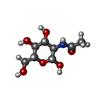
| #5: Polysaccharide | 2-acetamido-2-deoxy-beta-D-glucopyranose-(1-4)-2-acetamido-2-deoxy-beta-D-glucopyranose Source method: isolated from a genetically manipulated source #6: Polysaccharide | alpha-D-mannopyranose-(1-3)-alpha-D-mannopyranose-(1-6)-[alpha-D-mannopyranose-(1-3)]beta-D- ...alpha-D-mannopyranose-(1-3)-alpha-D-mannopyranose-(1-6)-[alpha-D-mannopyranose-(1-3)]beta-D-mannopyranose-(1-4)-2-acetamido-2-deoxy-beta-D-glucopyranose-(1-4)-2-acetamido-2-deoxy-beta-D-glucopyranose Source method: isolated from a genetically manipulated source #7: Sugar | ChemComp-NAG / | 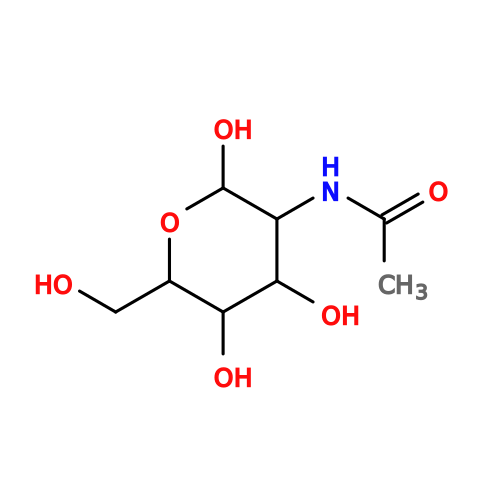 Type: D-saccharide, beta linking / Mass: 221.208 Da / Num. of mol.: 1 / Source method: obtained synthetically / Formula: C8H15NO6 Type: D-saccharide, beta linking / Mass: 221.208 Da / Num. of mol.: 1 / Source method: obtained synthetically / Formula: C8H15NO6 |
|---|
-Non-polymers , 3 types, 5 molecules 
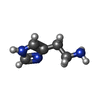

| #8: Chemical | ChemComp-ABU /  Mass: 103.120 Da / Num. of mol.: 1 / Source method: obtained synthetically / Formula: C4H9NO2 / Feature type: SUBJECT OF INVESTIGATION / Comment: neurotransmitter, inhibitor*YM Mass: 103.120 Da / Num. of mol.: 1 / Source method: obtained synthetically / Formula: C4H9NO2 / Feature type: SUBJECT OF INVESTIGATION / Comment: neurotransmitter, inhibitor*YM | ||
|---|---|---|---|
| #9: Chemical |  Mass: 111.145 Da / Num. of mol.: 3 / Source method: obtained synthetically / Formula: C5H9N3 Mass: 111.145 Da / Num. of mol.: 3 / Source method: obtained synthetically / Formula: C5H9N3#10: Water | ChemComp-HOH / | Mass: 18.015 Da / Num. of mol.: 1 / Source method: isolated from a natural source / Formula: H2O |
-Details
| Has ligand of interest | Y |
|---|---|
| Has protein modification | Y |
-Experimental details
-Experiment
| Experiment | Method: ELECTRON MICROSCOPY |
|---|---|
| EM experiment | Aggregation state: PARTICLE / 3D reconstruction method: single particle reconstruction |
- Sample preparation
| Component | Name: GABA-A receptor a3b3 (1:4) + a2NB77 + b3Mb125 + GABA / Type: COMPLEX / Entity ID: #1-#4 / Source: RECOMBINANT |
|---|---|
| Molecular weight | Value: 0.38 MDa / Experimental value: NO |
| Source (natural) | Organism: Homo sapiens (human) |
| Source (recombinant) | Organism: Homo sapiens (human) / Cell: Expi293F |
| Buffer solution | pH: 7.4 |
| Specimen | Embedding applied: NO / Shadowing applied: NO / Staining applied: NO / Vitrification applied: YES |
| Vitrification | Cryogen name: ETHANE |
- Electron microscopy imaging
| Experimental equipment |  Model: Titan Krios / Image courtesy: FEI Company |
|---|---|
| Microscopy | Model: TFS KRIOS |
| Electron gun | Electron source:  FIELD EMISSION GUN / Accelerating voltage: 300 kV / Illumination mode: SPOT SCAN FIELD EMISSION GUN / Accelerating voltage: 300 kV / Illumination mode: SPOT SCAN |
| Electron lens | Mode: DIFFRACTION / Nominal defocus max: 2500 nm / Nominal defocus min: 900 nm |
| Image recording | Electron dose: 51.5 e/Å2 / Film or detector model: GATAN K3 (6k x 4k) |
- Processing
| EM software | Name: PHENIX / Category: model refinement | ||||||||||||||||||||||||
|---|---|---|---|---|---|---|---|---|---|---|---|---|---|---|---|---|---|---|---|---|---|---|---|---|---|
| CTF correction | Type: PHASE FLIPPING AND AMPLITUDE CORRECTION | ||||||||||||||||||||||||
| 3D reconstruction | Resolution: 2.63 Å / Resolution method: FSC 0.143 CUT-OFF / Num. of particles: 102406 / Symmetry type: POINT | ||||||||||||||||||||||||
| Refinement | Highest resolution: 2.63 Å Stereochemistry target values: REAL-SPACE (WEIGHTED MAP SUM AT ATOM CENTERS) | ||||||||||||||||||||||||
| Refine LS restraints |
|
