 Movie
Movie Controller

[English] 日本語
 Yorodumi
- PDB-9q3i: Cryo-EM Structure of the Class II Cyclase Domain in the Bifunctio... -
+ Open data

- Basic information
| Entry | Database: PDB / ID: 9q3i | ||||||
|---|---|---|---|---|---|---|---|
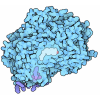
| Title | Cryo-EM Structure of the Class II Cyclase Domain in the Bifunctional Copalyl Diphosphate Synthase from Penicillium verruculosum | ||||||
 Components Components | Copalyl diphosphate synthase | ||||||
 Keywords Keywords | LYASE / Terpene / Natural products / Cyclization | ||||||
| Function / homology |  Function and homology information Function and homology informationcopalyl diphosphate synthase / copalyl diphosphate synthase activity / alcohol biosynthetic process / mycotoxin biosynthetic process / geranylgeranyl diphosphate synthase / geranylgeranyl diphosphate synthase activity / isoprenoid biosynthetic process / metal ion binding Similarity search - Function | ||||||
| Biological species |  Talaromyces verruculosus (fungus) Talaromyces verruculosus (fungus) | ||||||
| Method | ELECTRON MICROSCOPY / single particle reconstruction / cryo EM / Resolution: 2.9 Å | ||||||
 Authors Authors | Gaynes, M.N. / Christianson, D.W. | ||||||
| Funding support |  United States, 1items United States, 1items
| ||||||
 Citation Citation | Journal: bioRxiv / Year: 2025 Title: Cryo-EM Structure of the Cyclase Domain and Evaluation of Substrate Channeling in a Bifunctional Class II Terpene Synthase. Authors: Matthew N Gaynes / Kollin Schultz / Eliott S Wenger / Trey A Ronnebaum / Ronen Marmorstein / David W Christianson / Abstract: Copalyl diphosphate synthase from (PvCPS) is a bifunctional class II terpene synthase containing a prenyltransferase that produces geranylgeranyl diphosphate (GGPP) and a class II cyclase that ...Copalyl diphosphate synthase from (PvCPS) is a bifunctional class II terpene synthase containing a prenyltransferase that produces geranylgeranyl diphosphate (GGPP) and a class II cyclase that utilizes GGPP as a substrate to generate the bicyclic diterpene copalyl diphosphate. The various stereoisomers of copalyl diphosphate establish the greater family of labdane natural products, many of which have environmental and medicinal impact. Understanding structure-function relationships in class II diterpene synthases is crucial for guiding protein engineering campaigns aimed at the generation of diverse bicyclic diterpene scaffolds. However, only a limited number of structures are available for class II cyclases from bacteria, plants, and humans, and no structures are available for a class II cyclase from a fungus. Further, bifunctional class II terpene synthases have not been investigated with regard to substrate channeling between the prenyltransferase and the cyclase. Here, we report the 2.9 Å-resolution cryo-EM structure of the 63-kD class II cyclase domain from PvCPS. Comparisons with bacterial and plant copalyl diphosphate synthases reveal conserved residues that likely guide the formation of the bicyclic labdane core, but divergent catalytic dyads that mediate the final deprotonation step of catalysis. Substrate competition experiments reveal preferential GGPP transit from the PvCPS prenyltransferase to the cyclase, even when prepared as separate constructs. These results are consistent with a model in which transient prenyltransferase-cyclase association facilitates substrate channeling due to active site proximity. | ||||||
| History |
|
- Structure visualization
| Structure viewer | Molecule: MolmilJmol/JSmol |
|---|
- Downloads & links
-Download
| PDBx/mmCIF format | 9q3i.cif.gz | 116.3 KB | Display | PDBx/mmCIF format |
|---|---|---|---|---|
| PDB format | pdb9q3i.ent.gz | 78.1 KB | Display | PDB format |
| PDBx/mmJSON format | 9q3i.json.gz | Tree view | PDBx/mmJSON format | |
| Others |  Other downloads Other downloads |
-Validation report
| Arichive directory | https://data.pdbj.org/pub/pdb/validation_reports/q3/9q3iftp://data.pdbj.org/pub/pdb/validation_reports/q3/9q3i | HTTPS FTP |
|---|
-Related structure data
| Related structure data |  72194MC M: map data used to model this data C: citing same article ( |
|---|---|
| Similar structure data |
-Links
 PDBj
PDBj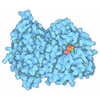
- Assembly
| Deposited unit | 
|
|---|---|
| 1 |
|
-Components
| #1: Protein | Mass: 110996.031 Da / Num. of mol.: 1 Source method: isolated from a genetically manipulated source Source: (gene. exp.) Talaromyces verruculosus (fungus) / Gene: PvCPS / Production host:   Escherichia coli BL21(DE3) (bacteria) Escherichia coli BL21(DE3) (bacteria)References: UniProt: A0A348FUE1, copalyl diphosphate synthase, geranylgeranyl diphosphate synthase |
|---|---|
| Has protein modification | N |
-Experimental details
-Experiment
| Experiment | Method: ELECTRON MICROSCOPY |
|---|---|
| EM experiment | Aggregation state: PARTICLE / 3D reconstruction method: single particle reconstruction |
- Sample preparation
| Component | Name: Copalyl diphosphate synthase / Type: COMPLEX / Entity ID: all / Source: RECOMBINANT | ||||||||||||||||||||
|---|---|---|---|---|---|---|---|---|---|---|---|---|---|---|---|---|---|---|---|---|---|
| Molecular weight | Value: 0.108 MDa / Experimental value: NO | ||||||||||||||||||||
| Source (natural) | Organism: Talaromyces verruculosus (fungus) | ||||||||||||||||||||
| Source (recombinant) | Organism: Escherichia coli BL21(DE3) (bacteria) | ||||||||||||||||||||
| Buffer solution | pH: 7.5 | ||||||||||||||||||||
| Buffer component |
| ||||||||||||||||||||
| Specimen | Conc.: 1 mg/ml / Embedding applied: NO / Shadowing applied: NO / Staining applied: NO / Vitrification applied: YES | ||||||||||||||||||||
| Specimen support | Grid material: COPPER / Grid mesh size: 300 divisions/in. / Grid type: Quantifoil R1.2/1.3 | ||||||||||||||||||||
| Vitrification | Instrument: FEI VITROBOT MARK IV / Cryogen name: ETHANE / Humidity: 100 % / Chamber temperature: 277 K |
- Electron microscopy imaging
| Experimental equipment |  Model: Titan Krios / Image courtesy: FEI Company |
|---|---|
| Microscopy | Model: TFS KRIOS |
| Electron gun | Electron source:  FIELD EMISSION GUN / Accelerating voltage: 300 kV / Illumination mode: FLOOD BEAM FIELD EMISSION GUN / Accelerating voltage: 300 kV / Illumination mode: FLOOD BEAM |
| Electron lens | Mode: BRIGHT FIELD / Nominal defocus max: 2500 nm / Nominal defocus min: 800 nm / Cs: 2.7 mm |
| Image recording | Average exposure time: 3.29 sec. / Electron dose: 33 e/Å2 / Film or detector model: GATAN K3 BIOQUANTUM (6k x 4k) / Num. of grids imaged: 1 / Num. of real images: 4100 |
- Processing
| EM software |
| ||||||||||||||||||||||||||||
|---|---|---|---|---|---|---|---|---|---|---|---|---|---|---|---|---|---|---|---|---|---|---|---|---|---|---|---|---|---|
| CTF correction | Type: PHASE FLIPPING AND AMPLITUDE CORRECTION | ||||||||||||||||||||||||||||
| Particle selection | Num. of particles selected: 1686323 | ||||||||||||||||||||||||||||
| 3D reconstruction | Resolution: 2.9 Å / Resolution method: FSC 0.143 CUT-OFF / Num. of particles: 381049 / Symmetry type: POINT | ||||||||||||||||||||||||||||
| Atomic model building | Source name: AlphaFold / Type: in silico model | ||||||||||||||||||||||||||||
| Refinement | Highest resolution: 2.9 Å Stereochemistry target values: REAL-SPACE (WEIGHTED MAP SUM AT ATOM CENTERS) | ||||||||||||||||||||||||||||
| Refine LS restraints |
|
