 Movie
Movie Controller


+ Open data

- Basic information
| Entry | Database: PDB / ID: 9puv | ||||||||||||||||||||||||
|---|---|---|---|---|---|---|---|---|---|---|---|---|---|---|---|---|---|---|---|---|---|---|---|---|---|
| Title | Insulin receptor bound to S961 | ||||||||||||||||||||||||
 Components Components |
| ||||||||||||||||||||||||
 Keywords Keywords | MEMBRANE PROTEIN / Antagonist / receptor tyrosine kinase | ||||||||||||||||||||||||
| Function / homology |  Function and homology information Function and homology informationregulation of female gonad development / positive regulation of meiotic cell cycle / insulin-like growth factor II binding / positive regulation of developmental growth / insulin receptor complex / insulin-like growth factor I binding / insulin receptor activity / positive regulation of protein-containing complex disassembly / adrenal gland development / dendritic spine maintenance ...regulation of female gonad development / positive regulation of meiotic cell cycle / insulin-like growth factor II binding / positive regulation of developmental growth / insulin receptor complex / insulin-like growth factor I binding / insulin receptor activity / positive regulation of protein-containing complex disassembly / adrenal gland development / dendritic spine maintenance / insulin binding / cargo receptor activity / Signaling by Insulin receptor / PTB domain binding / IRS activation / neuronal cell body membrane / positive regulation of respiratory burst / amyloid-beta clearance / heart morphogenesis / insulin receptor substrate binding / positive regulation of receptor internalization / regulation of embryonic development / positive regulation of glycogen biosynthetic process / Signal attenuation / protein kinase activator activity / phosphatidylinositol 3-kinase binding / transport across blood-brain barrier / Insulin receptor recycling / insulin-like growth factor receptor binding / neuron projection maintenance / positive regulation of mitotic nuclear division / receptor-mediated endocytosis / positive regulation of glycolytic process / Insulin receptor signalling cascade / male gonad development / learning / dendrite membrane / positive regulation of D-glucose import across plasma membrane / receptor protein-tyrosine kinase / memory / caveola / insulin receptor signaling pathway / positive regulation of nitric oxide biosynthetic process / glucose homeostasis / cellular response to insulin stimulus / late endosome / protein autophosphorylation / amyloid-beta binding / PI5P, PP2A and IER3 Regulate PI3K/AKT Signaling / protein tyrosine kinase activity / positive regulation of phosphatidylinositol 3-kinase/protein kinase B signal transduction / positive regulation of MAPK cascade / positive regulation of canonical NF-kappaB signal transduction / signaling receptor complex / lysosome / endosome membrane / positive regulation of cell migration / G protein-coupled receptor signaling pathway / external side of plasma membrane / protein domain specific binding / axon / positive regulation of cell population proliferation / symbiont entry into host cell / regulation of DNA-templated transcription / positive regulation of DNA-templated transcription / GTP binding / protein-containing complex binding / extracellular exosome / ATP binding / membrane / identical protein binding / plasma membrane Similarity search - Function | ||||||||||||||||||||||||
| Biological species |  Homo sapiens (human) Homo sapiens (human) Phage #D (virus) Phage #D (virus) | ||||||||||||||||||||||||
| Method | ELECTRON MICROSCOPY / single particle reconstruction / cryo EM / Resolution: 3.68 Å | ||||||||||||||||||||||||
 Authors Authors | Vogel, A. / Blakely, A. / Hill, C.P. | ||||||||||||||||||||||||
| Funding support |  United States, 1items United States, 1items
| ||||||||||||||||||||||||
 Citation Citation | Journal: Nat Commun / Year: 2026 Title: Structural basis of insulin receptor antagonism by bivalent site 1-site 2 ligands S961 and Ins-AC-S2. Authors: Amber Vogel / Alan Blakely / Yuankun Dao / Nai-Pin Lin / Danny Chou / Christopher P Hill / Abstract: Congenital hyperinsulinism is a rare genetic disease characterized by overproduction of insulin. One class of potential treatments is insulin receptor antagonists like S961 and Ins-AC-S2, which ...Congenital hyperinsulinism is a rare genetic disease characterized by overproduction of insulin. One class of potential treatments is insulin receptor antagonists like S961 and Ins-AC-S2, which comprise segments for binding each of the two insulin-binding sites (site 1 and site 2) on the receptor. Notably, S597 - containing the same receptor binding segments as S961 but in the opposite order (site 2-site 1) - is an insulin receptor agonist rather than an antagonist. Using cryo-EM, we show how both S961 and Ins-AC-S2 bind an inactive conformation of the receptor, thereby explaining their antagonism. Furthermore, our structures reveal how agonist vs. antagonist activity is influenced by the order of site 1- and site 2-binding modules in bivalent ligands. Additionally, we show subtle differences between the receptor-binding mechanisms of S961 and Ins-AC-S2, which include displacement or engagement of αCT, and a binding interface between the Ins-AC-S2 insulin and the receptor FnIII-2/insert domains. These structural insights may inform development of next generation insulin receptor antagonists for treatment of congenital hyperinsulinism. #1: Journal: Proc Natl Acad Sci U S A / Year: 2026Title: Structural basis of transcription-coupled RNA damage by incorporation of oxidized ribonucleotides. Authors: Peini Hou / Chanjoo Lee / Jenny Chong / Juntaek Oh / Dong Wang /  Abstract: Oxidative stress induces damage to DNA, RNA, and nucleotide pools. Unlike well-studied DNA damage, the formation of RNA damage and the impact of an oxidized ribonucleotide pool on transcription ...Oxidative stress induces damage to DNA, RNA, and nucleotide pools. Unlike well-studied DNA damage, the formation of RNA damage and the impact of an oxidized ribonucleotide pool on transcription fidelity are poorly understood. Here, we investigate the structural basis of transcription-coupled RNA damage and the effect of 8-oxo-guanosine triphosphate (8-oxo-rGTP) on RNA polymerase II (Pol II) transcription fidelity control steps. We revealed that the incorporation efficiency of 8-oxo-rGTP opposite a dC template is comparable to that of GTP. In contrast, the incorporation efficiency of 8-oxo-rGTP opposite a dA template is ~150-fold more efficient than that of GTP. For the extension step, Pol II extends substantially faster from a 3'-8-oxo-rG:dC base pair than from a 3'-8-oxo-rG:dA base pair. For the proofreading step, strikingly, Pol II EC with 3'-8-oxo-rG:dA base pair is much more resistant to backtracking and proofreading than Pol II EC with 3'-8-oxo-rG:dC base pair. Using X-ray crystallography, we revealed that 8-oxo-rGTP adopts different prechemistry binding sites depending on whether it is paired with a dC or a dA template. Upon incorporation, the nucleobase of 8-oxo-rG flips to the -conformation to form a Hoogsteen pair with a dA template, whereas it remains in the -conformation to form a Watson-Crick pair with a dC template. Collectively, our work demonstrates that nucleotide-pool oxidation can directly affect Pol II fidelity control steps and elongation dynamics and induce RNA damage in a transcription-coupled manner. | ||||||||||||||||||||||||
| History |
|
- Structure visualization
| Structure viewer | Molecule: MolmilJmol/JSmol |
|---|
- Downloads & links
-Download
| PDBx/mmCIF format | 9puv.cif.gz | 569 KB | Display | PDBx/mmCIF format |
|---|---|---|---|---|
| PDB format | pdb9puv.ent.gz | 460.3 KB | Display | PDB format |
| PDBx/mmJSON format | 9puv.json.gz | Tree view | PDBx/mmJSON format | |
| Others |  Other downloads Other downloads |
-Validation report
| Arichive directory | https://data.pdbj.org/pub/pdb/validation_reports/pu/9puvftp://data.pdbj.org/pub/pdb/validation_reports/pu/9puv | HTTPS FTP |
|---|
-Related structure data
| Related structure data |  71877MC  9puwC  9pvoC M: map data used to model this data C: citing same article ( |
|---|---|
| Similar structure data |


-Links
 PDBj
PDBj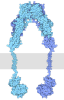
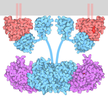
- Assembly
| Deposited unit | 
|
|---|---|
| 1 |
|
-Components
| #1: Protein | Mass: 156081.453 Da / Num. of mol.: 2 Source method: isolated from a genetically manipulated source Source: (gene. exp.) Homo sapiens (human) / Gene: INSR / Production host: Homo sapiens (human)References: UniProt: P06213, receptor protein-tyrosine kinase #2: Protein/peptide | Mass: 4806.093 Da / Num. of mol.: 2 / Source method: obtained synthetically / Source: (synth.) Phage #D (virus)Has protein modification | Y | |
|---|
-Experimental details
-Experiment
| Experiment | Method: ELECTRON MICROSCOPY |
|---|---|
| EM experiment | Aggregation state: PARTICLE / 3D reconstruction method: single particle reconstruction |
- Sample preparation
| Component | Name: Insulin Receptor-A isoform complexed with two S961 molecules. Type: COMPLEX / Entity ID: all / Source: MULTIPLE SOURCES |
|---|---|
| Source (natural) | Organism: Homo sapiens (human) |
| Source (recombinant) | Organism: Homo sapiens (human) / Cell: HEK293 |
| Buffer solution | pH: 7.5 |
| Specimen | Embedding applied: NO / Shadowing applied: NO / Staining applied: NO / Vitrification applied: YES |
| Vitrification | Cryogen name: ETHANE |
- Electron microscopy imaging
| Experimental equipment |  Model: Titan Krios / Image courtesy: FEI Company |
|---|---|
| Microscopy | Model: TFS KRIOS |
| Electron gun | Electron source:  FIELD EMISSION GUN / Accelerating voltage: 300 kV / Illumination mode: OTHER FIELD EMISSION GUN / Accelerating voltage: 300 kV / Illumination mode: OTHER |
| Electron lens | Mode: BRIGHT FIELD / Nominal defocus max: 2200 nm / Nominal defocus min: 800 nm |
| Image recording | Electron dose: 50 e/Å2 / Film or detector model: GATAN K3 BIOQUANTUM (6k x 4k) |
- Processing
| EM software |
| |||||||||
|---|---|---|---|---|---|---|---|---|---|---|
| CTF correction | Type: NONE | |||||||||
| 3D reconstruction | Resolution: 3.68 Å / Resolution method: FSC 0.143 CUT-OFF / Num. of particles: 378182 / Symmetry type: POINT |
