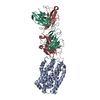
Movie
Movie Controller


+ Open data

- Basic information
| Entry | Database: PDB / ID: 9pro | |||||||||||||||||||||||||||||||||||||||
|---|---|---|---|---|---|---|---|---|---|---|---|---|---|---|---|---|---|---|---|---|---|---|---|---|---|---|---|---|---|---|---|---|---|---|---|---|---|---|---|---|
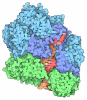
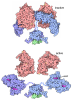
| Title | Human 19S proteasome bound to TXNL1 PITH domain and PSMD5 | |||||||||||||||||||||||||||||||||||||||
 Components Components |
| |||||||||||||||||||||||||||||||||||||||
 Keywords Keywords | HYDROLASE / Proteasome / 19S / RP / TXNL1 / PSMD5 | |||||||||||||||||||||||||||||||||||||||
| Function / homology |  Function and homology information Function and homology informationproteasome regulatory particle assembly / disulfide oxidoreductase activity / positive regulation of inclusion body assembly / thyrotropin-releasing hormone receptor binding / nuclear proteasome complex / host-mediated perturbation of viral transcription / Impaired BRCA2 translocation to the nucleus / Impaired BRCA2 binding to SEM1 (DSS1) / proteasome accessory complex / integrator complex ...proteasome regulatory particle assembly / disulfide oxidoreductase activity / positive regulation of inclusion body assembly / thyrotropin-releasing hormone receptor binding / nuclear proteasome complex / host-mediated perturbation of viral transcription / Impaired BRCA2 translocation to the nucleus / Impaired BRCA2 binding to SEM1 (DSS1) / proteasome accessory complex / integrator complex / cytosolic proteasome complex / proteasome regulatory particle / positive regulation of proteasomal protein catabolic process / transcription factor binding / transcription export complex 2 / proteasome-activating activity / RND1 GTPase cycle / RND2 GTPase cycle / RND3 GTPase cycle / proteasome regulatory particle, lid subcomplex / RHOBTB1 GTPase cycle / RHOV GTPase cycle / metal-dependent deubiquitinase activity / Regulation of ornithine decarboxylase (ODC) / Proteasome assembly / cellular response to type I interferon / Cross-presentation of soluble exogenous antigens (endosomes) / retrograde vesicle-mediated transport, Golgi to endoplasmic reticulum / Somitogenesis / protein K63-linked deubiquitination / K63-linked deubiquitinase activity / Homologous DNA Pairing and Strand Exchange / Defective homologous recombination repair (HRR) due to BRCA1 loss of function / Defective HDR through Homologous Recombination Repair (HRR) due to PALB2 loss of BRCA1 binding function / Defective HDR through Homologous Recombination Repair (HRR) due to PALB2 loss of BRCA2/RAD51/RAD51C binding function / Resolution of D-loop Structures through Synthesis-Dependent Strand Annealing (SDSA) / Resolution of D-loop Structures through Holliday Junction Intermediates / proteasome binding / RHOU GTPase cycle / Impaired BRCA2 binding to RAD51 / protein-disulfide reductase activity / positive regulation of RNA polymerase II transcription preinitiation complex assembly / general transcription initiation factor binding / Presynaptic phase of homologous DNA pairing and strand exchange / protein deubiquitination / negative regulation of programmed cell death / endopeptidase activator activity / RHOBTB2 GTPase cycle / mRNA export from nucleus / proteasome assembly / SARS-CoV-1 targets host intracellular signalling and regulatory pathways / enzyme regulator activity / regulation of macroautophagy / stem cell differentiation / ERAD pathway / proteasome storage granule / inclusion body / proteasome complex / TBP-class protein binding / regulation of proteasomal protein catabolic process / double-strand break repair via nonhomologous end joining / Regulation of activated PAK-2p34 by proteasome mediated degradation / ubiquitin binding / proteasomal protein catabolic process / Autodegradation of Cdh1 by Cdh1:APC/C / APC/C:Cdc20 mediated degradation of Securin / N-glycan trimming in the ER and Calnexin/Calreticulin cycle / Asymmetric localization of PCP proteins / Ubiquitin-dependent degradation of Cyclin D / SCF-beta-TrCP mediated degradation of Emi1 / AUF1 (hnRNP D0) binds and destabilizes mRNA / NIK-->noncanonical NF-kB signaling / P-body / TNFR2 non-canonical NF-kB pathway / Assembly of the pre-replicative complex / Vpu mediated degradation of CD4 / Cdc20:Phospho-APC/C mediated degradation of Cyclin A / double-strand break repair via homologous recombination / Dectin-1 mediated noncanonical NF-kB signaling / Degradation of DVL / Degradation of AXIN / Degradation of CRY and PER proteins / Hh mutants are degraded by ERAD / Activation of NF-kappaB in B cells / G2/M Checkpoints / Degradation of GLI1 by the proteasome / Hedgehog ligand biogenesis / Regulation of RUNX3 expression and activity / Autodegradation of the E3 ubiquitin ligase COP1 / Defective CFTR causes cystic fibrosis / GSK3B and BTRC:CUL1-mediated-degradation of NFE2L2 / osteoblast differentiation / Negative regulation of NOTCH4 signaling / AMPK-induced ERAD and lysosome mediated degradation of PD-L1(CD274) / Hedgehog 'on' state / APC/C:Cdh1 mediated degradation of Cdc20 and other APC/C:Cdh1 targeted proteins in late mitosis/early G1 / Vif-mediated degradation of APOBEC3G / FBXL7 down-regulates AURKA during mitotic entry and in early mitosis / Degradation of GLI2 by the proteasome / GLI3 is processed to GLI3R by the proteasome Similarity search - Function | |||||||||||||||||||||||||||||||||||||||
| Biological species |  Homo sapiens (human) Homo sapiens (human) | |||||||||||||||||||||||||||||||||||||||
| Method | ELECTRON MICROSCOPY / single particle reconstruction / cryo EM / Resolution: 4.07 Å | |||||||||||||||||||||||||||||||||||||||
 Authors Authors | Chen, X. / Negi, H. / Walters, K.J. | |||||||||||||||||||||||||||||||||||||||
| Funding support |  United States, 1items United States, 1items
| |||||||||||||||||||||||||||||||||||||||
 Citation Citation | Journal: Mol Cell / Year: 2026 Title: Structures of dynamic interactors at native proteasomes by PhIX-MS and cryo-electron microscopy. Authors: Kitaik Lee / Hitendra Negi / Xiang Chen / Katerina Atallah-Yunes / Sophia Truslow / Rithik E Castelino / Mary R Guest / Anthony M Ciancone / Xiuxiu Lu / Sergey G Tarasov / Raj Chari / Kylie ...Authors: Kitaik Lee / Hitendra Negi / Xiang Chen / Katerina Atallah-Yunes / Sophia Truslow / Rithik E Castelino / Mary R Guest / Anthony M Ciancone / Xiuxiu Lu / Sergey G Tarasov / Raj Chari / Kylie J Walters / Francis J O'Reilly / Abstract: Molecular machines rely on dynamic, low-affinity interactions to perform their functional roles. We developed PhIX-MS (photo-induced in situ crosslinking-mass spectrometry), a structural proteomics ...Molecular machines rely on dynamic, low-affinity interactions to perform their functional roles. We developed PhIX-MS (photo-induced in situ crosslinking-mass spectrometry), a structural proteomics workflow to capture topological information for such transient interactions in cells by UV-activated crosslinking. Applying PhIX-MS with cryo-electron microscopy (cryo-EM) to proteasomes, we mapped the redox sensor TXNL1 at the proteasome regulatory particle (RP), including its dynamic thioredoxin-like domain near RPN2/PSMD1 and RPN13/ADRM1, where it is ideal for reducing substrates prior to proteolysis. RPs without the proteolytic core particle (CP) were structurally resolved while bound to TXNL1 and/or the chaperone PSMD5/S5b, which inserts its C terminus into the ATPase pore, causing extensive structural rearrangements. Additionally, PhIX-MS and AlphaFold identified the ubiquitin ligase UBE3C/Hul5 at RPN2, RPN3, and a dynamic RPN10 region, tethering UBE3C above the substrate entry channel. Our integrative approach enables the localization of native, low-affinity protein interactions and is broadly applicable to dynamic macromolecular assemblies. | |||||||||||||||||||||||||||||||||||||||
| History |
|
- Structure visualization
| Structure viewer | Molecule: MolmilJmol/JSmol |
|---|
- Downloads & links
-Download
| PDBx/mmCIF format | 9pro.cif.gz | 1.3 MB | Display | PDBx/mmCIF format |
|---|---|---|---|---|
| PDB format | pdb9pro.ent.gz | Display | PDB format | |
| PDBx/mmJSON format | 9pro.json.gz | Tree view | PDBx/mmJSON format | |
| Others |  Other downloads Other downloads |
-Validation report
| Arichive directory | https://data.pdbj.org/pub/pdb/validation_reports/pr/9proftp://data.pdbj.org/pub/pdb/validation_reports/pr/9pro | HTTPS FTP |
|---|
-Related structure data
| Related structure data |  71810MC  12bmC  9pmjC  9pmoC  9pmqC  9prtC C: citing same article ( M: map data used to model this data |
|---|---|
| Similar structure data |


-Links
 PDBj
PDBj

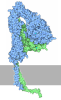
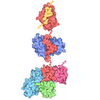
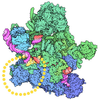
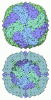
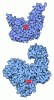
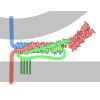
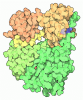
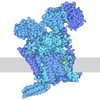
- Assembly
| Deposited unit | 
|
|---|---|
| 1 |
|
-Components
-Protein , 20 types, 20 molecules ABCDEFUVWXYZabcdefgz
| #1: Protein | Mass: 48700.805 Da / Num. of mol.: 1 Source method: isolated from a genetically manipulated source Source: (gene. exp.) Homo sapiens (human) / Gene: PSMC2, MSS1 / Production host: Homo sapiens (human) / References: UniProt: P35998 |
|---|---|
| #2: Protein | Mass: 49260.504 Da / Num. of mol.: 1 Source method: isolated from a genetically manipulated source Source: (gene. exp.) Homo sapiens (human) / Gene: PSMC1 / Production host: Homo sapiens (human) / References: UniProt: P62191 |
| #3: Protein | Mass: 45694.047 Da / Num. of mol.: 1 Source method: isolated from a genetically manipulated source Source: (gene. exp.) Homo sapiens (human) / Gene: PSMC5, SUG1 / Production host: Homo sapiens (human) / References: UniProt: P62195 |
| #4: Protein | Mass: 47426.141 Da / Num. of mol.: 1 Source method: isolated from a genetically manipulated source Source: (gene. exp.) Homo sapiens (human) / Gene: PSMC4, MIP224, TBP7 / Production host: Homo sapiens (human) / References: UniProt: P43686 |
| #5: Protein | Mass: 44241.008 Da / Num. of mol.: 1 Source method: isolated from a genetically manipulated source Source: (gene. exp.) Homo sapiens (human) / Gene: PSMC6, SUG2 / Production host: Homo sapiens (human) / References: UniProt: P62333 |
| #6: Protein | Mass: 49266.457 Da / Num. of mol.: 1 Source method: isolated from a genetically manipulated source Source: (gene. exp.) Homo sapiens (human) / Gene: PSMC3, TBP1 / Production host: Homo sapiens (human) / References: UniProt: P17980 |
| #7: Protein | Mass: 105958.234 Da / Num. of mol.: 1 Source method: isolated from a genetically manipulated source Source: (gene. exp.) Homo sapiens (human) / Gene: PSMD1 / Production host: Homo sapiens (human) / References: UniProt: Q99460 |
| #8: Protein | Mass: 61066.500 Da / Num. of mol.: 1 Source method: isolated from a genetically manipulated source Source: (gene. exp.) Homo sapiens (human) / Gene: PSMD3 / Production host: Homo sapiens (human) / References: UniProt: O43242 |
| #9: Protein | Mass: 52979.359 Da / Num. of mol.: 1 Source method: isolated from a genetically manipulated source Source: (gene. exp.) Homo sapiens (human) / Gene: PSMD12 / Production host: Homo sapiens (human) / References: UniProt: O00232 |
| #10: Protein | Mass: 47526.688 Da / Num. of mol.: 1 Source method: isolated from a genetically manipulated source Source: (gene. exp.) Homo sapiens (human) / Gene: PSMD11 / Production host: Homo sapiens (human) / References: UniProt: O00231 |
| #11: Protein | Mass: 45592.285 Da / Num. of mol.: 1 Source method: isolated from a genetically manipulated source Source: (gene. exp.) Homo sapiens (human) / Gene: PSMD6, KIAA0107, PFAAP4 / Production host: Homo sapiens (human) / References: UniProt: Q15008 |
| #12: Protein | Mass: 37086.441 Da / Num. of mol.: 1 Source method: isolated from a genetically manipulated source Source: (gene. exp.) Homo sapiens (human) / Gene: PSMD7, MOV34L / Production host: Homo sapiens (human) / References: UniProt: P51665 |
| #13: Protein | Mass: 42995.359 Da / Num. of mol.: 1 Source method: isolated from a genetically manipulated source Source: (gene. exp.) Homo sapiens (human) / Gene: PSMD13 / Production host: Homo sapiens (human) / References: UniProt: Q9UNM6 |
| #14: Protein | Mass: 40781.590 Da / Num. of mol.: 1 Source method: isolated from a genetically manipulated source Source: (gene. exp.) Homo sapiens (human) / Gene: PSMD4, MCB1 / Production host: Homo sapiens (human) / References: UniProt: P55036 |
| #15: Protein | Mass: 34620.023 Da / Num. of mol.: 1 Source method: isolated from a genetically manipulated source Source: (gene. exp.) Homo sapiens (human) / Gene: PSMD14, POH1 / Production host: Homo sapiens (human)References: UniProt: O00487, Hydrolases; Acting on peptide bonds (peptidases); Omega peptidases |
| #16: Protein | Mass: 39667.871 Da / Num. of mol.: 1 Source method: isolated from a genetically manipulated source Source: (gene. exp.) Homo sapiens (human) / Gene: PSMD8 / Production host: Homo sapiens (human) / References: UniProt: P48556 |
| #17: Protein | Mass: 8284.611 Da / Num. of mol.: 1 Source method: isolated from a genetically manipulated source Source: (gene. exp.) Homo sapiens (human) / Gene: SEM1, C7orf76, DSS1, SHFDG1, SHFM1 / Production host: Homo sapiens (human) / References: UniProt: P60896 |
| #18: Protein | Mass: 100313.625 Da / Num. of mol.: 1 Source method: isolated from a genetically manipulated source Source: (gene. exp.) Homo sapiens (human) / Gene: PSMD2, TRAP2 / Production host: Homo sapiens (human) / References: UniProt: Q13200 |
| #19: Protein | Mass: 32284.229 Da / Num. of mol.: 1 Source method: isolated from a genetically manipulated source Source: (gene. exp.) Homo sapiens (human) / Gene: TXNL1, TRP32, TXL, TXNL / Production host: Homo sapiens (human) / References: UniProt: O43396 |
| #20: Protein | Mass: 56253.441 Da / Num. of mol.: 1 Source method: isolated from a genetically manipulated source Source: (gene. exp.) Homo sapiens (human) / Gene: PSMD5, KIAA0072 / Production host: Homo sapiens (human) / References: UniProt: Q16401 |
-Non-polymers , 4 types, 9 molecules 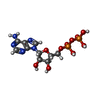
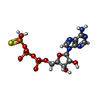


| #21: Chemical | 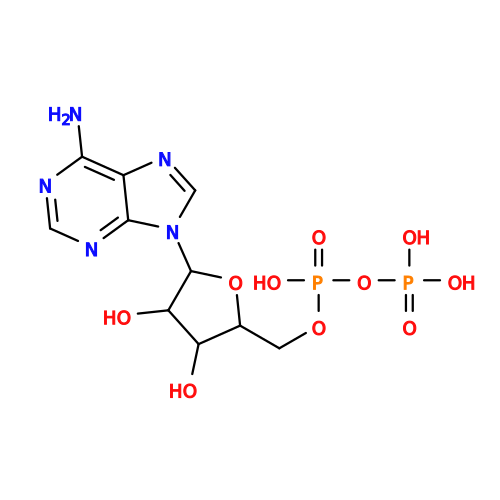 Mass: 427.201 Da / Num. of mol.: 2 / Source method: obtained synthetically / Formula: C10H15N5O10P2 / Feature type: SUBJECT OF INVESTIGATION / Comment: ADP, energy-carrying molecule*YM Mass: 427.201 Da / Num. of mol.: 2 / Source method: obtained synthetically / Formula: C10H15N5O10P2 / Feature type: SUBJECT OF INVESTIGATION / Comment: ADP, energy-carrying molecule*YM#22: Chemical | 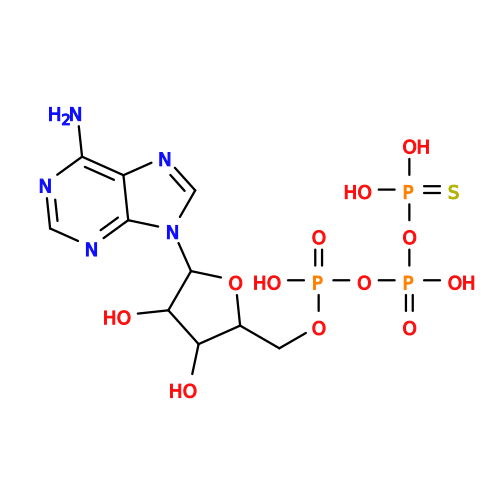 Mass: 523.247 Da / Num. of mol.: 3 / Source method: obtained synthetically / Formula: C10H16N5O12P3S / Feature type: SUBJECT OF INVESTIGATION / Comment: ATP-gamma-S, energy-carrying molecule analogue*YM Mass: 523.247 Da / Num. of mol.: 3 / Source method: obtained synthetically / Formula: C10H16N5O12P3S / Feature type: SUBJECT OF INVESTIGATION / Comment: ATP-gamma-S, energy-carrying molecule analogue*YM#23: Chemical |  Mass: 24.305 Da / Num. of mol.: 3 / Source method: obtained synthetically / Formula: Mg / Feature type: SUBJECT OF INVESTIGATION Mass: 24.305 Da / Num. of mol.: 3 / Source method: obtained synthetically / Formula: Mg / Feature type: SUBJECT OF INVESTIGATION#24: Chemical | ChemComp-ZN / |  Mass: 65.409 Da / Num. of mol.: 1 / Source method: obtained synthetically / Formula: Zn / Feature type: SUBJECT OF INVESTIGATION Mass: 65.409 Da / Num. of mol.: 1 / Source method: obtained synthetically / Formula: Zn / Feature type: SUBJECT OF INVESTIGATION |
|---|
-Details
| Has ligand of interest | Y |
|---|---|
| Has protein modification | Y |
-Experimental details
-Experiment
| Experiment | Method: ELECTRON MICROSCOPY |
|---|---|
| EM experiment | Aggregation state: PARTICLE / 3D reconstruction method: single particle reconstruction |
- Sample preparation
| Component | Name: Human proteasome from HCT116 cells / Type: COMPLEX / Entity ID: #1-#20 / Source: RECOMBINANT | ||||||||||||||||||||||||||||||
|---|---|---|---|---|---|---|---|---|---|---|---|---|---|---|---|---|---|---|---|---|---|---|---|---|---|---|---|---|---|---|---|
| Molecular weight | Value: 1 MDa / Experimental value: NO | ||||||||||||||||||||||||||||||
| Source (natural) | Organism: Homo sapiens (human) | ||||||||||||||||||||||||||||||
| Source (recombinant) | Organism: Homo sapiens (human) | ||||||||||||||||||||||||||||||
| Buffer solution | pH: 7.5 Details: 50 mM Tris [pH7.5], 50 mM NaCl, 1.5 mM ATP-gamma-S, 5 mM MgCl2 and 2 mM DTT | ||||||||||||||||||||||||||||||
| Buffer component |
| ||||||||||||||||||||||||||||||
| Specimen | Conc.: 0.75 mg/ml / Embedding applied: NO / Shadowing applied: NO / Staining applied: NO / Vitrification applied: YES Details: Quantifoil copper R 1.2/1.3 holey carbon 300 mesh grids (#Q3100CR1.3; Electron Microscopy Sciences). | ||||||||||||||||||||||||||||||
| Specimen support | Details: 25 mA / Grid material: COPPER / Grid mesh size: 300 divisions/in. / Grid type: Quantifoil R1.2/1.3 | ||||||||||||||||||||||||||||||
| Vitrification | Instrument: LEICA EM GP / Cryogen name: ETHANE / Humidity: 85 % / Chamber temperature: 295.15 K |
- Electron microscopy imaging
| Experimental equipment | 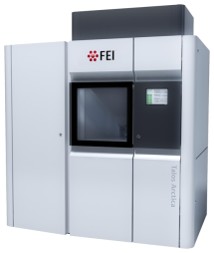 Model: Talos Arctica / Image courtesy: FEI Company |
|---|---|
| Microscopy | Model: FEI TALOS ARCTICA |
| Electron gun | Electron source:  FIELD EMISSION GUN / Accelerating voltage: 200 kV / Illumination mode: FLOOD BEAM FIELD EMISSION GUN / Accelerating voltage: 200 kV / Illumination mode: FLOOD BEAM |
| Electron lens | Mode: BRIGHT FIELD / Nominal magnification: 100000 X / Nominal defocus max: 2000 nm / Nominal defocus min: 800 nm / Cs: 2.7 mm |
| Specimen holder | Cryogen: NITROGEN / Specimen holder model: FEI TITAN KRIOS AUTOGRID HOLDER |
| Image recording | Average exposure time: 2.5 sec. / Electron dose: 55.6 e/Å2 / Film or detector model: GATAN K3 (6k x 4k) / Num. of real images: 40 |
| EM imaging optics | Energyfilter name: GIF Bioquantum |
| Image scans | Width: 5760 / Height: 4092 |
- Processing
| EM software |
| |||||||||||||||||||||||||||||||||||||||||||||||||||||||||||||||||||||||||||||||||||||||||||||||||||||||
|---|---|---|---|---|---|---|---|---|---|---|---|---|---|---|---|---|---|---|---|---|---|---|---|---|---|---|---|---|---|---|---|---|---|---|---|---|---|---|---|---|---|---|---|---|---|---|---|---|---|---|---|---|---|---|---|---|---|---|---|---|---|---|---|---|---|---|---|---|---|---|---|---|---|---|---|---|---|---|---|---|---|---|---|---|---|---|---|---|---|---|---|---|---|---|---|---|---|---|---|---|---|---|---|---|
| CTF correction | Type: PHASE FLIPPING AND AMPLITUDE CORRECTION | |||||||||||||||||||||||||||||||||||||||||||||||||||||||||||||||||||||||||||||||||||||||||||||||||||||||
| Particle selection | Num. of particles selected: 1504498 | |||||||||||||||||||||||||||||||||||||||||||||||||||||||||||||||||||||||||||||||||||||||||||||||||||||||
| 3D reconstruction | Resolution: 4.07 Å / Resolution method: FSC 0.143 CUT-OFF / Num. of particles: 54253 / Symmetry type: POINT | |||||||||||||||||||||||||||||||||||||||||||||||||||||||||||||||||||||||||||||||||||||||||||||||||||||||
| Atomic model building | B value: 89 / Protocol: RIGID BODY FIT / Space: REAL / Target criteria: Cross-correlation coefficient | |||||||||||||||||||||||||||||||||||||||||||||||||||||||||||||||||||||||||||||||||||||||||||||||||||||||
| Atomic model building | 3D fitting-ID: 1
|