[English] 日本語
Yorodumi
- PDB-9p0j: Human liver phosphofructokinase-1 bound to XJ-4-85 -

+
Open data


ID or keywords:

Loading...

-
Basic information

Entry
Database: PDB / ID: 9p0j
TitleHuman liver phosphofructokinase-1 bound to XJ-4-85
ComponentsATP-dependent 6-phosphofructokinase, liver type
KeywordsTRANSFERASE / phosphofructokinase-1 / liver / PFKL / activator
Function / homology
Function and homology information


6-phosphofructokinase complex / 6-phosphofructokinase / fructose binding / 6-phosphofructokinase activity / fructose-6-phosphate binding / fructose 1,6-bisphosphate metabolic process / fructose 6-phosphate metabolic process / Glycolysis / canonical glycolysis / response to glucose ...6-phosphofructokinase complex / 6-phosphofructokinase / fructose binding / 6-phosphofructokinase activity / fructose-6-phosphate binding / fructose 1,6-bisphosphate metabolic process / fructose 6-phosphate metabolic process / Glycolysis / canonical glycolysis / response to glucose / glycolytic process / kinase binding / secretory granule lumen / ficolin-1-rich granule lumen / Neutrophil degranulation / extracellular exosome / extracellular region / ATP binding / membrane / identical protein binding / cytosol
Similarity search - Function
ATP-dependent 6-phosphofructokinase, vertebrate-type / ATP-dependent 6-phosphofructokinase, eukaryotic-type / Phosphofructokinase, conserved site / Phosphofructokinase signature. / Phosphofructokinase domain / ATP-dependent 6-phosphofructokinase / Phosphofructokinase superfamily / Phosphofructokinase
Similarity search - Domain/homology
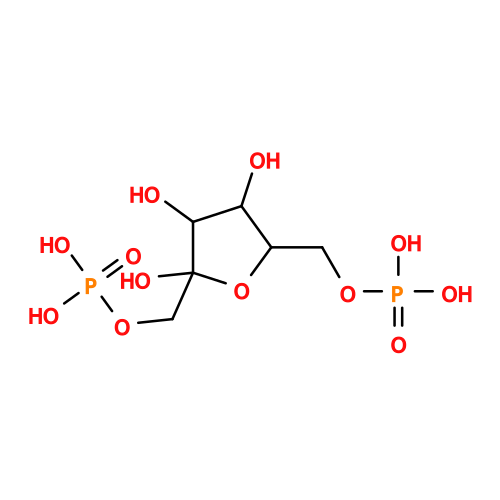
: / : / ADENOSINE-5'-DIPHOSPHATE / 6-O-phosphono-beta-D-fructofuranose / 1,6-di-O-phosphono-beta-D-fructofuranose / ATP-dependent 6-phosphofructokinase, liver type
Similarity search - Component
Biological speciesHomo sapiens (human)
MethodELECTRON MICROSCOPY / single particle reconstruction / cryo EM / Resolution: 3.2 Å
AuthorsLynch, E.M. / Jiang, X. / Hsu, K.-L. / Kollman, J.M.
Funding support United States, 2items
OrganizationGrant numberCountry
National Institutes of Health/National Institute of General Medical Sciences (NIH/NIGMS)R35GM149542 United States
National Institutes of Health/Office of the DirectorS10OD023476 United States
CitationJournal: Nat Chem Biol / Year: 2026
Title: A covalent PFKL activator suppresses tumor growth.
Authors: Xiaoding Jiang / Eric M Lynch / Congcong Lyu / Crystal N Wilson / Lauren E Salay / Hayden T Hess / Scott N Lyons / Mu-Jie Lu / Shuangyu Luo / Gibae Kim / Hsin-Ru Chan / Wesley J Wolfe / ...Authors: Xiaoding Jiang / Eric M Lynch / Congcong Lyu / Crystal N Wilson / Lauren E Salay / Hayden T Hess / Scott N Lyons / Mu-Jie Lu / Shuangyu Luo / Gibae Kim / Hsin-Ru Chan / Wesley J Wolfe / Lauren G Zacharias / Thomas P Mathews / Yi-Chih Lin / Bradley A Webb / Justin M Kollman / Xiaolu A Cambronne / Ku-Lung Hsu /
Abstract: Glycolysis fuels vital cellular functions, and its dysregulation has been implicated in cancer, neurodegeneration, antibiotic resistance and diabetes. The glycolytic dependency of cancer, known as ...Glycolysis fuels vital cellular functions, and its dysregulation has been implicated in cancer, neurodegeneration, antibiotic resistance and diabetes. The glycolytic dependency of cancer, known as the Warburg effect, represents a key vulnerability for development of targeted anticancer agents; however, the development of such agents remains challenging owing to metabolic heterogeneity and resistance. Here we developed a covalent phosphofructokinase-1 liver type (PFKL) activator that couples glycolytic activation with delivery of a cytotoxic carnitine palmitoyltransferase 2 (CPT2)-targeting payload to cancer cells in vitro and in vivo. The electrophile-drug conjugate site-specifically and proteome-wide selectively modifies K677 in the allosteric effector site to stabilize the R-state tetramer of PFKL, while concomitantly releasing a CPT2-selective inhibitor to destabilize cell metabolism. The delivery mechanism of electrophile-drug conjugates is analogous to that of antibody-drug conjugates, but differentiated by their selective covalent targeting of intracellular proteins.
History
DepositionJun 6, 2025Deposition site: RCSB / Processing site: RCSB
Revision 1.0Sep 23, 2026Provider: repository / Type: Initial release
Revision 1.0Sep 23, 2026Data content type: EM metadata / Data content type: EM metadata / Provider: repository / Type: Initial release

-
Structure visualization

Structure viewerMolecule:
MolmilJmol/JSmol

Downloads & links

-
Assembly

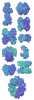
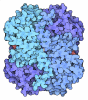
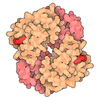
Deposited unit
A: ATP-dependent 6-phosphofructokinase, liver type
hetero molecules


Theoretical massNumber of molelcules
Total (without water)82,2776
Polymers80,7271
Non-polymers1,5505
Water00
1


  • Idetical with deposited unit
  • defined by author&software
  • Evidence: electron microscopy, not applicable
TypeNameSymmetry operationNumber
identity operation1_555x,y,z1

-
Components

-
Protein , 1 types, 1 molecules A

#1: Protein ATP-dependent 6-phosphofructokinase, liver type / ATP-PFK / PFK-L / 6-phosphofructokinase type B / Phosphofructo-1-kinase isozyme B / PFK-B / Phosphohexokinase


Mass: 80727.250 Da / Num. of mol.: 1
Source method: isolated from a genetically manipulated source
Source: (gene. exp.) Homo sapiens (human) / Gene: PFKL / Cell line (production host): Expi293F / Production host: Homo sapiens (human) / References: UniProt: P17858, 6-phosphofructokinase

-
Sugars , 2 types, 2 molecules

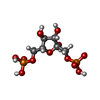
#3: Sugar ChemComp-FBP / 1,6-di-O-phosphono-beta-D-fructofuranose / BETA-FRUCTOSE-1,6-DIPHOSPHATE / FRUCTOSE-1,6-BISPHOSPHATE / 1,6-di-O-phosphono-beta-D-fructose / 1,6-di-O-phosphono-D-fructose / 1,6-di-O-phosphono-fructose


Type: D-saccharide, beta linking / Mass: 340.116 Da / Num. of mol.: 1 / Source method: obtained synthetically / Formula: C6H14O12P2 / Feature type: SUBJECT OF INVESTIGATION
IdentifierTypeProgram
b-D-Fruf1PO36PO3IUPAC CARBOHYDRATE SYMBOLPDB-CARE 1.0
#5: Sugar ChemComp-F6P / 6-O-phosphono-beta-D-fructofuranose / FRUCTOSE-6-PHOSPHATE / 6-O-phosphono-beta-D-fructose / 6-O-phosphono-D-fructose / 6-O-phosphono-fructose


Type: D-saccharide, beta linking / Mass: 260.136 Da / Num. of mol.: 1 / Source method: obtained synthetically / Formula: C6H13O9P / Feature type: SUBJECT OF INVESTIGATION
IdentifierTypeProgram
b-D-Fruf6PO3IUPAC CARBOHYDRATE SYMBOLPDB-CARE 1.0

-
Non-polymers , 3 types, 3 molecules

#2: Chemical ChemComp-A1C4X / 5-[bis(oxidanylidene)-$l^{5}-sulfanyl]-1,3-benzodioxole


Mass: 201.200 Da / Num. of mol.: 1 / Source method: obtained synthetically / Formula: C7H7NO4S / Feature type: SUBJECT OF INVESTIGATION
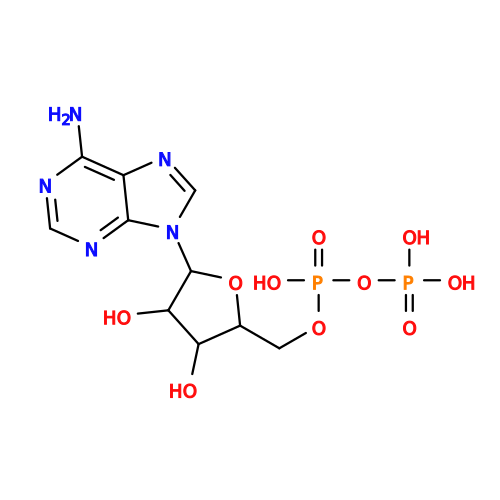
#4: Chemical ChemComp-ADP / ADENOSINE-5'-DIPHOSPHATE


Mass: 427.201 Da / Num. of mol.: 1 / Source method: obtained synthetically / Formula: C10H15N5O10P2 / Feature type: SUBJECT OF INVESTIGATION / Comment: ADP, energy-carrying molecule*YM
#6: Chemical ChemComp-A1CFQ / 4-[bis(3,4-difluorophenyl)methylidene]piperidine


Mass: 321.312 Da / Num. of mol.: 1 / Source method: obtained synthetically / Formula: C18H15F4N / Feature type: SUBJECT OF INVESTIGATION

-
Details

Has ligand of interestY
Has protein modificationY

-
Experimental details

-
Experiment

ExperimentMethod: ELECTRON MICROSCOPY
EM experimentAggregation state: PARTICLE / 3D reconstruction method: single particle reconstruction

-
Sample preparation

ComponentName: PFKL monomer / Type: COMPLEX / Entity ID: #1 / Source: RECOMBINANT
Molecular weightExperimental value: NO
Source (natural)Organism: Homo sapiens (human)
Source (recombinant)Organism: Homo sapiens (human) / Strain: Expi293F
Buffer solutionpH: 8
SpecimenEmbedding applied: NO / Shadowing applied: NO / Staining applied: NO / Vitrification applied: YES
VitrificationInstrument: FEI VITROBOT MARK IV / Cryogen name: ETHANE / Humidity: 100 %

-
Electron microscopy imaging

MicroscopyModel: TFS GLACIOS
Electron gunElectron source: FIELD EMISSION GUN / Accelerating voltage: 200 kV / Illumination mode: FLOOD BEAM
Electron lensMode: BRIGHT FIELD / Nominal defocus max: 2000 nm / Nominal defocus min: 800 nm
Specimen holderCryogen: NITROGEN
Image recordingElectron dose: 42 e/Å2 / Film or detector model: GATAN K3 (6k x 4k)

-
Processing

EM software
IDNameVersionCategoryFitting-ID
1cryoSPARCparticle selection
2SerialEMimage acquisition
4cryoSPARCCTF correction
9PHENIX1.19.2_4158:model refinement1
12ISOLDEmodel refinement2
13cryoSPARCinitial Euler assignment
14cryoSPARCfinal Euler assignment
15cryoSPARCclassification
16cryoSPARC3D reconstruction
CTF correctionType: PHASE FLIPPING AND AMPLITUDE CORRECTION
3D reconstructionResolution: 3.2 Å / Resolution method: FSC 0.143 CUT-OFF / Num. of particles: 124715 / Symmetry type: POINT
Atomic model building
IDProtocolSpace
1FLEXIBLE FITREAL
2FLEXIBLE FITREAL

+
About Yorodumi

-
News

-
Feb 9, 2022. New format data for meta-information of EMDB entries

New format data for meta-information of EMDB entries

  • Version 3 of the EMDB header file is now the official format.
  • The previous official version 1.9 will be removed from the archive.

Related info.:EMDB header

External links:wwPDB to switch to version 3 of the EMDB data model

-
Aug 12, 2020. Covid-19 info

Covid-19 info

URL: https://pdbj.org/emnavi/covid19.php

New page: Covid-19 featured information page in EM Navigator.

Related info.:Covid-19 info / Mar 5, 2020. Novel coronavirus structure data

+
Mar 5, 2020. Novel coronavirus structure data

Novel coronavirus structure data

Related info.:Yorodumi Speices / Aug 12, 2020. Covid-19 info

External links:COVID-19 featured content - PDBj / Molecule of the Month (242):Coronavirus Proteases

+
Jan 31, 2019. EMDB accession codes are about to change! (news from PDBe EMDB page)

EMDB accession codes are about to change! (news from PDBe EMDB page)

  • The allocation of 4 digits for EMDB accession codes will soon come to an end. Whilst these codes will remain in use, new EMDB accession codes will include an additional digit and will expand incrementally as the available range of codes is exhausted. The current 4-digit format prefixed with “EMD-” (i.e. EMD-XXXX) will advance to a 5-digit format (i.e. EMD-XXXXX), and so on. It is currently estimated that the 4-digit codes will be depleted around Spring 2019, at which point the 5-digit format will come into force.
  • The EM Navigator/Yorodumi systems omit the EMD- prefix.

Related info.:Q: What is EMD? / ID/Accession-code notation in Yorodumi/EM Navigator

External links:EMDB Accession Codes are Changing Soon! / Contact to PDBj

+
Jul 12, 2017. Major update of PDB

Major update of PDB

  • wwPDB released updated PDB data conforming to the new PDBx/mmCIF dictionary.
  • This is a major update changing the version number from 4 to 5, and with Remediation, in which all the entries are updated.
  • In this update, many items about electron microscopy experimental information are reorganized (e.g. em_software).
  • Now, EM Navigator and Yorodumi are based on the updated data.

External links:wwPDB Remediation / Enriched Model Files Conforming to OneDep Data Standards Now Available in the PDB FTP Archive

-
Yorodumi

Thousand views of thousand structures

  • Yorodumi is a browser for structure data from EMDB, PDB, SASBDB, etc.
  • This page is also the successor to EM Navigator detail page, and also detail information page/front-end page for Omokage search.
  • The word "yorodu" (or yorozu) is an old Japanese word meaning "ten thousand". "mi" (miru) is to see.

Related info.:EMDB / PDB / SASBDB / Comparison of 3 databanks / Yorodumi Search / Aug 31, 2016. New EM Navigator & Yorodumi / Yorodumi Papers / Jmol/JSmol / Function and homology information / Changes in new EM Navigator and Yorodumi

Read more