 ムービー
ムービー コントローラー


+ データを開く

- 基本情報
基本情報
| 登録情報 | データベース: PDB / ID: 9o55 | ||||||||||||||||||||||||
|---|---|---|---|---|---|---|---|---|---|---|---|---|---|---|---|---|---|---|---|---|---|---|---|---|---|
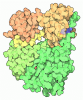
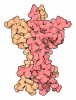
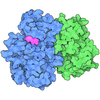
| タイトル | Structure of a synthetic antibody (RM010) in complex with a class I MHC presenting a hapten-peptide conjugate | ||||||||||||||||||||||||
 要素 要素 |
| ||||||||||||||||||||||||
 キーワード キーワード | IMMUNE SYSTEM / Complex / Fab | ||||||||||||||||||||||||
| 機能・相同性 |  機能・相同性情報 機能・相同性情報negative regulation of epithelial cell differentiation / response to mineralocorticoid / GMP binding / forebrain astrocyte development / epithelial tube branching involved in lung morphogenesis / LRR domain binding / regulation of synaptic transmission, GABAergic / response to isolation stress / type I pneumocyte differentiation / skeletal muscle cell differentiation ...negative regulation of epithelial cell differentiation / response to mineralocorticoid / GMP binding / forebrain astrocyte development / epithelial tube branching involved in lung morphogenesis / LRR domain binding / regulation of synaptic transmission, GABAergic / response to isolation stress / type I pneumocyte differentiation / skeletal muscle cell differentiation / response to gravity / myoblast proliferation / Rac protein signal transduction / cardiac muscle cell proliferation / Signaling by RAS GAP mutants / Signaling by RAS GTPase mutants / Activation of RAS in B cells / positive regulation of glial cell proliferation / RAS signaling downstream of NF1 loss-of-function variants / homeostasis of number of cells within a tissue / RUNX3 regulates p14-ARF / SOS-mediated signalling / Activated NTRK3 signals through RAS / Activated NTRK2 signals through RAS / SHC1 events in ERBB4 signaling / glial cell proliferation / antigen processing and presentation of peptide antigen via MHC class I / Signalling to RAS / SHC-related events triggered by IGF1R / Activated NTRK2 signals through FRS2 and FRS3 / Estrogen-stimulated signaling through PRKCZ / positive regulation of Rac protein signal transduction / SHC-mediated cascade:FGFR3 / MET activates RAS signaling / SHC-mediated cascade:FGFR2 / SHC-mediated cascade:FGFR4 / Signaling by PDGFRA transmembrane, juxtamembrane and kinase domain mutants / Signaling by PDGFRA extracellular domain mutants / PTK6 Regulates RHO GTPases, RAS GTPase and MAP kinases / Erythropoietin activates RAS / SHC-mediated cascade:FGFR1 / Signaling by FGFR4 in disease / striated muscle cell differentiation / Signaling by CSF3 (G-CSF) / FRS-mediated FGFR3 signaling / Signaling by FLT3 ITD and TKD mutants / FRS-mediated FGFR2 signaling / FRS-mediated FGFR4 signaling / p38MAPK events / Signaling by FGFR3 in disease / FRS-mediated FGFR1 signaling / Tie2 Signaling / protein-membrane adaptor activity / Signaling by FGFR2 in disease / Signaling by FLT3 fusion proteins / GRB2 events in EGFR signaling / SHC1 events in EGFR signaling / FLT3 Signaling / Signaling by FGFR1 in disease / EGFR Transactivation by Gastrin / NCAM signaling for neurite out-growth / CD209 (DC-SIGN) signaling / liver development / Downstream signal transduction / GRB2 events in ERBB2 signaling / response to glucocorticoid / Insulin receptor signalling cascade / SHC1 events in ERBB2 signaling / Constitutive Signaling by Overexpressed ERBB2 / Ras activation upon Ca2+ influx through NMDA receptor / Signaling by phosphorylated juxtamembrane, extracellular and kinase domain KIT mutants / VEGFR2 mediated cell proliferation / small monomeric GTPase / FCERI mediated MAPK activation / lumenal side of endoplasmic reticulum membrane / regulation of long-term neuronal synaptic plasticity / female pregnancy / ER to Golgi transport vesicle membrane / Signaling by ERBB2 TMD/JMD mutants / visual learning / Signaling by SCF-KIT / Constitutive Signaling by EGFRvIII / RAF activation / Signaling by high-kinase activity BRAF mutants / MHC class I protein complex / Signaling by ERBB2 ECD mutants / MAP2K and MAPK activation / Signaling by ERBB2 KD Mutants / neuron apoptotic process / gene expression / recycling endosome membrane / phagocytic vesicle membrane / cytokine-mediated signaling pathway / cytoplasmic side of plasma membrane / Signaling by RAF1 mutants / Signaling by CSF1 (M-CSF) in myeloid cells / Signaling by moderate kinase activity BRAF mutants / Paradoxical activation of RAF signaling by kinase inactive BRAF / Signaling downstream of RAS mutants / MAPK cascade 類似検索 - 分子機能 | ||||||||||||||||||||||||
| 生物種 |  Homo sapiens (ヒト) Homo sapiens (ヒト) | ||||||||||||||||||||||||
| 手法 | 電子顕微鏡法 / 単粒子再構成法 / クライオ電子顕微鏡法 / 解像度: 2.88 Å | ||||||||||||||||||||||||
 データ登録者 データ登録者 | Hu, Z. / Rajak, E. / Maso, L. / Koide, S. | ||||||||||||||||||||||||
| 資金援助 |  米国, 1件 米国, 1件
| ||||||||||||||||||||||||
 引用 引用 | ジャーナル: Proc Natl Acad Sci U S A / 年: 2025 タイトル: Generation of actionable, cancer-specific neoantigens from KRAS(G12C) with adagrasib. 著者: Lorenzo Maso / Epsa Rajak / Takamitsu Hattori / Zhengshan Hu / Akiko Koide / Benjamin G Neel / Shohei Koide / 要旨: Effective immune therapy against cancer ideally should target a cancer-specific antigen, an antigen that is present exclusively in cancer cells. However, there is a paucity of cancer-specific ...Effective immune therapy against cancer ideally should target a cancer-specific antigen, an antigen that is present exclusively in cancer cells. However, there is a paucity of cancer-specific antigens that are endogenously produced. HapImmune™ technology utilizes covalent inhibitors directed to an intracellular cancer driver to create cancer-specific neoantigens in the form of drug-peptide conjugates presented by class I MHC molecules. Our previous study with sotorasib, an FDA-approved covalent inhibitor of KRAS(G12C), demonstrated that drug-treated cells produce such neoantigens and can be killed by T cell engagers directed against the drug-peptide/MHC complex. Thus, this technology can unite targeted and immune therapies. In the present study, we examined whether this approach could generalize to another FDA-approved KRAS(G12C) inhibitor, adagrasib, whose chemical structure and cysteine reactivity differ substantially from sotorasib. We developed antibodies selective to adagrasib-KRAS(G12C) peptides presented by HLA-A*03 and A*11 that also show cross-reactivity to other KRAS(G12C) inhibitors presented in the same manner. Cryoelectron microscopy structures revealed a mode of adagrasib-peptide/HLA recognition distinctly different from that of sotorasib-directed HapImmune antibodies. The antibodies in a bispecific T cell engager format killed adagrasib-resistant lung cancer cells upon adagrasib treatment. These results support the broad applicability of the HapImmune approach for creating actionable cancer-specific neoantigens and offer candidates for therapeutic development. | ||||||||||||||||||||||||
| 履歴 |
|
- 構造の表示
構造の表示
| 構造ビューア | 分子: MolmilJmol/JSmol |
|---|
- ダウンロードとリンク
-ダウンロード
| PDBx/mmCIF形式 | 9o55.cif.gz | 86.4 KB | 表示 | PDBx/mmCIF形式 |
|---|---|---|---|---|
| PDB形式 | pdb9o55.ent.gz | 表示 | PDB形式 | |
| PDBx/mmJSON形式 | 9o55.json.gz | ツリー表示 | PDBx/mmJSON形式 | |
| その他 |  その他のダウンロード その他のダウンロード |
-検証レポート
| アーカイブディレクトリ | https://data.pdbj.org/pub/pdb/validation_reports/o5/9o55ftp://data.pdbj.org/pub/pdb/validation_reports/o5/9o55 | HTTPS FTP |
|---|
-関連構造データ

-リンク
 PDBj
PDBj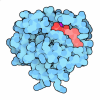

- 集合体
集合体
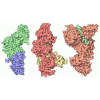
| 登録構造単位 | 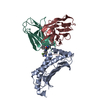
|
|---|---|
| 1 |
|
-要素
| #1: タンパク質 | 分子量: 21081.148 Da / 分子数: 1 / 由来タイプ: 組換発現 / 由来: (組換発現) Homo sapiens (ヒト) / 遺伝子: HLA-A / 発現宿主:   Escherichia coli (大腸菌) / 参照: UniProt: A0A6B7HGG7 Escherichia coli (大腸菌) / 参照: UniProt: A0A6B7HGG7 |
|---|---|
| #2: タンパク質・ペプチド | 分子量: 889.094 Da / 分子数: 1 / 由来タイプ: 組換発現 / 由来: (組換発現) Homo sapiens (ヒト) / 遺伝子: KRAS, KRAS2, RASK2 / 発現宿主: Escherichia coli (大腸菌) / 参照: UniProt: P01116 |
| #3: 抗体 | 分子量: 12432.712 Da / 分子数: 1 / 由来タイプ: 組換発現 / 由来: (組換発現) Homo sapiens (ヒト) / 発現宿主: Escherichia coli (大腸菌) |
| #4: 抗体 | 分子量: 11914.289 Da / 分子数: 1 / 由来タイプ: 組換発現 / 由来: (組換発現) Homo sapiens (ヒト) / 発現宿主: Escherichia coli (大腸菌) |
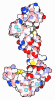
| #5: 化合物 | ChemComp-A1B8E / [( 分子量: 606.133 Da / 分子数: 1 / 由来タイプ: 合成 / 式: C32H37ClFN7O2 / タイプ: SUBJECT OF INVESTIGATION |
| 研究の焦点であるリガンドがあるか | Y |
| Has protein modification | Y |
-実験情報
-実験
| 実験 | 手法: 電子顕微鏡法 |
|---|---|
| EM実験 | 試料の集合状態: PARTICLE / 3次元再構成法: 単粒子再構成法 |
- 試料調製
試料調製
| 構成要素 | 名称: Binary complex of Fab RM010 with adagrasib-conjugated KRAS G12C peptide presented by HLA-A11 タイプ: COMPLEX / Entity ID: #1, #4, #3 / 由来: RECOMBINANT |
|---|---|
| 由来(天然) | 生物種: Homo sapiens (ヒト) |
| 由来(組換発現) | 生物種: Escherichia coli (大腸菌) |
| 緩衝液 | pH: 7.4 |
| 試料 | 包埋: NO / シャドウイング: NO / 染色: NO / 凍結: YES |
| 急速凍結 | 凍結剤: ETHANE |
- 電子顕微鏡撮影
| 実験機器 |  モデル: Titan Krios / 画像提供: FEI Company |
|---|---|
| 顕微鏡 | モデル: TFS KRIOS |
| 電子銃 | 電子線源:  FIELD EMISSION GUN / 加速電圧: 300 kV / 照射モード: FLOOD BEAM FIELD EMISSION GUN / 加速電圧: 300 kV / 照射モード: FLOOD BEAM |
| 電子レンズ | モード: BRIGHT FIELD / 最大 デフォーカス(公称値): 2500 nm / 最小 デフォーカス(公称値): 500 nm |
| 撮影 | 電子線照射量: 47.31 e/Å2 / フィルム・検出器のモデル: GATAN K3 (6k x 4k) |
- 解析
解析
| CTF補正 | タイプ: PHASE FLIPPING AND AMPLITUDE CORRECTION | ||||||||||||||||||||||||
|---|---|---|---|---|---|---|---|---|---|---|---|---|---|---|---|---|---|---|---|---|---|---|---|---|---|
| 3次元再構成 | 解像度: 2.88 Å / 解像度の算出法: FSC 0.143 CUT-OFF / 粒子像の数: 155365 / 対称性のタイプ: POINT | ||||||||||||||||||||||||
| 原子モデル構築 | B value: 106.4 | ||||||||||||||||||||||||
| 精密化 | 立体化学のターゲット値: REAL-SPACE (WEIGHTED MAP SUM AT ATOM CENTERS) | ||||||||||||||||||||||||
| 拘束条件 |
|
