 Movie
Movie Controller


+ Open data

- Basic information
| Entry | Database: PDB / ID: 9m7u | |||||||||||||||||||||
|---|---|---|---|---|---|---|---|---|---|---|---|---|---|---|---|---|---|---|---|---|---|---|
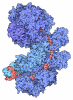
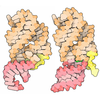
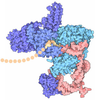
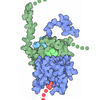
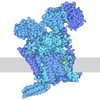
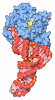
| Title | At S1+tRNA trimer | |||||||||||||||||||||
 Components Components |
| |||||||||||||||||||||
 Keywords Keywords | MEMBRANE PROTEIN/RNA / At S1+tRNA trimer / MEMBRANE PROTEIN-RNA complex | |||||||||||||||||||||
| Function / homology |  Function and homology information Function and homology informationvoltage-gated monoatomic anion channel activity / intracellular monoatomic ion homeostasis / response to water deprivation / chloride transport / response to salt stress / plasma membrane Similarity search - Function | |||||||||||||||||||||
| Biological species |   Arabidopsis thaliana (thale cress) Arabidopsis thaliana (thale cress) Homo sapiens (human) Homo sapiens (human) | |||||||||||||||||||||
| Method | ELECTRON MICROSCOPY / single particle reconstruction / cryo EM / Resolution: 3.18 Å | |||||||||||||||||||||
 Authors Authors | Zhang, S.S. | |||||||||||||||||||||
| Funding support |  China, 1items China, 1items
| |||||||||||||||||||||
 Citation Citation | Journal: Nat Commun / Year: 2025 Title: Structural insights into the coordinated regulation of the SLAH family in Arabidopsis thaliana. Authors: Sensen Zhang / Xueying Huang / Xiaojuan Wang / Boya Qi / Kaiwen Yang / Chang Liu / Ruochong Li / Xudong Chen / Jingbo Yi / Jian Yin / Maofei Chen / Botong Liu / Jiayi Fan / Tao Liu / Zhilin ...Authors: Sensen Zhang / Xueying Huang / Xiaojuan Wang / Boya Qi / Kaiwen Yang / Chang Liu / Ruochong Li / Xudong Chen / Jingbo Yi / Jian Yin / Maofei Chen / Botong Liu / Jiayi Fan / Tao Liu / Zhilin Hao / Kun Cui / Ni Xiao / Yingcai Song / Yujie Li / Di Wu / Tiancong Qi / Jian Mao / Bing Zhang / Maojun Yang / Jianping Xie / Zhiqiang Liu / Abstract: S-type anion channel homologs (SLAH) are widely expressed in various plant tissues and play a key role in anion transport, which is crucial for plant adaptation to both biotic and abiotic stresses. ...S-type anion channel homologs (SLAH) are widely expressed in various plant tissues and play a key role in anion transport, which is crucial for plant adaptation to both biotic and abiotic stresses. In this study, we employ cryo-electron microscopy (cryo-EM) to analyze four SLAH channel complexes from Arabidopsis thaliana: the homotrimeric SLAH3 channel, the 2SLAH1 + SLAH3+tRNA complex, the 1SLAH1 + 2SLAH3 complex, and the 3SLAH1+tRNA complex. Critically, our studies reveal that tRNA directly binds to and occupies the intracellular entrance of the SLAH1 homotrimer and the 2SLAH1 + SLAH3 heterocomplex. Electrophysiological experiments confirm tRNA's role as a potent inhibitory regulatory subunit: RNase-mediated tRNA degradation robustly activates SLAH1 currents, while targeted mutagenesis of SLAH1 tRNA-interacting residues phenocopy this activation and enhanced ABA-induced stomatal closure. Combining with structural biology, electrophysiology, and biochemistry, we comprehensively examine the key residues in SLAH1 and SLAH3 that are responsible for the anion permeation. This mechanistic advancement provides a deeper understanding of the molecular basis for plant stress tolerance and identifies specific molecular targets for future engineering crops. #1: Journal: Nat Commun / Year: 2025Title: Structural insights into the coordinated regulation of the SLAH family in Arabidopsis thaliana. Authors: Sensen Zhang / Xueying Huang / Xiaojuan Wang / Boya Qi / Kaiwen Yang / Chang Liu / Ruochong Li / Xudong Chen / Jingbo Yi / Jian Yin / Maofei Chen / Botong Liu / Jiayi Fan / Tao Liu / Zhilin ...Authors: Sensen Zhang / Xueying Huang / Xiaojuan Wang / Boya Qi / Kaiwen Yang / Chang Liu / Ruochong Li / Xudong Chen / Jingbo Yi / Jian Yin / Maofei Chen / Botong Liu / Jiayi Fan / Tao Liu / Zhilin Hao / Kun Cui / Ni Xiao / Yingcai Song / Yujie Li / Di Wu / Tiancong Qi / Jian Mao / Bing Zhang / Maojun Yang / Jianping Xie / Zhiqiang Liu / Abstract: S-type anion channel homologs (SLAH) are widely expressed in various plant tissues and play a key role in anion transport, which is crucial for plant adaptation to both biotic and abiotic stresses. ...S-type anion channel homologs (SLAH) are widely expressed in various plant tissues and play a key role in anion transport, which is crucial for plant adaptation to both biotic and abiotic stresses. In this study, we employ cryo-electron microscopy (cryo-EM) to analyze four SLAH channel complexes from Arabidopsis thaliana: the homotrimeric SLAH3 channel, the 2SLAH1 + SLAH3+tRNA complex, the 1SLAH1 + 2SLAH3 complex, and the 3SLAH1+tRNA complex. Critically, our studies reveal that tRNA directly binds to and occupies the intracellular entrance of the SLAH1 homotrimer and the 2SLAH1 + SLAH3 heterocomplex. Electrophysiological experiments confirm tRNA's role as a potent inhibitory regulatory subunit: RNase-mediated tRNA degradation robustly activates SLAH1 currents, while targeted mutagenesis of SLAH1 tRNA-interacting residues phenocopy this activation and enhanced ABA-induced stomatal closure. Combining with structural biology, electrophysiology, and biochemistry, we comprehensively examine the key residues in SLAH1 and SLAH3 that are responsible for the anion permeation. This mechanistic advancement provides a deeper understanding of the molecular basis for plant stress tolerance and identifies specific molecular targets for future engineering crops. | |||||||||||||||||||||
| History |
|
- Structure visualization
| Structure viewer | Molecule: MolmilJmol/JSmol |
|---|
- Downloads & links
-Download
| PDBx/mmCIF format | 9m7u.cif.gz | 213.4 KB | Display | PDBx/mmCIF format |
|---|---|---|---|---|
| PDB format | pdb9m7u.ent.gz | 167.4 KB | Display | PDB format |
| PDBx/mmJSON format | 9m7u.json.gz | Tree view | PDBx/mmJSON format | |
| Others |  Other downloads Other downloads |
-Validation report
| Arichive directory | https://data.pdbj.org/pub/pdb/validation_reports/m7/9m7uftp://data.pdbj.org/pub/pdb/validation_reports/m7/9m7u | HTTPS FTP |
|---|
-Related structure data
| Related structure data |  63693MC  9m7rC  9m7sC  9m7wC M: map data used to model this data C: citing same article ( |
|---|---|
| Similar structure data |


-Links
 PDBj
PDBj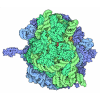
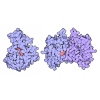
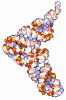
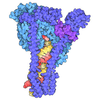
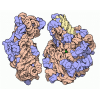
- Assembly
| Deposited unit | 
|
|---|---|
| 1 |
|
-Components
| #1: Protein | Mass: 43445.320 Da / Num. of mol.: 3 Source method: isolated from a genetically manipulated source Source: (gene. exp.) Arabidopsis thaliana (thale cress) / Gene: SLAH1, At1g62280, F19K23.20 / Production host: Homo sapiens (human) / References: UniProt: Q5E930#2: RNA chain | | Mass: 24108.287 Da / Num. of mol.: 1 / Source method: isolated from a natural source / Source: (natural) Homo sapiens (human)Has protein modification | N | |
|---|
-Experimental details
-Experiment
| Experiment | Method: ELECTRON MICROSCOPY |
|---|---|
| EM experiment | Aggregation state: PARTICLE / 3D reconstruction method: single particle reconstruction |
- Sample preparation
| Component | Name: At S1+2S3 trimer / Type: ORGANELLE OR CELLULAR COMPONENT / Entity ID: all / Source: RECOMBINANT | ||||||||||||
|---|---|---|---|---|---|---|---|---|---|---|---|---|---|
| Source (natural) |
| ||||||||||||
| Source (recombinant) | Organism: Homo sapiens (human) | ||||||||||||
| Buffer solution | pH: 7.2 | ||||||||||||
| Specimen | Embedding applied: NO / Shadowing applied: NO / Staining applied: NO / Vitrification applied: YES | ||||||||||||
| Vitrification | Cryogen name: ETHANE-PROPANE |
- Electron microscopy imaging
| Experimental equipment |  Model: Titan Krios / Image courtesy: FEI Company |
|---|---|
| Microscopy | Model: TFS KRIOS |
| Electron gun | Electron source:  FIELD EMISSION GUN / Accelerating voltage: 300 kV / Illumination mode: FLOOD BEAM FIELD EMISSION GUN / Accelerating voltage: 300 kV / Illumination mode: FLOOD BEAM |
| Electron lens | Mode: BRIGHT FIELD / Nominal defocus max: 2500 nm / Nominal defocus min: 1200 nm |
| Image recording | Electron dose: 50 e/Å2 / Film or detector model: GATAN K3 BIOQUANTUM (6k x 4k) |
- Processing
| EM software |
| |||||||||
|---|---|---|---|---|---|---|---|---|---|---|
| CTF correction | Type: PHASE FLIPPING AND AMPLITUDE CORRECTION | |||||||||
| 3D reconstruction | Resolution: 3.18 Å / Resolution method: FSC 0.143 CUT-OFF / Num. of particles: 159000 / Symmetry type: POINT |
