 Movie
Movie Controller


+ Open data

- Basic information
| Entry | Database: PDB / ID: 9l8w | |||||||||||||||||||||
|---|---|---|---|---|---|---|---|---|---|---|---|---|---|---|---|---|---|---|---|---|---|---|
| Title | Human KCNQ2-CaM in complex with QO-58 | |||||||||||||||||||||
 Components Components | Potassium voltage-gated channel subfamily KQT member 2 | |||||||||||||||||||||
 Keywords Keywords | MEMBRANE PROTEIN / KCNQ2 | |||||||||||||||||||||
| Function / homology |  Function and homology information Function and homology informationaxon initial segment / Voltage gated Potassium channels / node of Ranvier / Interaction between L1 and Ankyrins / ankyrin binding / voltage-gated monoatomic cation channel activity / action potential / voltage-gated potassium channel activity / voltage-gated potassium channel complex / potassium ion transmembrane transport ...axon initial segment / Voltage gated Potassium channels / node of Ranvier / Interaction between L1 and Ankyrins / ankyrin binding / voltage-gated monoatomic cation channel activity / action potential / voltage-gated potassium channel activity / voltage-gated potassium channel complex / potassium ion transmembrane transport / nervous system development / chemical synaptic transmission / calmodulin binding / synapse / membrane / plasma membrane Similarity search - Function | |||||||||||||||||||||
| Biological species |  Homo sapiens (human) Homo sapiens (human) | |||||||||||||||||||||
| Method | ELECTRON MICROSCOPY / single particle reconstruction / cryo EM / Resolution: 2.9 Å | |||||||||||||||||||||
 Authors Authors | Zhao, Y.W. / Yang, Z.N. / Du, X.N. / Guo, J.T. | |||||||||||||||||||||
| Funding support |  China, 1items China, 1items
| |||||||||||||||||||||
 Citation Citation | Journal: Cell Rep / Year: 2026 Title: Structure basis for the activation of KCNQ2 by endogenous and exogenous ligands. Authors: Yiwen Zhao / Zhenni Yang / Sai Shi / Han Hao / Xinmeng Li / Demin Ma / Nannan Su / Weixin Zhao / Jicheng Shao / Yating An / Ke Wang / Yinuo Liu / Lu Zou / Jinlong Qi / Hailin Zhang / Jiangtao Guo / Xiaona Du / Abstract: The voltage-gated potassium channel KCNQ2 is crucial for stabilizing neuronal membrane potential, and its mutations can cause various epilepsies. KCNQ2 is activated by endogenous ligand ...The voltage-gated potassium channel KCNQ2 is crucial for stabilizing neuronal membrane potential, and its mutations can cause various epilepsies. KCNQ2 is activated by endogenous ligand phosphatidylinositol-4,5-bisphosphate (PIP) and exogenous ligands, yet the structural mechanisms underlying these activations remain unclear. Here, we report the cryo-electron microscopy structures of human KCNQ2 in complex with exogenous ligands QO-58 and QO-83 in the absence or presence of PIP in either closed or open conformation. While QO-83 binds in the classical fenestration pocket of the pore domain, QO-58 mainly binds at the flank of S4 in the voltage-sensing domain. These structures, along with electrophysiological assays and computational studies, provide mechanistic insights into the ligand activation of KCNQ2 and may guide the development of anti-epileptic drugs targeting KCNQ2. | |||||||||||||||||||||
| History |
|
- Structure visualization
| Structure viewer | Molecule: MolmilJmol/JSmol |
|---|
- Downloads & links
-Download
| PDBx/mmCIF format | 9l8w.cif.gz | 259.4 KB | Display | PDBx/mmCIF format |
|---|---|---|---|---|
| PDB format | pdb9l8w.ent.gz | Display | PDB format | |
| PDBx/mmJSON format | 9l8w.json.gz | Tree view | PDBx/mmJSON format | |
| Others |  Other downloads Other downloads |
-Validation report
| Arichive directory | https://data.pdbj.org/pub/pdb/validation_reports/l8/9l8wftp://data.pdbj.org/pub/pdb/validation_reports/l8/9l8w | HTTPS FTP |
|---|
-Related structure data
| Related structure data |  62892MC  8xo1C  9xb9C  9xedC M: map data used to model this data C: citing same article ( |
|---|---|
| Similar structure data |


-Links
 PDBj
PDBj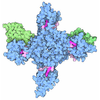
- Assembly
| Deposited unit | 
|
|---|---|
| 1 |
|
-Components
| #1: Protein | Mass: 95976.742 Da / Num. of mol.: 4 Source method: isolated from a genetically manipulated source Source: (gene. exp.) Homo sapiens (human) / Gene: KCNQ2 / Cell line (production host): HEK293 / Production host: Homo sapiens (human) / References: UniProt: O43526#2: Chemical | ChemComp-A1LVR / Mass: 443.182 Da / Num. of mol.: 8 / Source method: obtained synthetically / Formula: C18H8Cl2F4N4O / Feature type: SUBJECT OF INVESTIGATION Has ligand of interest | Y | Has protein modification | N | |
|---|
-Experimental details
-Experiment
| Experiment | Method: ELECTRON MICROSCOPY |
|---|---|
| EM experiment | Aggregation state: PARTICLE / 3D reconstruction method: single particle reconstruction |
- Sample preparation
| Component | Name: Human KCNQ2-CaM in complex with QO-58 / Type: COMPLEX / Entity ID: #1 / Source: RECOMBINANT |
|---|---|
| Source (natural) | Organism: Homo sapiens (human) |
| Source (recombinant) | Organism: Homo sapiens (human) |
| Buffer solution | pH: 8 |
| Specimen | Embedding applied: NO / Shadowing applied: NO / Staining applied: NO / Vitrification applied: YES |
| Vitrification | Cryogen name: ETHANE |
- Electron microscopy imaging
| Experimental equipment |  Model: Titan Krios / Image courtesy: FEI Company |
|---|---|
| Microscopy | Model: TFS KRIOS |
| Electron gun | Electron source:  FIELD EMISSION GUN / Accelerating voltage: 300 kV / Illumination mode: FLOOD BEAM FIELD EMISSION GUN / Accelerating voltage: 300 kV / Illumination mode: FLOOD BEAM |
| Electron lens | Mode: BRIGHT FIELD / Nominal defocus max: 1600 nm / Nominal defocus min: 800 nm |
| Image recording | Electron dose: 52 e/Å2 / Film or detector model: GATAN K2 SUMMIT (4k x 4k) |
- Processing
| CTF correction | Type: PHASE FLIPPING AND AMPLITUDE CORRECTION |
|---|---|
| 3D reconstruction | Resolution: 2.9 Å / Resolution method: FSC 0.143 CUT-OFF / Num. of particles: 103232 / Symmetry type: POINT |
