 Movie
Movie Controller


+ Open data

- Basic information
| Entry | Database: PDB / ID: 9l5y | |||||||||
|---|---|---|---|---|---|---|---|---|---|---|
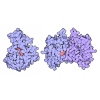
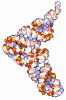
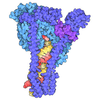
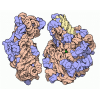
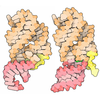
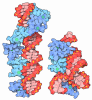
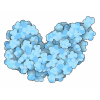
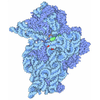
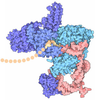
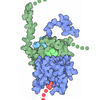
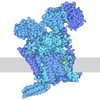
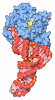
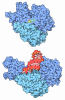
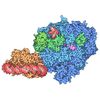
| Title | Structure of Ro60 dimer from Thermus phage phiLo | |||||||||
 Components Components |
| |||||||||
 Keywords Keywords | RNA BINDING PROTEIN/RNA / Ro60 / trove / Rsr / Y-RNA / cryo-EM / protein-RNA complex / RNA BINDING PROTEIN-RNA complex | |||||||||
| Function / homology |  Function and homology information Function and homology information | |||||||||
| Biological species |   Thermus phage phiLo (virus) Thermus phage phiLo (virus) | |||||||||
| Method | ELECTRON MICROSCOPY / single particle reconstruction / cryo EM / Resolution: 3.81 Å | |||||||||
 Authors Authors | Hu, Z. / Huang, Y. | |||||||||
| Funding support |  China, 2items China, 2items
| |||||||||
 Citation Citation | Journal: Nucleic Acids Res / Year: 2025 Title: Structural and molecular mechanisms of an Ro60 homolog from a Thermus bacteriophage. Authors: Zetao Hu / Zhaohui Jin / Lulu Guo / Ling Zeng / Xuanjia Dong / Lin Jiang / Wenting Dai / Jinbiao Ma / Ying Huang / Abstract: Ro60 is a conserved RNA-binding protein essential for RNA quality control and implicated in autoimmune responses. In this study, we present the structural and functional characterization of φRo60, ...Ro60 is a conserved RNA-binding protein essential for RNA quality control and implicated in autoimmune responses. In this study, we present the structural and functional characterization of φRo60, an Ro60 homolog from Thermus phage phiLo, with its crystal structure determined at 1.99 Å. Despite limited sequence identity with bacterial and amphibian homologs, φRo60 maintains the canonical doughnut-shaped architecture comprising HEAT repeats and a von Willebrand factor A domain. Surface electrostatic analysis reveals an extensive positively charged region across multiple α-helices, likely facilitating diverse RNA interactions. Moreover, φRo60 binds two Y RNA-like molecules (Yrl1 and Yrl2), identified from the phiLo genome, with distinct stoichiometries, leading to the formation of higher-order nucleocytoplasmic ribonucleoprotein (RNP) complexes. Cryo-electron microscopy of φRo60-Yrl2 RNP complexes revealed a minor population adopting a dimeric assembly, and key positively charged residues are important for φRo60-Yrl2 interactions. Additionally, φRo60 and Yrls interact with host Thermus thermophilus HB8 polynucleotide phosphorylase (PNPase), forming tripartite RYPER-like complexes and attenuating the ribonuclease activity of PNPase. These findings highlight φRo60 as a structurally adaptable Ro60 homolog capable of diverse RNA interactions and host factor recruitment, implying unique strategies for phages to counteract host defense systems in thermophilic environments. | |||||||||
| History |
|
- Structure visualization
| Structure viewer | Molecule: MolmilJmol/JSmol |
|---|
- Downloads & links
-Download
| PDBx/mmCIF format | 9l5y.cif.gz | 190.7 KB | Display | PDBx/mmCIF format |
|---|---|---|---|---|
| PDB format | pdb9l5y.ent.gz | 146.8 KB | Display | PDB format |
| PDBx/mmJSON format | 9l5y.json.gz | Tree view | PDBx/mmJSON format | |
| Others |  Other downloads Other downloads |
-Validation report
| Arichive directory | https://data.pdbj.org/pub/pdb/validation_reports/l5/9l5yftp://data.pdbj.org/pub/pdb/validation_reports/l5/9l5y | HTTPS FTP |
|---|
-Related structure data
| Related structure data |  62848MC  9kopC C: citing same article ( M: map data used to model this data |
|---|---|
| Similar structure data |
-Links
 PDBj
PDBj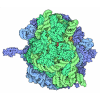
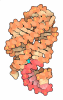
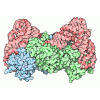
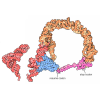
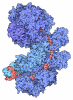
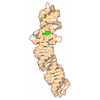
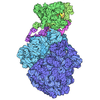
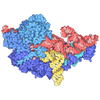
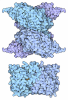
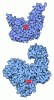
- Assembly
| Deposited unit | 
|
|---|---|
| 1 |
|
-Components
| #1: Protein | Mass: 57038.781 Da / Num. of mol.: 2 Source method: isolated from a genetically manipulated source Source: (gene. exp.) Thermus phage phiLo (virus) / Gene: phiLo_26 / Production host:   Escherichia coli (E. coli) / References: UniProt: A0A3S7URH6 Escherichia coli (E. coli) / References: UniProt: A0A3S7URH6#2: RNA chain | Mass: 20096.021 Da / Num. of mol.: 2 Source method: isolated from a genetically manipulated source Source: (gene. exp.) Thermus phage phiLo (virus) / Production host: Escherichia coli (E. coli)Has protein modification | N | |
|---|
-Experimental details
-Experiment
| Experiment | Method: ELECTRON MICROSCOPY |
|---|---|
| EM experiment | Aggregation state: PARTICLE / 3D reconstruction method: single particle reconstruction |
- Sample preparation
| Component | Name: phiLoTrove in complex with Yrl2 / Type: COMPLEX / Entity ID: all / Source: RECOMBINANT |
|---|---|
| Source (natural) | Organism: Thermus phage phiLo (virus) |
| Source (recombinant) | Organism: Escherichia coli (E. coli) |
| Buffer solution | pH: 7 |
| Specimen | Embedding applied: NO / Shadowing applied: NO / Staining applied: NO / Vitrification applied: YES |
| Vitrification | Cryogen name: ETHANE |
- Electron microscopy imaging
| Experimental equipment |  Model: Titan Krios / Image courtesy: FEI Company |
|---|---|
| Microscopy | Model: TFS KRIOS |
| Electron gun | Electron source:  FIELD EMISSION GUN / Accelerating voltage: 300 kV / Illumination mode: FLOOD BEAM FIELD EMISSION GUN / Accelerating voltage: 300 kV / Illumination mode: FLOOD BEAM |
| Electron lens | Mode: BRIGHT FIELD / Nominal defocus max: 2200 nm / Nominal defocus min: 1500 nm |
| Image recording | Electron dose: 50 e/Å2 / Film or detector model: FEI FALCON IV (4k x 4k) |
- Processing
| EM software | Name: PHENIX / Version: 1.21.2_5419 / Category: model refinement | ||||||||||||||||||||||||
|---|---|---|---|---|---|---|---|---|---|---|---|---|---|---|---|---|---|---|---|---|---|---|---|---|---|
| CTF correction | Type: NONE | ||||||||||||||||||||||||
| 3D reconstruction | Resolution: 3.81 Å / Resolution method: FSC 0.143 CUT-OFF / Num. of particles: 47986 / Symmetry type: POINT | ||||||||||||||||||||||||
| Refinement | Highest resolution: 3.81 Å Stereochemistry target values: REAL-SPACE (WEIGHTED MAP SUM AT ATOM CENTERS) | ||||||||||||||||||||||||
| Refine LS restraints |
|
