 Movie
Movie Controller

[English] 日本語
 Yorodumi
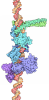
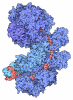
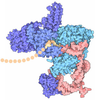
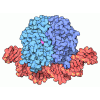
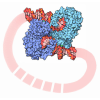
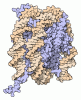
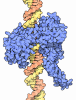
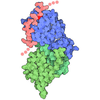
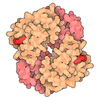
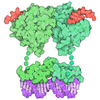
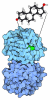
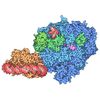
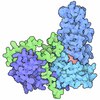
- PDB-9ge4: CryoEM structure of the human INO80 core- H2A.Z nucleosome complex -
+ Open data

- Basic information
| Entry | Database: PDB / ID: 9ge4 | |||||||||||||||||||||
|---|---|---|---|---|---|---|---|---|---|---|---|---|---|---|---|---|---|---|---|---|---|---|
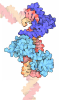
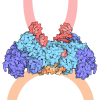
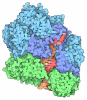
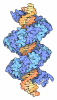
| Title | CryoEM structure of the human INO80 core- H2A.Z nucleosome complex | |||||||||||||||||||||
 Components Components |
| |||||||||||||||||||||
 Keywords Keywords | DNA / Homo sapiens / Nucleosome | |||||||||||||||||||||
| Function / homology |  Function and homology information Function and homology informationRNA polymerase II core promoter sequence-specific DNA binding / negative regulation of megakaryocyte differentiation / protein localization to CENP-A containing chromatin / Chromatin modifying enzymes / heterochromatin / Replacement of protamines by nucleosomes in the male pronucleus / CENP-A containing nucleosome / nucleosomal DNA binding / Packaging Of Telomere Ends / Recognition and association of DNA glycosylase with site containing an affected purine ...RNA polymerase II core promoter sequence-specific DNA binding / negative regulation of megakaryocyte differentiation / protein localization to CENP-A containing chromatin / Chromatin modifying enzymes / heterochromatin / Replacement of protamines by nucleosomes in the male pronucleus / CENP-A containing nucleosome / nucleosomal DNA binding / Packaging Of Telomere Ends / Recognition and association of DNA glycosylase with site containing an affected purine / Cleavage of the damaged purine / Deposition of new CENPA-containing nucleosomes at the centromere / telomere organization / Interleukin-7 signaling / epigenetic regulation of gene expression / Recognition and association of DNA glycosylase with site containing an affected pyrimidine / Cleavage of the damaged pyrimidine / Regulation of PD-L1(CD274) transcription / RNA Polymerase I Promoter Opening / Inhibition of DNA recombination at telomere / Assembly of the ORC complex at the origin of replication / Meiotic synapsis / SUMOylation of chromatin organization proteins / Regulation of endogenous retroelements by the Human Silencing Hub (HUSH) complex / DNA methylation / Condensation of Prophase Chromosomes / Chromatin modifications during the maternal to zygotic transition (MZT) / HCMV Late Events / SIRT1 negatively regulates rRNA expression / ERCC6 (CSB) and EHMT2 (G9a) positively regulate rRNA expression / PRC2 methylates histones and DNA / cellular response to estradiol stimulus / Regulation of endogenous retroelements by KRAB-ZFP proteins / Defective pyroptosis / HDACs deacetylate histones / Regulation of endogenous retroelements by Piwi-interacting RNAs (piRNAs) / innate immune response in mucosa / Transcriptional regulation by small RNAs / RNA Polymerase I Promoter Escape / Nonhomologous End-Joining (NHEJ) / euchromatin / HDMs demethylate histones / Formation of the beta-catenin:TCF transactivating complex / Activated PKN1 stimulates transcription of AR (androgen receptor) regulated genes KLK2 and KLK3 / chromatin DNA binding / RUNX1 regulates genes involved in megakaryocyte differentiation and platelet function / Negative Regulation of CDH1 Gene Transcription / NoRC negatively regulates rRNA expression / G2/M DNA damage checkpoint / PKMTs methylate histone lysines / B-WICH complex positively regulates rRNA expression / DNA Damage/Telomere Stress Induced Senescence / Dengue Virus-Host Interactions / Meiotic recombination / Pre-NOTCH Transcription and Translation / Activation of anterior HOX genes in hindbrain development during early embryogenesis / Transcriptional regulation of granulopoiesis / RMTs methylate histone arginines / HCMV Early Events / structural constituent of chromatin / nucleosome / nucleosome assembly / antimicrobial humoral immune response mediated by antimicrobial peptide / HATs acetylate histones / Recruitment and ATM-mediated phosphorylation of repair and signaling proteins at DNA double strand breaks / Factors involved in megakaryocyte development and platelet production / MLL4 and MLL3 complexes regulate expression of PPARG target genes in adipogenesis and hepatic steatosis / antibacterial humoral response / RUNX1 regulates transcription of genes involved in differentiation of HSCs / chromatin organization / heterochromatin formation / Processing of DNA double-strand break ends / Senescence-Associated Secretory Phenotype (SASP) / Oxidative Stress Induced Senescence / Estrogen-dependent gene expression / chromosome, telomeric region / defense response to Gram-positive bacterium / Ub-specific processing proteases / RNA polymerase II cis-regulatory region sequence-specific DNA binding / cadherin binding / protein heterodimerization activity / Amyloid fiber formation / positive regulation of transcription by RNA polymerase II / protein-containing complex / DNA binding / : / RNA binding / extracellular exosome / extracellular region / nucleoplasm / membrane / nucleus Similarity search - Function | |||||||||||||||||||||
| Biological species |  Homo sapiens (human) Homo sapiens (human)synthetic construct (others) | |||||||||||||||||||||
| Method | ELECTRON MICROSCOPY / single particle reconstruction / cryo EM / Resolution: 3.52 Å | |||||||||||||||||||||
 Authors Authors | Aggarwal, P. / Sharma, M. / Hopfner, K.P. | |||||||||||||||||||||
| Funding support | European Union,  Germany, 2items Germany, 2items
| |||||||||||||||||||||
 Citation Citation | Journal: Nucleic Acids Res / Year: 2026 Title: Recognition and remodelling of nucleosomes and hexasomes by the human INO80 complex. Authors: Priyanka Aggarwal / Manmohan Sharma / Stephan Woike / Franziska Kunert / Annika Brem / Manuela Moldt / Karl-Peter Hopfner / Abstract: The ATP-dependent INO80 chromatin remodeller slides and repositions nucleosomes to shape and maintain chromatin around gene regulatory elements and replication origins. Recent work uncovered ...The ATP-dependent INO80 chromatin remodeller slides and repositions nucleosomes to shape and maintain chromatin around gene regulatory elements and replication origins. Recent work uncovered capabilities of yeast and fungal INO80 to bind and slide hexasomes, but whether this is a universal feature is unknown. Here, we show that human INO80 also slides hexasomes as efficiently as H2A and H2A.Z nucleosomes. By determining a variety of structures of human INO80 bound to canonical and H2A.Z nucleosomes as well as hexasomes, we reveal a predominantly topological sensing of nucleosomal species with at least three positions depending on entry DNA unwrapping. INO80 spin-rotates around the nucleosomal core particle as a function of entry DNA unwrapping. Different degrees of unwrapped entry DNA lead to two different nucleosomal and one hexasomal locations of INO80, determined by binding of the Snf2 ATPase to entry point of extranucleosomal DNA at the nucleosome/hexasome core. Acidic patch binding by the INO80 subunit IES2 can differentiate between (sub)nucleosomal species, is important for nucleosome but not hexasome sliding, and may sense unwrapped exit DNA. These findings provide structural and mechanistic insights into how human INO80 remodels diverse chromatin substrates in a topology driven manner. | |||||||||||||||||||||
| History |
|
- Structure visualization
| Structure viewer | Molecule: MolmilJmol/JSmol |
|---|
- Downloads & links
-Download
| PDBx/mmCIF format | 9ge4.cif.gz | 331.1 KB | Display | PDBx/mmCIF format |
|---|---|---|---|---|
| PDB format | pdb9ge4.ent.gz | 250.3 KB | Display | PDB format |
| PDBx/mmJSON format | 9ge4.json.gz | Tree view | PDBx/mmJSON format | |
| Others |  Other downloads Other downloads |
-Validation report
| Arichive directory | https://data.pdbj.org/pub/pdb/validation_reports/ge/9ge4ftp://data.pdbj.org/pub/pdb/validation_reports/ge/9ge4 | HTTPS FTP |
|---|
-Related structure data
| Related structure data |  51289MC  9gcgC  9ge5C  9gelC  9gevC  9gf6C  9gfbC  9gfmC M: map data used to model this data C: citing same article ( |
|---|---|
| Similar structure data |


-Links
 PDBj
PDBj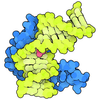

- Assembly
| Deposited unit | 
|
|---|---|
| 1 |
|
-Components
-Nucleosome DNA strand ... , 2 types, 2 molecules KL
| #1: DNA chain | Mass: 47121.051 Da / Num. of mol.: 1 / Source method: obtained synthetically / Source: (synth.) synthetic construct (others) |
|---|---|
| #2: DNA chain | Mass: 46715.758 Da / Num. of mol.: 1 / Source method: obtained synthetically / Source: (synth.) synthetic construct (others) |
-Protein , 5 types, 8 molecules MQNROPTS
| #3: Protein | Mass: 15437.167 Da / Num. of mol.: 2 Source method: isolated from a genetically manipulated source Source: (gene. exp.) Homo sapiens (human)Gene: HIST1H3A, H3FA, HIST1H3B, H3FL, HIST1H3C, H3FC, HIST1H3D, H3FB, HIST1H3E, H3FD, HIST1H3F, H3FI, HIST1H3G, H3FH, HIST1H3H, H3FK, HIST1H3I, H3FF, HIST1H3J, H3FJ Production host:   Escherichia coli (E. coli) / References: UniProt: P68431 Escherichia coli (E. coli) / References: UniProt: P68431#4: Protein | Mass: 11263.231 Da / Num. of mol.: 2 Source method: isolated from a genetically manipulated source Source: (gene. exp.) Homo sapiens (human)Gene: HIST1H4A, H4/A, H4FA, HIST1H4B, H4/I, H4FI, HIST1H4C, H4/G, H4FG, HIST1H4D, H4/B, H4FB, HIST1H4E, H4/J, H4FJ, HIST1H4F, H4/C, H4FC, HIST1H4H, H4/H, H4FH, HIST1H4I, H4/M, H4FM, HIST1H4J, H4/E, ...Gene: HIST1H4A, H4/A, H4FA, HIST1H4B, H4/I, H4FI, HIST1H4C, H4/G, H4FG, HIST1H4D, H4/B, H4FB, HIST1H4E, H4/J, H4FJ, HIST1H4F, H4/C, H4FC, HIST1H4H, H4/H, H4FH, HIST1H4I, H4/M, H4FM, HIST1H4J, H4/E, H4FE, HIST1H4K, H4/D, H4FD, HIST1H4L, H4/K, H4FK, HIST2H4A, H4/N, H4F2, H4FN, HIST2H4, HIST2H4B, H4/O, H4FO, HIST4H4 Production host: Escherichia coli (E. coli) / References: UniProt: P62805#5: Protein | | Mass: 13450.601 Da / Num. of mol.: 1 Source method: isolated from a genetically manipulated source Source: (gene. exp.) Homo sapiens (human) / Gene: H2AZ1, H2AFZ, H2AZ / Production host: Escherichia coli (E. coli) / References: UniProt: P0C0S5#6: Protein | Mass: 13820.045 Da / Num. of mol.: 2 Source method: isolated from a genetically manipulated source Source: (gene. exp.) Homo sapiens (human) / Gene: H2BC21, H2BFQ, HIST2H2BE / Production host: Escherichia coli (E. coli) / References: UniProt: Q16778#7: Protein | | Mass: 13450.601 Da / Num. of mol.: 1 Source method: isolated from a genetically manipulated source Source: (gene. exp.) Homo sapiens (human) / Gene: H2AZ1, H2AFZ, H2AZ / Production host: Escherichia coli (E. coli) / References: UniProt: P0C0S5 |
|---|
-Details
| Has protein modification | N |
|---|
-Experimental details
-Experiment
| Experiment | Method: ELECTRON MICROSCOPY |
|---|---|
| EM experiment | Aggregation state: PARTICLE / 3D reconstruction method: single particle reconstruction |
- Sample preparation
| Component |
| ||||||||||||||||||||||||
|---|---|---|---|---|---|---|---|---|---|---|---|---|---|---|---|---|---|---|---|---|---|---|---|---|---|
| Molecular weight |
| ||||||||||||||||||||||||
| Source (natural) |
| ||||||||||||||||||||||||
| Source (recombinant) |
| ||||||||||||||||||||||||
| Buffer solution | pH: 8 | ||||||||||||||||||||||||
| Buffer component |
| ||||||||||||||||||||||||
| Specimen | Embedding applied: NO / Shadowing applied: NO / Staining applied: NO / Vitrification applied: YES | ||||||||||||||||||||||||
| Specimen support | Details: Negative Polarity / Grid material: COPPER / Grid mesh size: 200 divisions/in. / Grid type: Quantifoil R2/1 | ||||||||||||||||||||||||
| Vitrification | Instrument: LEICA EM GP / Cryogen name: ETHANE / Humidity: 95 % / Chamber temperature: 283 K |
 Trichoplusia ni (cabbage looper)
- Electron microscopy imaging
| Experimental equipment |  Model: Titan Krios / Image courtesy: FEI Company |
|---|---|
| Microscopy | Model: FEI TITAN KRIOS |
| Electron gun | Electron source:  FIELD EMISSION GUN / Accelerating voltage: 300 kV / Illumination mode: FLOOD BEAM FIELD EMISSION GUN / Accelerating voltage: 300 kV / Illumination mode: FLOOD BEAM |
| Electron lens | Mode: BRIGHT FIELD / Nominal defocus max: 2900 nm / Nominal defocus min: 1100 nm / Cs: 2.7 mm |
| Image recording | Electron dose: 1 e/Å2 / Film or detector model: GATAN K2 SUMMIT (4k x 4k) |
- Processing
| EM software |
| ||||||||||||||||||||||||||||||||||||||||||||||||||||||||||||||||||||||||||||||||||||||||||||||||||||||||||
|---|---|---|---|---|---|---|---|---|---|---|---|---|---|---|---|---|---|---|---|---|---|---|---|---|---|---|---|---|---|---|---|---|---|---|---|---|---|---|---|---|---|---|---|---|---|---|---|---|---|---|---|---|---|---|---|---|---|---|---|---|---|---|---|---|---|---|---|---|---|---|---|---|---|---|---|---|---|---|---|---|---|---|---|---|---|---|---|---|---|---|---|---|---|---|---|---|---|---|---|---|---|---|---|---|---|---|---|
| CTF correction | Type: PHASE FLIPPING AND AMPLITUDE CORRECTION | ||||||||||||||||||||||||||||||||||||||||||||||||||||||||||||||||||||||||||||||||||||||||||||||||||||||||||
| Particle selection | Num. of particles selected: 12419217 Details: Minimum particle diameter (A) = 120 Maximum particle diameter (A) = 240 | ||||||||||||||||||||||||||||||||||||||||||||||||||||||||||||||||||||||||||||||||||||||||||||||||||||||||||
| Symmetry | Point symmetry: C1 (asymmetric) | ||||||||||||||||||||||||||||||||||||||||||||||||||||||||||||||||||||||||||||||||||||||||||||||||||||||||||
| 3D reconstruction | Resolution: 3.52 Å / Resolution method: FSC 0.143 CUT-OFF / Num. of particles: 94892 / Symmetry type: POINT | ||||||||||||||||||||||||||||||||||||||||||||||||||||||||||||||||||||||||||||||||||||||||||||||||||||||||||
| Atomic model building | Protocol: FLEXIBLE FIT / Space: RECIPROCAL / Target criteria: MAXIMUM LIKELIHOOD WITH PHASES | ||||||||||||||||||||||||||||||||||||||||||||||||||||||||||||||||||||||||||||||||||||||||||||||||||||||||||
| Refinement | Resolution: 3.52→3.52 Å / Cor.coef. Fo:Fc: 0.934 / SU B: 23.588 / SU ML: 0.332 / ESU R: 0.542 Stereochemistry target values: MAXIMUM LIKELIHOOD WITH PHASES Details: HYDROGENS HAVE BEEN ADDED IN THE RIDING POSITIONS
| ||||||||||||||||||||||||||||||||||||||||||||||||||||||||||||||||||||||||||||||||||||||||||||||||||||||||||
| Solvent computation | Solvent model: PARAMETERS FOR MASK CACLULATION | ||||||||||||||||||||||||||||||||||||||||||||||||||||||||||||||||||||||||||||||||||||||||||||||||||||||||||
| Displacement parameters | Biso mean: 134.964 Å2 | ||||||||||||||||||||||||||||||||||||||||||||||||||||||||||||||||||||||||||||||||||||||||||||||||||||||||||
| Refinement step | Cycle: 1 / Total: 12125 | ||||||||||||||||||||||||||||||||||||||||||||||||||||||||||||||||||||||||||||||||||||||||||||||||||||||||||
| Refine LS restraints |
|