 Movie
Movie Controller


+ Open data

- Basic information
| Entry | Database: PDB / ID: 9dzg | |||||||||||||||||||||
|---|---|---|---|---|---|---|---|---|---|---|---|---|---|---|---|---|---|---|---|---|---|---|
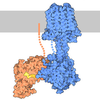
| Title | Human GC-A bound to XX16 | |||||||||||||||||||||
 Components Components |
| |||||||||||||||||||||
 Keywords Keywords | MEMBRANE PROTEIN / receptor | |||||||||||||||||||||
| Function / homology |  Function and homology information Function and homology informationANPR-A receptor complex / body fluid secretion / natriuretic peptide receptor activity / peptide receptor activity / guanylate cyclase / receptor guanylyl cyclase signaling pathway / guanylate cyclase activity / cGMP biosynthetic process / Physiological factors / positive regulation of renal sodium excretion ...ANPR-A receptor complex / body fluid secretion / natriuretic peptide receptor activity / peptide receptor activity / guanylate cyclase / receptor guanylyl cyclase signaling pathway / guanylate cyclase activity / cGMP biosynthetic process / Physiological factors / positive regulation of renal sodium excretion / regulation of vascular permeability / G protein-coupled peptide receptor activity / positive regulation of urine volume / dopamine metabolic process / hormone binding / peptide hormone binding / negative regulation of angiogenesis / blood vessel diameter maintenance / negative regulation of smooth muscle cell proliferation / negative regulation of cell growth / regulation of blood pressure / nuclear membrane / protein kinase activity / cell surface receptor signaling pathway / signaling receptor complex / intracellular signal transduction / endoplasmic reticulum membrane / ATP binding / plasma membrane Similarity search - Function | |||||||||||||||||||||
| Biological species |  Homo sapiens (human) Homo sapiens (human)  Mus musculus (house mouse) Mus musculus (house mouse) | |||||||||||||||||||||
| Method | ELECTRON MICROSCOPY / single particle reconstruction / cryo EM / Resolution: 3.3 Å | |||||||||||||||||||||
 Authors Authors | Liu, S. / Huang, X.-Y. | |||||||||||||||||||||
| Funding support |  United States, 1items United States, 1items
| |||||||||||||||||||||
 Citation Citation | Journal: Nat Commun / Year: 2026 Title: Structural insights into single-pass transmembrane receptor GC-A activation by distinct antihypertensive antibodies. Authors: Shian Liu / Onorina Manzo / Jinan Wang / Lan Zhu / Fu Xiao / Yi-Chen Su / Devanshu Kurre / Wei Liu / Yinglong Miao / Annarita Di Lorenzo / Xin-Yun Huang / Abstract: The single-pass transmembrane receptor guanylyl cyclase A (GC-A), also known as natriuretic peptide receptor A (NPR-A) or NPR1, regulates blood pressure through vasodilation and natriuresis, making ...The single-pass transmembrane receptor guanylyl cyclase A (GC-A), also known as natriuretic peptide receptor A (NPR-A) or NPR1, regulates blood pressure through vasodilation and natriuresis, making it a promising therapeutic target for hypertension and heart failure. We describe two monoclonal antibodies, XX16 and REGN5308, that differentially activate GC-A. Using cryo-electron microscopy and molecular dynamics simulations, we reveal that XX16 stabilizes GC-A in an active conformation even without its ligand ANP, whereas REGN5308 requires ANP to fully promote receptor activation. Both antibodies increase ANP binding affinity to GC-A and enhance GC-A-mediated cGMP signaling, although XX16 exerts a stronger stabilizing influence on ATP and GTP binding. In a mouse model of obesity-induced hypertension, XX16 treatment significantly reduces blood pressure, underscoring its therapeutic potential. These findings outline the structural and functional basis of GC-A activation by antibody positive allosteric modulators, offering strategies for durable antihypertensive therapies and improved management of cardiovascular diseases. | |||||||||||||||||||||
| History |
|
- Structure visualization
| Structure viewer | Molecule: MolmilJmol/JSmol |
|---|
- Downloads & links
-Download
| PDBx/mmCIF format | 9dzg.cif.gz | 243.7 KB | Display | PDBx/mmCIF format |
|---|---|---|---|---|
| PDB format | pdb9dzg.ent.gz | 173.5 KB | Display | PDB format |
| PDBx/mmJSON format | 9dzg.json.gz | Tree view | PDBx/mmJSON format | |
| Others |  Other downloads Other downloads |
-Validation report
| Arichive directory | https://data.pdbj.org/pub/pdb/validation_reports/dz/9dzgftp://data.pdbj.org/pub/pdb/validation_reports/dz/9dzg | HTTPS FTP |
|---|
-Related structure data
| Related structure data |  47329MC  9dzfC  9dzhC  9dzjC  9dzkC C: citing same article ( M: map data used to model this data |
|---|---|
| Similar structure data |


-Links
 PDBj
PDBj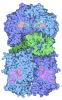
- Assembly
| Deposited unit | 
|
|---|---|
| 1 |
|
-Components
-Protein , 1 types, 2 molecules AB
| #1: Protein | Mass: 115560.688 Da / Num. of mol.: 2 Source method: isolated from a genetically manipulated source Source: (gene. exp.) Homo sapiens (human) / Gene: NPR1, ANPRA / Production host:   Spodoptera frugiperda (fall armyworm) / References: UniProt: P16066, guanylate cyclase Spodoptera frugiperda (fall armyworm) / References: UniProt: P16066, guanylate cyclase |
|---|
-Antibody , 2 types, 2 molecules HL
| #2: Antibody | Mass: 24483.457 Da / Num. of mol.: 1 Source method: isolated from a genetically manipulated source Source: (gene. exp.) Mus musculus (house mouse) / Production host: Spodoptera frugiperda (fall armyworm) |
|---|---|
| #3: Antibody | Mass: 23450.102 Da / Num. of mol.: 1 Source method: isolated from a genetically manipulated source Source: (gene. exp.) Mus musculus (house mouse) / Production host: Spodoptera frugiperda (fall armyworm) |
-Sugars , 2 types, 4 molecules
| #4: Polysaccharide | Source method: isolated from a genetically manipulated source #5: Polysaccharide | beta-D-mannopyranose-(1-4)-2-acetamido-2-deoxy-beta-D-glucopyranose-(1-4)-2-acetamido-2-deoxy-beta- ...beta-D-mannopyranose-(1-4)-2-acetamido-2-deoxy-beta-D-glucopyranose-(1-4)-2-acetamido-2-deoxy-beta-D-glucopyranose | Source method: isolated from a genetically manipulated source |
|---|
-Non-polymers , 2 types, 4 molecules 

| #6: Chemical |  Mass: 35.453 Da / Num. of mol.: 2 / Source method: obtained synthetically / Formula: Cl / Feature type: SUBJECT OF INVESTIGATION Mass: 35.453 Da / Num. of mol.: 2 / Source method: obtained synthetically / Formula: Cl / Feature type: SUBJECT OF INVESTIGATION#7: Water | ChemComp-HOH / | Mass: 18.015 Da / Num. of mol.: 2 / Source method: isolated from a natural source / Formula: H2O |
|---|
-Details
| Has ligand of interest | Y |
|---|---|
| Has protein modification | Y |
-Experimental details
-Experiment
| Experiment | Method: ELECTRON MICROSCOPY |
|---|---|
| EM experiment | Aggregation state: PARTICLE / 3D reconstruction method: single particle reconstruction |
- Sample preparation
| Component | Name: Complex of Guanylyl Cyclase-A/Natriuretic peptide receptor A with Fab fragment Type: COMPLEX / Entity ID: #1-#3 / Source: RECOMBINANT |
|---|---|
| Source (natural) | Organism: Homo sapiens (human) |
| Source (recombinant) | Organism: Spodoptera frugiperda (fall armyworm) |
| Buffer solution | pH: 8 |
| Specimen | Embedding applied: NO / Shadowing applied: NO / Staining applied: NO / Vitrification applied: YES |
| Vitrification | Cryogen name: ETHANE |
- Electron microscopy imaging
| Experimental equipment |  Model: Titan Krios / Image courtesy: FEI Company |
|---|---|
| Microscopy | Model: TFS KRIOS |
| Electron gun | Electron source:  FIELD EMISSION GUN / Accelerating voltage: 300 kV / Illumination mode: FLOOD BEAM FIELD EMISSION GUN / Accelerating voltage: 300 kV / Illumination mode: FLOOD BEAM |
| Electron lens | Mode: BRIGHT FIELD / Nominal defocus max: 2000 nm / Nominal defocus min: 800 nm |
| Image recording | Electron dose: 51 e/Å2 / Film or detector model: GATAN K3 (6k x 4k) |
- Processing
| EM software | Name: PHENIX / Version: 1.20.1_4487: / Category: model refinement | ||||||||||||||||||||||||
|---|---|---|---|---|---|---|---|---|---|---|---|---|---|---|---|---|---|---|---|---|---|---|---|---|---|
| CTF correction | Type: PHASE FLIPPING AND AMPLITUDE CORRECTION | ||||||||||||||||||||||||
| 3D reconstruction | Resolution: 3.3 Å / Resolution method: FSC 0.143 CUT-OFF / Num. of particles: 505000 / Symmetry type: POINT | ||||||||||||||||||||||||
| Refine LS restraints |
|
