 ムービー
ムービー コントローラー


+ データを開く

- 基本情報
基本情報
| 登録情報 | データベース: PDB / ID: 9cci | |||||||||||||||||||||||||||||||||||||||||||||||||||
|---|---|---|---|---|---|---|---|---|---|---|---|---|---|---|---|---|---|---|---|---|---|---|---|---|---|---|---|---|---|---|---|---|---|---|---|---|---|---|---|---|---|---|---|---|---|---|---|---|---|---|---|---|
| タイトル | Dissecting human monoclonal antibody responses from mRNA and protein-based booster vaccinations against XBB1.5 SARS-CoV-2 | |||||||||||||||||||||||||||||||||||||||||||||||||||
 要素 要素 |
| |||||||||||||||||||||||||||||||||||||||||||||||||||
 キーワード キーワード | VIRAL PROTEIN/IMMUNE SYSTEM / SARS-CoV-2 / Antibody / RBD / Immune SYSTEM / VIRUS LIKE PARTICLE / VIRAL PROTEIN-IMMUNE SYSTEM complex | |||||||||||||||||||||||||||||||||||||||||||||||||||
| 機能・相同性 |  機能・相同性情報 機能・相同性情報symbiont-mediated disruption of host tissue / Maturation of spike protein / Translation of Structural Proteins / Virion Assembly and Release / host cell surface / host extracellular region / symbiont-mediated-mediated suppression of host tetherin activity / Induction of Cell-Cell Fusion / structural constituent of virion / positive regulation of viral entry into host cell ...symbiont-mediated disruption of host tissue / Maturation of spike protein / Translation of Structural Proteins / Virion Assembly and Release / host cell surface / host extracellular region / symbiont-mediated-mediated suppression of host tetherin activity / Induction of Cell-Cell Fusion / structural constituent of virion / positive regulation of viral entry into host cell / membrane fusion / host cell endoplasmic reticulum-Golgi intermediate compartment membrane / Attachment and Entry / entry receptor-mediated virion attachment to host cell / receptor-mediated virion attachment to host cell / host cell surface receptor binding / symbiont-mediated suppression of host innate immune response / endocytosis involved in viral entry into host cell / receptor ligand activity / fusion of virus membrane with host plasma membrane / fusion of virus membrane with host endosome membrane / viral envelope / symbiont entry into host cell / virion attachment to host cell / host cell plasma membrane / SARS-CoV-2 activates/modulates innate and adaptive immune responses / virion membrane / membrane / identical protein binding / plasma membrane 類似検索 - 分子機能 | |||||||||||||||||||||||||||||||||||||||||||||||||||
| 生物種 |  Homo sapiens (ヒト) Homo sapiens (ヒト) 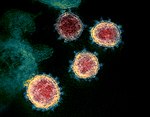 Severe acute respiratory syndrome coronavirus 2 (ウイルス) Severe acute respiratory syndrome coronavirus 2 (ウイルス) | |||||||||||||||||||||||||||||||||||||||||||||||||||
| 手法 | 電子顕微鏡法 / 単粒子再構成法 / クライオ電子顕微鏡法 / 解像度: 2.65 Å | |||||||||||||||||||||||||||||||||||||||||||||||||||
 データ登録者 データ登録者 | Bajic, G. / Jaiswal, D. | |||||||||||||||||||||||||||||||||||||||||||||||||||
| 資金援助 |  米国, 1件 米国, 1件
| |||||||||||||||||||||||||||||||||||||||||||||||||||
 引用 引用 | ジャーナル: Lancet Microbe / 年: 2025 タイトル: Mapping of human monoclonal antibody responses to XBB.1.5 COVID-19 monovalent vaccines: a B cell analysis. 著者: Raianna F Fantin / Jordan J Clark / Hallie Cohn / Deepika Jaiswal / Bailey Bozarth / Vishal Rao / Alesandro Civljak / Igor Lobo / Jessica R Nardulli / Komal Srivastava / Jeremy S Yong / ...著者: Raianna F Fantin / Jordan J Clark / Hallie Cohn / Deepika Jaiswal / Bailey Bozarth / Vishal Rao / Alesandro Civljak / Igor Lobo / Jessica R Nardulli / Komal Srivastava / Jeremy S Yong / Robert Andreata-Santos / Kaitlyn Bushfield / Edward S Lee / Gagandeep Singh / / Steven H Kleinstein / Florian Krammer / Viviana Simon / Goran Bajic / Camila H Coelho /   要旨: BACKGROUND: The rapid emergence of highly transmissible and immune-evasive SARS-CoV-2 variants has required the reformulation of COVID-19 vaccines to target these evolving threats. Although previous ...BACKGROUND: The rapid emergence of highly transmissible and immune-evasive SARS-CoV-2 variants has required the reformulation of COVID-19 vaccines to target these evolving threats. Although previous infections and booster vaccinations can boost variant neutralisation, it remains uncertain whether monovalent vaccines-delivered via mRNA or protein-based platforms-can trigger novel B-cell responses specific to omicron XBB.1.5 variants. We sought to address this uncertainty by characterising the antibody repertoire of individuals receiving a monovalent booster vaccine. 手法: In this observational study, we analysed the genetic antibody repertoire of 603 individual plasmablasts from five individuals (recruited at the Icahn School of Medicine at Mount Sinai, New ...手法: In this observational study, we analysed the genetic antibody repertoire of 603 individual plasmablasts from five individuals (recruited at the Icahn School of Medicine at Mount Sinai, New York, NY, USA, from STUDY-16-01215/IRB-16-00971 and STUDY-20-00442/IRB-20-03374) vaccinated with a monovalent XBB.1.5 vaccine, either through mRNA (Moderna or Pfizer-BioNTech; participants 1, 2, and 3) or adjuvanted protein (Novavax; participants 4 and 5) platforms. Before XBB.1.5 booster vaccination, all participants received mRNA-based priming and booster vaccine with ancestral SARS-CoV-2 and four of the five participants had a breakthrough omicron variant infection. We expressed 100 human monoclonal antibodies (mAbs; 50 from participants 1, 2, and 3, and 50 from participants 4 and 5) and evaluated their binding and neutralisation against various SARS-CoV-2 variants, including JN.1. We then selected four mAbs for in-vivo protection experiments by passive immunisation and viral challenge, and cryo-electron microscopy with two selected mAbs complexed with the XBB.1.5 spike (S) protein to determine their structures and binding interactions. FINDINGS: Between October and November, 2023, we enrolled three male and two female participants (mean age 46 years) all of whom were White. We identified 21 binding mAbs and tested their ...FINDINGS: Between October and November, 2023, we enrolled three male and two female participants (mean age 46 years) all of whom were White. We identified 21 binding mAbs and tested their neutralisation capacity against ancestral SARS-CoV-2, XBB.1.5, and JN.1. From the six neutralising mAbs we characterised, we selected three (M2, M27, and M39) for in-vivo protection studies, along with one broadly binding antibody (M15), finding that three neutralising mAbs offered full protection against morbidity from XBB.1.5. M27 also displayed robust protection against the ancestral and JN.1 strains, and M39 offered partial protection from JN.1. Among these, we identified two standout antibodies: M2 and M39. M2 was uniquely specific to XBB.1.5, and M39 demonstrated the ability to bind and neutralise both XBB.1.5 and JN.1 strains. Using high-resolution cryo-electron microscopy, we mapped the binding sites of M2 and M39 on the XBB.1.5 S glycoprotein, uncovering the precise molecular interactions that dictate their specificity. INTERPRETATION: Our findings offer key molecular insights into whether strain-specific boosters elicit sufficient protection against SARS-CoV-2 emerging variants. This knowledge can inform decisions ...INTERPRETATION: Our findings offer key molecular insights into whether strain-specific boosters elicit sufficient protection against SARS-CoV-2 emerging variants. This knowledge can inform decisions on booster design and strategies to enhance preparedness to evolving viral threats. FUNDING: Icahn School of Medicine at Mount Sinai; National Institutes of Health (NIH) FIRST; Laura and Isaac Perlmutter Cancer Center Support Grant; National Institute of Allergy and Infectious ...FUNDING: Icahn School of Medicine at Mount Sinai; National Institutes of Health (NIH) FIRST; Laura and Isaac Perlmutter Cancer Center Support Grant; National Institute of Allergy and Infectious Diseases; Human Immunology Project Consortium by NIH; the São Paulo Research Foundation; the National Heart, Lung, and Blood Institute of the NIH; Irma T Hirschl and Monique Weill-Caulier Trust; and the Collaborative Influenza Vaccine Innovation Centers. #1: ジャーナル: bioRxiv / 年: 2024 タイトル: Dissecting human monoclonal antibody responses from mRNA- and protein-based XBB.1.5 COVID-19 monovalent vaccines. 著者: Raianna F Fantin / Jordan J Clark / Hallie Cohn / Deepika Jaiswal / Bailey Bozarth / Alesandro Civljak / Vishal Rao / Igor Lobo / Jessica R Nardulli / Komal Srivastava / Jeremy Yong / Robert ...著者: Raianna F Fantin / Jordan J Clark / Hallie Cohn / Deepika Jaiswal / Bailey Bozarth / Alesandro Civljak / Vishal Rao / Igor Lobo / Jessica R Nardulli / Komal Srivastava / Jeremy Yong / Robert Andreata-Santos / Kaitlyn Bushfield / Edward S Lee / Gagandeep Singh / / Steven H Kleinstein / Florian Krammer / Viviana Simon / Goran Bajic / Camila H Coelho / 要旨: The emergence of highly contagious and immune-evasive severe acute respiratory syndrome coronavirus 2 (SARS-CoV-2) variants has required reformulation of coronavirus disease 2019 (COVID-19) vaccines ...The emergence of highly contagious and immune-evasive severe acute respiratory syndrome coronavirus 2 (SARS-CoV-2) variants has required reformulation of coronavirus disease 2019 (COVID-19) vaccines to target those new variants specifically. While previous infections and booster vaccinations can enhance variant neutralization, it is unclear whether the monovalent version, administered using either mRNA or protein-based vaccine platforms, can elicit B-cell responses specific for Omicron XBB.1.5 variants. Here, we dissected the genetic antibody repertoire of 603 individual plasmablasts derived from five individuals who received a monovalent XBB.1.5 vaccination either with mRNA (Moderna or Pfizer/BioNtech) or adjuvanted protein (Novavax). From these sequences, we expressed 100 human monoclonal antibodies and determined binding, affinity and protective potential against several SARS-CoV-2 variants, including JN.1. We then select two vaccine-induced XBB.1.5 mAbs, M2 and M39. M2 mAb was a , antibody, i.e., specific for XBB.1.5 but not ancestral SARS-CoV-2. M39 bound and neutralized both XBB.1.5 and JN.1 strains. Our high-resolution cryo-electron microscopy (EM) structures of M2 and M39 in complex with the XBB.1.5 spike glycoprotein defined the epitopes engaged and revealed the molecular determinants for the mAbs' specificity. These data show, at the molecular level, that monovalent, variant-specific vaccines can elicit functional antibodies, and shed light on potential functional and genetic differences of mAbs induced by vaccinations with different vaccine platforms.\. | |||||||||||||||||||||||||||||||||||||||||||||||||||
| 履歴 |
|
- 構造の表示
構造の表示
| 構造ビューア | 分子: MolmilJmol/JSmol |
|---|
- ダウンロードとリンク
-ダウンロード
| PDBx/mmCIF形式 | 9cci.cif.gz | 148 KB | 表示 | PDBx/mmCIF形式 |
|---|---|---|---|---|
| PDB形式 | pdb9cci.ent.gz | 99.5 KB | 表示 | PDB形式 |
| PDBx/mmJSON形式 | 9cci.json.gz | ツリー表示 | PDBx/mmJSON形式 | |
| その他 |  その他のダウンロード その他のダウンロード |
-検証レポート
| アーカイブディレクトリ | https://data.pdbj.org/pub/pdb/validation_reports/cc/9cciftp://data.pdbj.org/pub/pdb/validation_reports/cc/9cci | HTTPS FTP |
|---|
-関連構造データ
-リンク
 PDBj
PDBj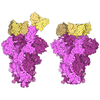
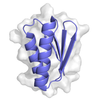
- 集合体
集合体
| 登録構造単位 | 
|
|---|---|
| 1 |
|
-要素
| #1: 抗体 | 分子量: 24543.383 Da / 分子数: 1 / 由来タイプ: 組換発現 / 由来: (組換発現) Homo sapiens (ヒト) / 発現宿主: Homo sapiens (ヒト) |
|---|---|
| #2: タンパク質 | 分子量: 137862.172 Da / 分子数: 1 / 由来タイプ: 組換発現 / 詳細: variant XBB1.5 on a hexapro background 由来: (組換発現) Severe acute respiratory syndrome coronavirus 2 (ウイルス)遺伝子: S, 2 / 発現宿主: Homo sapiens (ヒト) / 参照: UniProt: P0DTC2 |
| #3: 抗体 | 分子量: 22990.451 Da / 分子数: 1 / 由来タイプ: 組換発現 / 由来: (組換発現) Homo sapiens (ヒト) / 発現宿主: Homo sapiens (ヒト) |
| #4: 糖 | ChemComp-NAG / 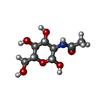 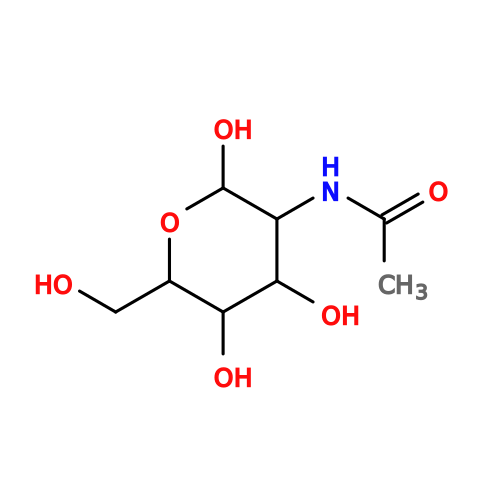 タイプ: D-saccharide, beta linking / 分子量: 221.208 Da / 分子数: 1 / 由来タイプ: 組換発現 / 式: C8H15NO6 / タイプ: SUBJECT OF INVESTIGATION タイプ: D-saccharide, beta linking / 分子量: 221.208 Da / 分子数: 1 / 由来タイプ: 組換発現 / 式: C8H15NO6 / タイプ: SUBJECT OF INVESTIGATION |
| 研究の焦点であるリガンドがあるか | Y |
| Has protein modification | Y |
-実験情報
-実験
| 実験 | 手法: 電子顕微鏡法 |
|---|---|
| EM実験 | 試料の集合状態: PARTICLE / 3次元再構成法: 単粒子再構成法 |
- 試料調製
試料調製
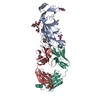
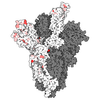
| 構成要素 | 名称: M39 Fab complex with RBD on XBB1.5 spike / タイプ: COMPLEX / Entity ID: #1-#3 / 由来: MULTIPLE SOURCES |
|---|---|
| 緩衝液 | pH: 7.5 |
| 試料 | 濃度: 2 mg/ml / 包埋: NO / シャドウイング: NO / 染色: NO / 凍結: YES |
| 急速凍結 | 凍結剤: ETHANE |
- 電子顕微鏡撮影
| 実験機器 |  モデル: Titan Krios / 画像提供: FEI Company |
|---|---|
| 顕微鏡 | モデル: TFS KRIOS |
| 電子銃 | 電子線源:  FIELD EMISSION GUN / 加速電圧: 300 kV / 照射モード: OTHER FIELD EMISSION GUN / 加速電圧: 300 kV / 照射モード: OTHER |
| 電子レンズ | モード: BRIGHT FIELD / 最大 デフォーカス(公称値): 2400 nm / 最小 デフォーカス(公称値): 600 nm |
| 撮影 | 電子線照射量: 49.883 e/Å2 / フィルム・検出器のモデル: GATAN K3 (6k x 4k) |
- 解析
解析
| EMソフトウェア | 名称: PHENIX / カテゴリ: モデル精密化 | ||||||||||||||||||||||||
|---|---|---|---|---|---|---|---|---|---|---|---|---|---|---|---|---|---|---|---|---|---|---|---|---|---|
| CTF補正 | タイプ: PHASE FLIPPING ONLY | ||||||||||||||||||||||||
| 3次元再構成 | 解像度: 2.65 Å / 解像度の算出法: FSC 0.143 CUT-OFF / 粒子像の数: 549696 / 対称性のタイプ: POINT | ||||||||||||||||||||||||
| 拘束条件 |
|
