 Movie
Movie Controller

[English] 日本語
 Yorodumi
- PDB-8wqg: cryo-EM structure of neddylated CUL2-RBX1-ELOB-ELOC-FEM1B bound w... -
+ Open data

- Basic information
| Entry | Database: PDB / ID: 8wqg | ||||||
|---|---|---|---|---|---|---|---|
| Title | cryo-EM structure of neddylated CUL2-RBX1-ELOB-ELOC-FEM1B bound with the C-degron of CCDC89 (conformation 1) | ||||||
 Components Components |
| ||||||
 Keywords Keywords | LIGASE / E3 ubiquitin ligase / Pro/C-degron | ||||||
| Function / homology |  Function and homology information Function and homology informationcellular response to camptothecin / negative regulation of beige fat cell differentiation / cullin-RING-type E3 NEDD8 transferase / NEDD8 transferase activity / negative regulation of mitophagy / cullin-RING ubiquitin ligase complex / regulation of xenophagy / target-directed miRNA degradation / Loss of Function of FBXW7 in Cancer and NOTCH1 Signaling / cellular response to chemical stress ...cellular response to camptothecin / negative regulation of beige fat cell differentiation / cullin-RING-type E3 NEDD8 transferase / NEDD8 transferase activity / negative regulation of mitophagy / cullin-RING ubiquitin ligase complex / regulation of xenophagy / target-directed miRNA degradation / Loss of Function of FBXW7 in Cancer and NOTCH1 Signaling / cellular response to chemical stress / Cul7-RING ubiquitin ligase complex / elongin complex / death receptor binding / regulation of extrinsic apoptotic signaling pathway via death domain receptors / regulation of cell cycle process / neural crest cell differentiation / RNA polymerase II transcription initiation surveillance / positive regulation of protein autoubiquitination / protein neddylation / regulation of BMP signaling pathway / NEDD8 ligase activity / regulation of mitophagy / negative regulation of response to oxidative stress / regulation of centrosome duplication / protein K27-linked ubiquitination / VCB complex / Cul5-RING ubiquitin ligase complex / regulation of TOR signaling / ubiquitin-ubiquitin ligase activity / ubiquitin-dependent protein catabolic process via the C-end degron rule pathway / Cul2-RING ubiquitin ligase complex / SCF ubiquitin ligase complex / negative regulation of DNA-templated DNA replication / regulation of mitotic cytokinesis / Cul3-RING ubiquitin ligase complex / regulation of DNA damage checkpoint / negative regulation of type I interferon production / regulation of miRNA-mediated gene silencing / regulation of natural killer cell activation / SCF-dependent proteasomal ubiquitin-dependent protein catabolic process / Prolactin receptor signaling / regulation of cell cycle phase transition / Cul4A-RING E3 ubiquitin ligase complex / Cul4-RING E3 ubiquitin ligase complex / regulation of stem cell population maintenance / Cul4B-RING E3 ubiquitin ligase complex / TGF-beta receptor signaling activates SMADs / ubiquitin ligase complex scaffold activity / negative regulation of adipose tissue development / regulation of proteolysis / regulation of cellular response to stress / Pausing and recovery of Tat-mediated HIV elongation / Tat-mediated HIV elongation arrest and recovery / limb development / HIV elongation arrest and recovery / Pausing and recovery of HIV elongation / regulation of postsynapse assembly / protein monoubiquitination / anatomical structure morphogenesis / cullin family protein binding / Tat-mediated elongation of the HIV-1 transcript / ubiquitin ligase complex / Formation of HIV-1 elongation complex containing HIV-1 Tat / regulation of DNA-templated DNA replication initiation / centrosome duplication / Formation of HIV elongation complex in the absence of HIV Tat / cilium assembly / ubiquitin-like ligase-substrate adaptor activity / RNA Polymerase II Transcription Elongation / Formation of RNA Pol II elongation complex / intrinsic apoptotic signaling pathway / ribosome-associated ubiquitin-dependent protein catabolic process / signal transduction in response to DNA damage / negative regulation of insulin receptor signaling pathway / Nuclear events stimulated by ALK signaling in cancer / protein K48-linked ubiquitination / RNA Polymerase II Pre-transcription Events / regulation of cellular response to insulin stimulus / positive regulation of TORC1 signaling / transcription-coupled nucleotide-excision repair / post-translational protein modification / cellular response to amino acid stimulus / regulation of embryonic development / replication fork processing / transcription corepressor binding / protein modification process / negative regulation of canonical NF-kappaB signal transduction / rescue of stalled cytosolic ribosome / regulation of mitotic cell cycle / site of DNA damage / Regulation of BACH1 activity / T cell activation / TP53 Regulates Transcription of DNA Repair Genes / G1/S transition of mitotic cell cycle / negative regulation of canonical Wnt signaling pathway / transcription initiation at RNA polymerase II promoter / epigenetic regulation of gene expression / Degradation of DVL / Degradation of CRY and PER proteins / nucleotide-excision repair Similarity search - Function | ||||||
| Biological species |  Homo sapiens (human) Homo sapiens (human) | ||||||
| Method | ELECTRON MICROSCOPY / single particle reconstruction / cryo EM / Resolution: 4.09 Å | ||||||
 Authors Authors | Chen, X. / Zhang, K. / Xu, C. | ||||||
| Funding support |  China, 1items China, 1items
| ||||||
 Citation Citation | Journal: Nat Commun / Year: 2024 Title: Mechanism of Ψ-Pro/C-degron recognition by the CRL2 ubiquitin ligase. Authors: Xinyan Chen / Anat Raiff / Shanshan Li / Qiong Guo / Jiahai Zhang / Hualin Zhou / Richard T Timms / Xuebiao Yao / Stephen J Elledge / Itay Koren / Kaiming Zhang / Chao Xu /    Abstract: The E3 ligase-degron interaction determines the specificity of the ubiquitin‒proteasome system. We recently discovered that FEM1B, a substrate receptor of Cullin 2-RING ligase (CRL2), recognizes C- ...The E3 ligase-degron interaction determines the specificity of the ubiquitin‒proteasome system. We recently discovered that FEM1B, a substrate receptor of Cullin 2-RING ligase (CRL2), recognizes C-degrons containing a C-terminal proline. By solving several cryo-EM structures of CRL2 bound to different C-degrons, we elucidate the dimeric assembly of the complex. Furthermore, we reveal distinct dimerization states of unmodified and neddylated CRL2 to uncover the NEDD8-mediated activation mechanism of CRL2. Our research also indicates that, FEM1B utilizes a bipartite mechanism to recognize both the C-terminal proline and an upstream aromatic residue within the substrate. These structural findings, complemented by in vitro ubiquitination and in vivo cell-based assays, demonstrate that CRL2-mediated polyubiquitination and subsequent protein turnover depend on both FEM1B-degron interactions and the dimerization state of the E3 ligase complex. Overall, this study deepens our molecular understanding of how Cullin-RING E3 ligase substrate selection mediates protein turnover. | ||||||
| History |
|
- Structure visualization
| Structure viewer | Molecule: MolmilJmol/JSmol |
|---|
- Downloads & links
-Download
| PDBx/mmCIF format | 8wqg.cif.gz | 656.9 KB | Display | PDBx/mmCIF format |
|---|---|---|---|---|
| PDB format | pdb8wqg.ent.gz | 524.4 KB | Display | PDB format |
| PDBx/mmJSON format | 8wqg.json.gz | Tree view | PDBx/mmJSON format | |
| Others |  Other downloads Other downloads |
-Validation report
| Arichive directory | https://data.pdbj.org/pub/pdb/validation_reports/wq/8wqgftp://data.pdbj.org/pub/pdb/validation_reports/wq/8wqg | HTTPS FTP |
|---|
-Related structure data
| Related structure data |  37744MC  8wqaC  8wqbC  8wqcC  8wqdC  8wqeC  8wqfC  8wqhC  8wqiC M: map data used to model this data C: citing same article ( |
|---|---|
| Similar structure data |


-Links
 PDBj
PDBj

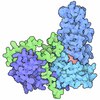
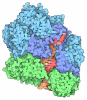
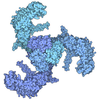
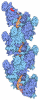
- Assembly
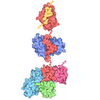
| Deposited unit | 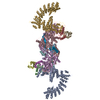
|
|---|---|
| 1 |
|
-Components
-Protein , 6 types, 12 molecules DIFJBHCENKAG
| #1: Protein | Mass: 13147.781 Da / Num. of mol.: 2 Source method: isolated from a genetically manipulated source Source: (gene. exp.) Homo sapiens (human) / Gene: ELOB, TCEB2 / Production host:   Escherichia coli (E. coli) / References: UniProt: Q15370 Escherichia coli (E. coli) / References: UniProt: Q15370#2: Protein | Mass: 11196.830 Da / Num. of mol.: 2 Source method: isolated from a genetically manipulated source Source: (gene. exp.) Homo sapiens (human) / Gene: RBX1, RNF75, ROC1 / Production host: Escherichia coli (E. coli) / References: UniProt: P62877#3: Protein | Mass: 10843.420 Da / Num. of mol.: 2 Source method: isolated from a genetically manipulated source Source: (gene. exp.) Homo sapiens (human) / Gene: ELOC, TCEB1 / Production host: Escherichia coli (E. coli) / References: UniProt: Q15369#4: Protein | Mass: 87114.750 Da / Num. of mol.: 2 Source method: isolated from a genetically manipulated source Source: (gene. exp.) Homo sapiens (human) / Gene: CUL2 / Production host: Escherichia coli (E. coli) / References: UniProt: Q13617#5: Protein | Mass: 8573.978 Da / Num. of mol.: 2 Source method: isolated from a genetically manipulated source Source: (gene. exp.) Homo sapiens (human) / Gene: NEDD8 / Production host: Escherichia coli (E. coli) / References: UniProt: Q15843#6: Protein | Mass: 70355.062 Da / Num. of mol.: 2 Source method: isolated from a genetically manipulated source Source: (gene. exp.) Homo sapiens (human) / Gene: FEM1B, F1AA, KIAA0396 / Production host: Escherichia coli (E. coli) / References: UniProt: Q9UK73 |
|---|
-Non-polymers , 1 types, 6 molecules 
| #7: Chemical | ChemComp-ZN /  Mass: 65.409 Da / Num. of mol.: 6 / Source method: obtained synthetically / Formula: Zn Mass: 65.409 Da / Num. of mol.: 6 / Source method: obtained synthetically / Formula: Zn |
|---|
-Details
| Has ligand of interest | N |
|---|---|
| Has protein modification | Y |
-Experimental details
-Experiment
| Experiment | Method: ELECTRON MICROSCOPY |
|---|---|
| EM experiment | Aggregation state: PARTICLE / 3D reconstruction method: single particle reconstruction |
- Sample preparation
| Component | Name: cryo-EM structure of neddylated CUL2-RBX1-ELOB-ELOC-FEM1B bound with the C-degron of CCDC89 (conformation 1) Type: COMPLEX / Entity ID: #1-#6 / Source: MULTIPLE SOURCES |
|---|---|
| Source (natural) | Organism: Homo sapiens (human) |
| Source (recombinant) | Organism: Escherichia coli (E. coli) |
| Buffer solution | pH: 7.5 |
| Specimen | Conc.: 5 mg/ml / Embedding applied: NO / Shadowing applied: NO / Staining applied: NO / Vitrification applied: YES |
| Specimen support | Grid material: COPPER |
| Vitrification | Instrument: FEI VITROBOT MARK IV / Cryogen name: ETHANE / Humidity: 100 % / Chamber temperature: 277.15 K |
- Electron microscopy imaging
| Experimental equipment |  Model: Titan Krios / Image courtesy: FEI Company |
|---|---|
| Microscopy | Model: FEI TITAN KRIOS |
| Electron gun | Electron source:  FIELD EMISSION GUN / Accelerating voltage: 300 kV / Illumination mode: FLOOD BEAM FIELD EMISSION GUN / Accelerating voltage: 300 kV / Illumination mode: FLOOD BEAM |
| Electron lens | Mode: BRIGHT FIELD / Nominal defocus max: 2900 nm / Nominal defocus min: 1500 nm |
| Specimen holder | Cryogen: NITROGEN |
| Image recording | Electron dose: 57.6 e/Å2 / Film or detector model: GATAN K3 BIOQUANTUM (6k x 4k) / Num. of real images: 4223 |
| EM imaging optics | Energyfilter name: GIF Bioquantum / Energyfilter slit width: 20 eV |
- Processing
| EM software |
| ||||||||||||||||||||||||
|---|---|---|---|---|---|---|---|---|---|---|---|---|---|---|---|---|---|---|---|---|---|---|---|---|---|
| CTF correction | Type: PHASE FLIPPING AND AMPLITUDE CORRECTION | ||||||||||||||||||||||||
| 3D reconstruction | Resolution: 4.09 Å / Resolution method: FSC 0.143 CUT-OFF / Num. of particles: 102432 / Symmetry type: POINT | ||||||||||||||||||||||||
| Refine LS restraints |
|
