 Movie
Movie Controller


+ Open data

- Basic information
| Entry | Database: PDB / ID: 8k9i | |||||||||||||||
|---|---|---|---|---|---|---|---|---|---|---|---|---|---|---|---|---|
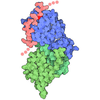
| Title | Structure of CUL3-RBX1-KLHL22 complex without CUL3 NA motif | |||||||||||||||
 Components Components |
| |||||||||||||||
 Keywords Keywords | LIGASE / Cullin Ring E3 ubiquitin ligase | |||||||||||||||
| Function / homology |  Function and homology information Function and homology informationpositive regulation of mitotic cell cycle phase transition / POZ domain binding / negative regulation of Rho protein signal transduction / embryonic cleavage / polar microtubule / anaphase-promoting complex-dependent catabolic process / nuclear protein quality control by the ubiquitin-proteasome system / regulation protein catabolic process at postsynapse / COPII vesicle coat assembly / cell projection organization ...positive regulation of mitotic cell cycle phase transition / POZ domain binding / negative regulation of Rho protein signal transduction / embryonic cleavage / polar microtubule / anaphase-promoting complex-dependent catabolic process / nuclear protein quality control by the ubiquitin-proteasome system / regulation protein catabolic process at postsynapse / COPII vesicle coat assembly / cell projection organization / RHOBTB3 ATPase cycle / cellular response to L-leucine / negative regulation of beige fat cell differentiation / positive regulation of T cell mediated immune response to tumor cell / cullin-RING-type E3 NEDD8 transferase / NEDD8 transferase activity / stem cell division / negative regulation of mitophagy / cullin-RING ubiquitin ligase complex / regulation of xenophagy / Loss of Function of FBXW7 in Cancer and NOTCH1 Signaling / positive regulation of mitotic metaphase/anaphase transition / cellular response to chemical stress / Cul7-RING ubiquitin ligase complex / regulation of cell cycle process / neural crest cell differentiation / RNA polymerase II transcription initiation surveillance / Notch binding / positive regulation of protein autoubiquitination / protein neddylation / stress fiber assembly / regulation of BMP signaling pathway / NEDD8 ligase activity / regulation of mitophagy / RHOBTB1 GTPase cycle / negative regulation of response to oxidative stress / regulation of centrosome duplication / protein K27-linked ubiquitination / VCB complex / Cul5-RING ubiquitin ligase complex / regulation of TOR signaling / ubiquitin-ubiquitin ligase activity / ubiquitin-dependent protein catabolic process via the C-end degron rule pathway / mitotic spindle assembly checkpoint signaling / Cul2-RING ubiquitin ligase complex / SCF ubiquitin ligase complex / negative regulation of DNA-templated DNA replication / intercellular bridge / regulation of mitotic cytokinesis / Cul3-RING ubiquitin ligase complex / regulation of DNA damage checkpoint / negative regulation of type I interferon production / positive regulation of cytokinesis / regulation of miRNA-mediated gene silencing / regulation of natural killer cell activation / SCF-dependent proteasomal ubiquitin-dependent protein catabolic process / Prolactin receptor signaling / regulation of cell cycle phase transition / Cul4A-RING E3 ubiquitin ligase complex / Cul4-RING E3 ubiquitin ligase complex / regulation of stem cell population maintenance / Cul4B-RING E3 ubiquitin ligase complex / mitotic sister chromatid segregation / ubiquitin ligase complex scaffold activity / negative regulation of adipose tissue development / regulation of cellular response to stress / limb development / protein monoubiquitination / cullin family protein binding / mitotic metaphase chromosome alignment / endoplasmic reticulum to Golgi vesicle-mediated transport / RHOBTB2 GTPase cycle / regulation of DNA-templated DNA replication initiation / centrosome duplication / sperm flagellum / protein autoubiquitination / cilium assembly / ubiquitin-like ligase-substrate adaptor activity / kidney development / intrinsic apoptotic signaling pathway / ribosome-associated ubiquitin-dependent protein catabolic process / signal transduction in response to DNA damage / negative regulation of insulin receptor signaling pathway / Nuclear events stimulated by ALK signaling in cancer / 14-3-3 protein binding / protein K48-linked ubiquitination / regulation of cellular response to insulin stimulus / positive regulation of TORC1 signaling / gene expression / transcription-coupled nucleotide-excision repair / post-translational protein modification / integrin-mediated signaling pathway / negative regulation of autophagy / cellular response to amino acid stimulus / regulation of embryonic development / cyclin binding / replication fork processing / positive regulation of protein ubiquitination / negative regulation of canonical NF-kappaB signal transduction / regulation of mitotic cell cycle Similarity search - Function | |||||||||||||||
| Biological species |  Homo sapiens (human) Homo sapiens (human) | |||||||||||||||
| Method | ELECTRON MICROSCOPY / single particle reconstruction / cryo EM / Resolution: 4.2 Å | |||||||||||||||
 Authors Authors | Wang, W. / Ling, L. / Dai, Z. / Zuo, P. / Yin, Y. | |||||||||||||||
| Funding support |  China, 4items China, 4items
| |||||||||||||||
 Citation Citation | Journal: Nat Commun / Year: 2024 Title: A conserved N-terminal motif of CUL3 contributes to assembly and E3 ligase activity of CRL3. Authors: Weize Wang / Ling Liang / Zonglin Dai / Peng Zuo / Shang Yu / Yishuo Lu / Dian Ding / Hongyi Chen / Hui Shan / Yan Jin / Youdong Mao / Yuxin Yin / Abstract: The CUL3-RING E3 ubiquitin ligases (CRL3s) play an essential role in response to extracellular nutrition and stress stimuli. The ubiquitin ligase function of CRL3s is activated through dimerization. ...The CUL3-RING E3 ubiquitin ligases (CRL3s) play an essential role in response to extracellular nutrition and stress stimuli. The ubiquitin ligase function of CRL3s is activated through dimerization. However, how and why such a dimeric assembly is required for its ligase activity remains elusive. Here, we report the cryo-EM structure of the dimeric CRL3 complex and reveal a conserved N-terminal motif in CUL3 that contributes to the dimerization assembly and the E3 ligase activity of CRL3. We show that deletion of the CUL3 N-terminal motif impairs dimeric assembly and the E3 ligase activity of both CRL3 and several other CRL3s. In addition, we found that the dynamics of dimeric assembly of CRL3 generates a variable ubiquitination zone, potentially facilitating substrate recognition and ubiquitination. These findings demonstrate that a CUL3 N-terminal motif participates in the assembly process and provide insights into the assembly and activation of CRL3s. | |||||||||||||||
| History |
|
- Structure visualization
| Structure viewer | Molecule: MolmilJmol/JSmol |
|---|
- Downloads & links
-Download
| PDBx/mmCIF format | 8k9i.cif.gz | 183.5 KB | Display | PDBx/mmCIF format |
|---|---|---|---|---|
| PDB format | pdb8k9i.ent.gz | 141.6 KB | Display | PDB format |
| PDBx/mmJSON format | 8k9i.json.gz | Tree view | PDBx/mmJSON format | |
| Others |  Other downloads Other downloads |
-Validation report
| Arichive directory | https://data.pdbj.org/pub/pdb/validation_reports/k9/8k9iftp://data.pdbj.org/pub/pdb/validation_reports/k9/8k9i | HTTPS FTP |
|---|
-Related structure data
| Related structure data |  36987MC 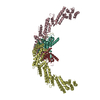 8k8tC M: map data used to model this data C: citing same article ( |
|---|---|
| Similar structure data |


-Links
 PDBj
PDBj
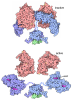

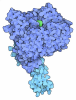

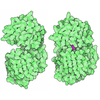
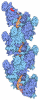
- Assembly
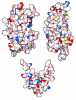
| Deposited unit | 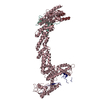
|
|---|---|
| 1 |
|
-Components
| #1: Protein | Mass: 87432.312 Da / Num. of mol.: 1 Source method: isolated from a genetically manipulated source Source: (gene. exp.) Homo sapiens (human) / Gene: CUL3 / Production host:   Spodoptera frugiperda (fall armyworm) / References: UniProt: Q13618 Spodoptera frugiperda (fall armyworm) / References: UniProt: Q13618 | ||
|---|---|---|---|
| #2: Protein | Mass: 20365.340 Da / Num. of mol.: 2 Source method: isolated from a genetically manipulated source Source: (gene. exp.) Homo sapiens (human) / Gene: KLHL22 / Production host: Spodoptera frugiperda (fall armyworm) / References: UniProt: Q53GT1#3: Protein | | Mass: 12289.977 Da / Num. of mol.: 1 Source method: isolated from a genetically manipulated source Source: (gene. exp.) Homo sapiens (human) / Gene: RBX1, RNF75, ROC1 / Production host: Spodoptera frugiperda (fall armyworm) / References: UniProt: P62877 |
-Experimental details
-Experiment
| Experiment | Method: ELECTRON MICROSCOPY |
|---|---|
| EM experiment | Aggregation state: PARTICLE / 3D reconstruction method: single particle reconstruction |
- Sample preparation
| Component | Name: CUL3-RBX1-KLHL22 complex without CUL3 NA motif / Type: COMPLEX / Entity ID: all / Source: RECOMBINANT | ||||||||||||||||||||
|---|---|---|---|---|---|---|---|---|---|---|---|---|---|---|---|---|---|---|---|---|---|
| Source (natural) | Organism: Homo sapiens (human) | ||||||||||||||||||||
| Source (recombinant) | Organism: Spodoptera frugiperda (fall armyworm) | ||||||||||||||||||||
| Buffer solution | pH: 7.5 | ||||||||||||||||||||
| Buffer component |
| ||||||||||||||||||||
| Specimen | Conc.: 2 mg/ml / Embedding applied: NO / Shadowing applied: NO / Staining applied: NO / Vitrification applied: YES | ||||||||||||||||||||
| Specimen support | Grid type: Quantifoil R1.2/1.3 | ||||||||||||||||||||
| Vitrification | Instrument: FEI VITROBOT MARK IV / Cryogen name: ETHANE / Humidity: 100 % / Chamber temperature: 277 K |
- Electron microscopy imaging
| Experimental equipment |  Model: Titan Krios / Image courtesy: FEI Company |
|---|---|
| Microscopy | Model: FEI TITAN KRIOS |
| Electron gun | Electron source:  FIELD EMISSION GUN / Accelerating voltage: 300 kV / Illumination mode: FLOOD BEAM FIELD EMISSION GUN / Accelerating voltage: 300 kV / Illumination mode: FLOOD BEAM |
| Electron lens | Mode: DIFFRACTION / Nominal defocus max: 2000 nm / Nominal defocus min: 1500 nm |
| Image recording | Electron dose: 50 e/Å2 / Detector mode: SUPER-RESOLUTION / Film or detector model: GATAN K2 SUMMIT (4k x 4k) |
- Processing
| EM software |
| ||||||||||||||||||||||||
|---|---|---|---|---|---|---|---|---|---|---|---|---|---|---|---|---|---|---|---|---|---|---|---|---|---|
| CTF correction | Type: PHASE FLIPPING AND AMPLITUDE CORRECTION | ||||||||||||||||||||||||
| Particle selection | Num. of particles selected: 74279 | ||||||||||||||||||||||||
| 3D reconstruction | Resolution: 4.2 Å / Resolution method: FSC 0.143 CUT-OFF / Num. of particles: 74279 / Symmetry type: POINT |
