 Movie
Movie Controller


+ Open data

- Basic information
| Entry | Database: PDB / ID: 36pr | |||||||||
|---|---|---|---|---|---|---|---|---|---|---|
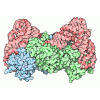
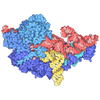
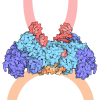
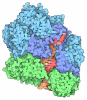
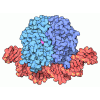
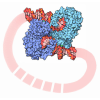
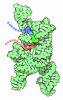
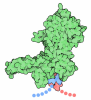
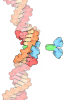
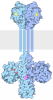
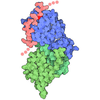
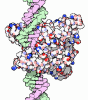
| Title | P. fulva VIPR Ternary Complex Consensus Conformation | |||||||||
 Components Components |
| |||||||||
 Keywords Keywords | RNA BINDING PROTEIN/RNA/DNA / Ribonucleoprotein / VIPR / RNA Binding Protein / Ternary Complex / RNA BINDING PROTEIN-RNA-DNA complex | |||||||||
| Function / homology | DNA / DNA (> 10) / RNA / RNA (> 10) Function and homology information Function and homology information | |||||||||
| Biological species |  Pseudomonas fulva (bacteria) Pseudomonas fulva (bacteria) Escherichia coli (E. coli) Escherichia coli (E. coli) | |||||||||
| Method | ELECTRON MICROSCOPY / single particle reconstruction / cryo EM / Resolution: 2.5 Å | |||||||||
 Authors Authors | Docter, T.A. / Yoon, P.H. / Zhang, Z. / Brohawn, S.G. / Doudna, J.A. | |||||||||
| Funding support |  United States, 1items United States, 1items
| |||||||||
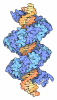
 Citation Citation | Journal: Science / Year: 2026 Title: VIPR RNA-guided DNA recognition by noncontiguous geometric triplex formation. Authors: Peter H Yoon / Trevor A Docter / Zeyuan Terry Zhang / Kenneth Loi / Santiago C Lopez / Luis E Valentin-Alvarado / Owen T Tuck / Stephen G Brohawn / Jennifer A Doudna / Abstract: Viral interference programmable repeat (VIPR) systems use a noncontiguous code for RNA-guided transcriptional silencing. How the Vipr protein and a VIPR RNA (vrRNA) comprising alternating GGY and NN ...Viral interference programmable repeat (VIPR) systems use a noncontiguous code for RNA-guided transcriptional silencing. How the Vipr protein and a VIPR RNA (vrRNA) comprising alternating GGY and NN segments achieve precise DNA targeting is unknown. Here, we present 21 cryo-electron microscopy structures that help explain the mechanism of target engagement. Vipr protomers oligomerize along the vrRNA to form a right-handed helical filament, sequestering each GGY motif and positioning the adjacent NN bases for target base pairing. DNA binding, in which every third nucleotide is skipped, results in a gapped vrRNA-DNA hybrid helix that encircles the nontarget DNA strand to form a geometric triplex. These findings suggest that triplex-mediated target-strand handoff could enable noncontiguous and programmable RNA-guided DNA recognition in VIPR systems. | |||||||||
| History |
|
- Structure visualization
| Structure viewer | Molecule: MolmilJmol/JSmol |
|---|
- Downloads & links
-Download
| PDBx/mmCIF format | 36pr.cif.gz | 420.6 KB | Display | PDBx/mmCIF format |
|---|---|---|---|---|
| PDB format | pdb36pr.ent.gz | 343.7 KB | Display | PDB format |
| PDBx/mmJSON format | 36pr.json.gz | Tree view | PDBx/mmJSON format | |
| Others |  Other downloads Other downloads |
-Validation report
| Arichive directory | https://data.pdbj.org/pub/pdb/validation_reports/6p/36prftp://data.pdbj.org/pub/pdb/validation_reports/6p/36pr | HTTPS FTP |
|---|
-Related structure data
| Related structure data |  77745MC  35seC  35sfC  35sgC  35syC  35trC  35twC  35txC  36pbC  36pcC  36pdC  36peC  36pfC  36pgC  36pjC  36pkC  36pmC  36poC M: map data used to model this data C: citing same article ( |
|---|---|
| Similar structure data |


-Links
 PDBj
PDBj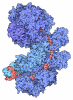
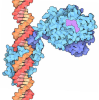
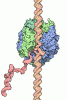
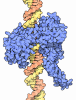

- Assembly
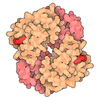
| Deposited unit | 
|
|---|---|
| 1 |
|
-Components
| #1: RNA chain | Mass: 17098.258 Da / Num. of mol.: 1 Source method: isolated from a genetically manipulated source Details: Pseudomonas fulva prophage / Source: (gene. exp.) Pseudomonas fulva (bacteria) / Production host: Escherichia coli (E. coli) | ||
|---|---|---|---|
| #2: DNA chain | Mass: 9280.916 Da / Num. of mol.: 1 Source method: isolated from a genetically manipulated source Details: Segment of an unknown target DNA sequence. DNA segments were modeled with the following logic: vrRNA NN domains were modeled as adenosines or cytosines, the target strand was modeled as ...Details: Segment of an unknown target DNA sequence. DNA segments were modeled with the following logic: vrRNA NN domains were modeled as adenosines or cytosines, the target strand was modeled as complementary to the vrRNA with x3 bases being treated as cytosines or guanines as density permitted. The non-target strand was modeled largely as thymines, with intermittent guanines and cytosines as density permitted. Source: (gene. exp.) Escherichia coli (E. coli) / Production host: Escherichia coli (E. coli) | ||
| #3: DNA chain | Mass: 5196.351 Da / Num. of mol.: 1 Source method: isolated from a genetically manipulated source Details: Segment of an unknown non-target DNA sequence. DNA segments were modeled with the following logic: vrRNA NN domains were modeled as adenosines or cytosines, the target strand was modeled as ...Details: Segment of an unknown non-target DNA sequence. DNA segments were modeled with the following logic: vrRNA NN domains were modeled as adenosines or cytosines, the target strand was modeled as complementary to the vrRNA with x3 bases being treated as cytosines or guanines as density permitted. The non-target strand was modeled largely as thymines, with intermittent guanines and cytosines as density permitted. Source: (gene. exp.) Escherichia coli (E. coli) / Production host: Escherichia coli (E. coli) | ||
| #4: Protein | Mass: 24085.209 Da / Num. of mol.: 10 Source method: isolated from a genetically manipulated source Details: Pseudomonas fulva prophage / Source: (gene. exp.) Pseudomonas fulva (bacteria) / Production host: Escherichia coli (E. coli)Has protein modification | N | |
-Experimental details
-Experiment
| Experiment | Method: ELECTRON MICROSCOPY |
|---|---|
| EM experiment | Aggregation state: PARTICLE / 3D reconstruction method: single particle reconstruction |
- Sample preparation
| Component | Name: Consensus Ternary complex of a P. fulva prophage VIPR system with an unknown substrate, showing 10 subunits. Type: COMPLEX / Entity ID: all / Source: RECOMBINANT |
|---|---|
| Source (natural) | Organism: Pseudomonas fulva (bacteria) |
| Source (recombinant) | Organism: Escherichia coli (E. coli) |
| Buffer solution | pH: 7.4 |
| Specimen | Embedding applied: NO / Shadowing applied: NO / Staining applied: NO / Vitrification applied: YES |
| Vitrification | Cryogen name: ETHANE |
- Electron microscopy imaging
| Experimental equipment |  Model: Titan Krios / Image courtesy: FEI Company |
|---|---|
| Microscopy | Model: TFS KRIOS |
| Electron gun | Electron source:  FIELD EMISSION GUN / Accelerating voltage: 300 kV / Illumination mode: FLOOD BEAM FIELD EMISSION GUN / Accelerating voltage: 300 kV / Illumination mode: FLOOD BEAM |
| Electron lens | Mode: BRIGHT FIELD / Nominal defocus max: 1600 nm / Nominal defocus min: 600 nm |
| Image recording | Electron dose: 50 e/Å2 / Film or detector model: GATAN K3 BIOQUANTUM (6k x 4k) |
- Processing
| EM software |
| ||||||||||||||||
|---|---|---|---|---|---|---|---|---|---|---|---|---|---|---|---|---|---|
| CTF correction | Type: PHASE FLIPPING AND AMPLITUDE CORRECTION | ||||||||||||||||
| 3D reconstruction | Resolution: 2.5 Å / Resolution method: FSC 0.143 CUT-OFF / Num. of particles: 95999 / Symmetry type: POINT | ||||||||||||||||
| Refinement | Highest resolution: 2.5 Å Stereochemistry target values: REAL-SPACE (WEIGHTED MAP SUM AT ATOM CENTERS) |
