 Movie
Movie Controller


+ Open data

- Basic information
| Entry | Database: PDB / ID: 22jx | |||||||||
|---|---|---|---|---|---|---|---|---|---|---|
| Title | Cryo-EM structure of the mGlu5-beta-arrestin 1 complex | |||||||||
 Components Components |
| |||||||||
 Keywords Keywords | MEMBRANE PROTEIN/IMMUNE SYSTEM / GPCR / Metabotropic glutamate receptor / beta-arrestin / MEMBRANE PROTEIN / MEMBRANE PROTEIN-IMMUNE SYSTEM complex | |||||||||
| Function / homology |  Function and homology information Function and homology informationA2A adenosine receptor binding / sensory perception of hot stimulus / negative regulation of dendritic spine morphogenesis / : / operant conditioning / G protein-coupled receptor activity involved in regulation of postsynaptic membrane potential / adenylate cyclase inhibiting G protein-coupled glutamate receptor activity / protein localization to nuclear inner membrane / phospholipase C-activating G protein-coupled glutamate receptor signaling pathway / positive regulation of cellular response to hypoxia ...A2A adenosine receptor binding / sensory perception of hot stimulus / negative regulation of dendritic spine morphogenesis / : / operant conditioning / G protein-coupled receptor activity involved in regulation of postsynaptic membrane potential / adenylate cyclase inhibiting G protein-coupled glutamate receptor activity / protein localization to nuclear inner membrane / phospholipase C-activating G protein-coupled glutamate receptor signaling pathway / positive regulation of cellular response to hypoxia / positive regulation of long-term neuronal synaptic plasticity / positive regulation of sensory perception of pain / positive regulation of dopamine secretion / negative regulation of excitatory postsynaptic potential / desensitization of G protein-coupled receptor signaling pathway / G protein-coupled glutamate receptor signaling pathway / positive regulation of neural precursor cell proliferation / Class C/3 (Metabotropic glutamate/pheromone receptors) / nuclear inner membrane / Neurexins and neuroligins / glutamate receptor activity / astrocyte projection / response to corticosterone / response to morphine / temperature homeostasis / protein tyrosine kinase activator activity / conditioned place preference / regulation of synaptic transmission, glutamatergic / positive regulation of calcium-mediated signaling / regulation of long-term synaptic depression / response to amphetamine / protein tyrosine kinase binding / dendritic shaft / synapse organization / postsynaptic density membrane / cognition / Schaffer collateral - CA1 synapse / cellular response to amyloid-beta / G protein-coupled receptor activity / positive regulation of cytosolic calcium ion concentration / chemical synaptic transmission / response to ethanol / dendritic spine / G alpha (q) signalling events / positive regulation of MAPK cascade / learning or memory / response to antibiotic / neuronal cell body / regulation of DNA-templated transcription / dendrite / glutamatergic synapse / identical protein binding / plasma membrane / cytoplasm Similarity search - Function | |||||||||
| Biological species |  Homo sapiens (human) Homo sapiens (human)  Mus musculus (house mouse) Mus musculus (house mouse) | |||||||||
| Method | ELECTRON MICROSCOPY / single particle reconstruction / cryo EM / Resolution: 3.7 Å | |||||||||
 Authors Authors | Lin, S. / Zhang, C. / Wei, J. / Chen, K. / Feng, Y. / Wang, Z. / Chu, X. / Yi, C. / Ma, L. / Han, S. ...Lin, S. / Zhang, C. / Wei, J. / Chen, K. / Feng, Y. / Wang, Z. / Chu, X. / Yi, C. / Ma, L. / Han, S. / Zhao, Q. / Wu, B. | |||||||||
| Funding support |  China, 2items China, 2items
| |||||||||
 Citation Citation | Journal: To be published Title: Subtype-dependent arrestin engagement of the metabotropic glutamate receptors Authors: Lin, S. / Zhang, C. / Wei, J. / Yu, J. / Li, S. / Xu, J. / Su, J. / Chen, K. / Feng, Y. / Wang, Z. / Chu, X. / Yi, C. / Ma, L. / Han, S. / Zhang, H. / Shui, W. / Zhao, Q. / Wu, B. | |||||||||
| History |
|
- Structure visualization
| Structure viewer | Molecule: MolmilJmol/JSmol |
|---|
- Downloads & links
-Download
| PDBx/mmCIF format | 22jx.cif.gz | 488.1 KB | Display | PDBx/mmCIF format |
|---|---|---|---|---|
| PDB format | pdb22jx.ent.gz | 373.3 KB | Display | PDB format |
| PDBx/mmJSON format | 22jx.json.gz | Tree view | PDBx/mmJSON format | |
| Others |  Other downloads Other downloads |
-Validation report
| Arichive directory | https://data.pdbj.org/pub/pdb/validation_reports/2j/22jxftp://data.pdbj.org/pub/pdb/validation_reports/2j/22jx | HTTPS FTP |
|---|
-Related structure data
| Related structure data |  68388MC  22jzC C: citing same article ( M: map data used to model this data |
|---|---|
| Similar structure data |


-Links
 PDBj
PDBj
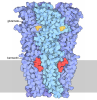
- Assembly
| Deposited unit | 
|
|---|---|
| 1 |
|
-Components
| #1: Protein | Mass: 100124.969 Da / Num. of mol.: 2 Source method: isolated from a genetically manipulated source Source: (gene. exp.) Homo sapiens (human) / Gene: GRM5, GPRC1E, MGLUR5 / Production host:  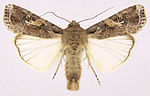 Spodoptera frugiperda (fall armyworm) / References: UniProt: P41594 Spodoptera frugiperda (fall armyworm) / References: UniProt: P41594#2: Antibody | Mass: 58499.957 Da / Num. of mol.: 4 / Mutation: C59A, C125S,C140I,C150V,R169E,C242V,C251V,C269S Source method: isolated from a genetically manipulated source Source: (gene. exp.) Homo sapiens (human) / Gene: ARRB1 / Production host: Spodoptera frugiperda (fall armyworm)#3: Antibody | Mass: 11976.338 Da / Num. of mol.: 2 Source method: isolated from a genetically manipulated source Source: (gene. exp.) Mus musculus (house mouse) / Production host: Spodoptera frugiperda (fall armyworm)#4: Chemical | 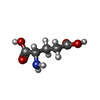 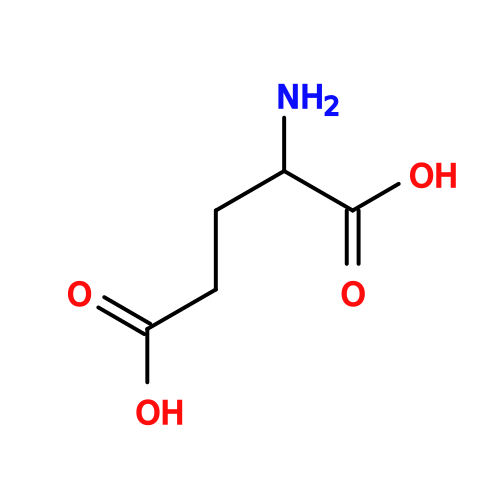 Type: L-peptide linking / Mass: 147.129 Da / Num. of mol.: 2 / Source method: obtained synthetically / Formula: C5H9NO4 Type: L-peptide linking / Mass: 147.129 Da / Num. of mol.: 2 / Source method: obtained synthetically / Formula: C5H9NO4#5: Sugar | 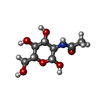 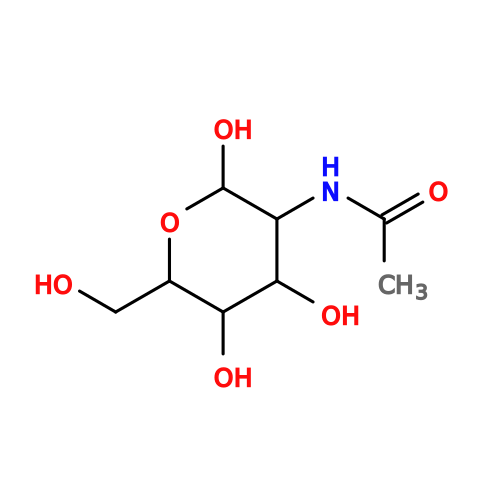 Type: D-saccharide, beta linking / Mass: 221.208 Da / Num. of mol.: 2 / Source method: obtained synthetically / Formula: C8H15NO6 Type: D-saccharide, beta linking / Mass: 221.208 Da / Num. of mol.: 2 / Source method: obtained synthetically / Formula: C8H15NO6Has ligand of interest | N | Has protein modification | Y | |
|---|
-Experimental details
-Experiment
| Experiment | Method: ELECTRON MICROSCOPY |
|---|---|
| EM experiment | Aggregation state: PARTICLE / 3D reconstruction method: single particle reconstruction |
- Sample preparation
| Component | Name: mGlu5-beta-arrestin 1 complex / Type: COMPLEX / Entity ID: #1-#3 / Source: RECOMBINANT | ||||||||||||
|---|---|---|---|---|---|---|---|---|---|---|---|---|---|
| Molecular weight | Experimental value: NO | ||||||||||||
| Source (natural) |
| ||||||||||||
| Source (recombinant) | Organism: Spodoptera frugiperda (fall armyworm) | ||||||||||||
| Buffer solution | pH: 7.5 | ||||||||||||
| Specimen | Embedding applied: NO / Shadowing applied: NO / Staining applied: NO / Vitrification applied: YES | ||||||||||||
| Vitrification | Cryogen name: ETHANE |
- Electron microscopy imaging
| Experimental equipment |  Model: Titan Krios / Image courtesy: FEI Company |
|---|---|
| Microscopy | Model: TFS KRIOS |
| Electron gun | Electron source:  FIELD EMISSION GUN / Accelerating voltage: 300 kV / Illumination mode: FLOOD BEAM FIELD EMISSION GUN / Accelerating voltage: 300 kV / Illumination mode: FLOOD BEAM |
| Electron lens | Mode: BRIGHT FIELD / Nominal defocus max: 2000 nm / Nominal defocus min: 1000 nm |
| Image recording | Electron dose: 50 e/Å2 / Film or detector model: GATAN K3 BIOCONTINUUM (6k x 4k) |
- Processing
| EM software |
| ||||||||||||||||||||||||
|---|---|---|---|---|---|---|---|---|---|---|---|---|---|---|---|---|---|---|---|---|---|---|---|---|---|
| CTF correction | Type: NONE | ||||||||||||||||||||||||
| 3D reconstruction | Resolution: 3.7 Å / Resolution method: FSC 0.143 CUT-OFF / Num. of particles: 312647 / Symmetry type: POINT | ||||||||||||||||||||||||
| Refinement | Stereochemistry target values: GeoStd + Monomer Library + CDL v1.2 | ||||||||||||||||||||||||
| Displacement parameters | Biso mean: 21.06 Å2 | ||||||||||||||||||||||||
| Refine LS restraints |
|
