 Movie
Movie Controller


+ Open data

- Basic information
| Entry | Database: PDB / ID: 21kl | |||||||||||||||||||||||||||
|---|---|---|---|---|---|---|---|---|---|---|---|---|---|---|---|---|---|---|---|---|---|---|---|---|---|---|---|---|
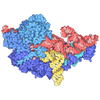
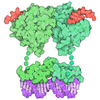
| Title | Cryo-EM structure of TasH-pre-tigRNA-dsDNA complex | |||||||||||||||||||||||||||
 Components Components |
| |||||||||||||||||||||||||||
 Keywords Keywords | ANTIVAL PROTEIN/RNA/DNA / protein complex / ANTIVIRAL PROTEIN/RNA/DNA / ANTIVAL PROTEIN-RNA-DNA complex | |||||||||||||||||||||||||||
| Function / homology | DNA / DNA (> 10) / RNA / RNA (> 10) Function and homology information Function and homology information | |||||||||||||||||||||||||||
| Biological species |  Salicola phage CGphi29 (virus) Salicola phage CGphi29 (virus) | |||||||||||||||||||||||||||
| Method | ELECTRON MICROSCOPY / single particle reconstruction / cryo EM / Resolution: 3.19 Å | |||||||||||||||||||||||||||
 Authors Authors | Zhang, H. / Liu, Z. | |||||||||||||||||||||||||||
| Funding support |  China, 1items China, 1items
| |||||||||||||||||||||||||||
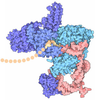
 Citation Citation | Journal: Mol Cell / Year: 2026 Title: Molecular basis for dual-spacer-guided target cleavage by the TIGR-TasH system. Authors: Jie Yang / Tongyao Wang / Zhikun Liu / Wenqi Wu / Yangyue Sun / Yancheng Zhan / Shuqin Zhang / Hong Chen / Bin Liu / Caidie Yue / Zhenning Yin / Zhengda Shan / Xuzichao Li / Zhuang Li / ...Authors: Jie Yang / Tongyao Wang / Zhikun Liu / Wenqi Wu / Yangyue Sun / Yancheng Zhan / Shuqin Zhang / Hong Chen / Bin Liu / Caidie Yue / Zhenning Yin / Zhengda Shan / Xuzichao Li / Zhuang Li / Zhiyong Yuan / Hang Yin / Heng Zhang / Abstract: The RNA-directed programmable nuclease systems, exemplified by the CRISPR-Cas system, have been widely used in genome editing. In contrast to the single-spacer configuration of CRISPR RNA (crRNA), ...The RNA-directed programmable nuclease systems, exemplified by the CRISPR-Cas system, have been widely used in genome editing. In contrast to the single-spacer configuration of CRISPR RNA (crRNA), the guide RNA (tigRNA) of the tandem interspaced guide RNA (TIGR) system features a dual-spacer arrangement, thereby directing the TIGR-associated (Tas) protein to engage both strands of the target double-stranded DNA (dsDNA). Here, we determine six cryo-electron microscopy structures of the Salicola phage TIGR-TasH complex. The central coiled-coil region of TasH mediates dimerization, while the C-terminal nucleolar protein (Nop) domain is able to autonomously process precursor tigRNA. Upon target binding, the dynamic N-terminal HNH nuclease domain is recruited for cleavage through a β-hairpin, which also determines the target preference. More interestingly, the conserved box C motif of tigRNA stabilizes this β-hairpin in an adenine-specific manner, enabling us to rationally design a guide RNA-defined nickase, distinct from conventional protein-based nickase strategies used in genome editing. | |||||||||||||||||||||||||||
| History |
|
- Structure visualization
| Structure viewer | Molecule: MolmilJmol/JSmol |
|---|
- Downloads & links
-Download
| PDBx/mmCIF format | 21kl.cif.gz | 159.5 KB | Display | PDBx/mmCIF format |
|---|---|---|---|---|
| PDB format | pdb21kl.ent.gz | 117.8 KB | Display | PDB format |
| PDBx/mmJSON format | 21kl.json.gz | Tree view | PDBx/mmJSON format | |
| Others |  Other downloads Other downloads |
-Validation report
| Arichive directory | https://data.pdbj.org/pub/pdb/validation_reports/1k/21klftp://data.pdbj.org/pub/pdb/validation_reports/1k/21kl | HTTPS FTP |
|---|
-Related structure data
| Related structure data |  67763MC  9vzxC  9w02C  9w03C  9w04C  9w26C M: map data used to model this data C: citing same article ( |
|---|---|
| Similar structure data |


-Links
 PDBj
PDBj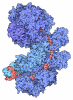
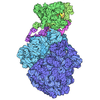
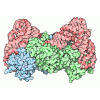

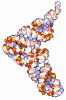
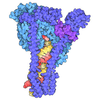
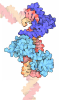
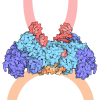
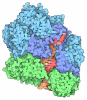
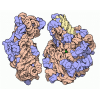
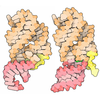
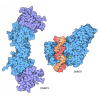
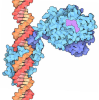
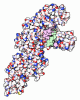
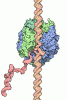
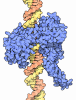

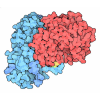
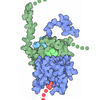
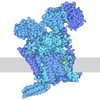
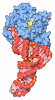
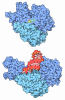
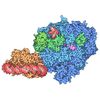
- Assembly
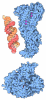
| Deposited unit | 
|
|---|---|
| 1 |
|
-Components
| #1: Protein | Mass: 40031.242 Da / Num. of mol.: 2 Source method: isolated from a genetically manipulated source Source: (gene. exp.) Salicola phage CGphi29 (virus) / Production host:   Escherichia coli (E. coli) Escherichia coli (E. coli)#2: RNA chain | | Mass: 11948.239 Da / Num. of mol.: 1 Source method: isolated from a genetically manipulated source Source: (gene. exp.) Salicola phage CGphi29 (virus) / Production host: Escherichia coli (E. coli)#3: DNA chain | | Mass: 11606.450 Da / Num. of mol.: 1 Source method: isolated from a genetically manipulated source Source: (gene. exp.) Salicola phage CGphi29 (virus) / Production host: Escherichia coli (E. coli)#4: DNA chain | | Mass: 11784.576 Da / Num. of mol.: 1 Source method: isolated from a genetically manipulated source Source: (gene. exp.) Salicola phage CGphi29 (virus) / Production host: Escherichia coli (E. coli)Has protein modification | N | |
|---|
-Experimental details
-Experiment
| Experiment | Method: ELECTRON MICROSCOPY |
|---|---|
| EM experiment | Aggregation state: PARTICLE / 3D reconstruction method: single particle reconstruction |
- Sample preparation
| Component | Name: putative nuclease / Type: COMPLEX / Entity ID: all / Source: RECOMBINANT |
|---|---|
| Source (natural) | Organism: Salicola phage CGphi29 (virus) |
| Source (recombinant) | Organism: Escherichia coli (E. coli) |
| Buffer solution | pH: 7.5 |
| Specimen | Embedding applied: NO / Shadowing applied: NO / Staining applied: NO / Vitrification applied: YES |
| Vitrification | Cryogen name: ETHANE |
- Electron microscopy imaging
| Experimental equipment |  Model: Titan Krios / Image courtesy: FEI Company |
|---|---|
| Microscopy | Model: TFS KRIOS |
| Electron gun | Electron source:  FIELD EMISSION GUN / Accelerating voltage: 300 kV / Illumination mode: FLOOD BEAM FIELD EMISSION GUN / Accelerating voltage: 300 kV / Illumination mode: FLOOD BEAM |
| Electron lens | Mode: BRIGHT FIELD / Nominal defocus max: 1600 nm / Nominal defocus min: 1200 nm |
| Image recording | Electron dose: 50 e/Å2 / Film or detector model: FEI FALCON IV (4k x 4k) |
- Processing
| EM software |
| |||||||||
|---|---|---|---|---|---|---|---|---|---|---|
| CTF correction | Type: PHASE FLIPPING ONLY | |||||||||
| 3D reconstruction | Resolution: 3.19 Å / Resolution method: FSC 0.143 CUT-OFF / Num. of particles: 107720 / Symmetry type: POINT |
