 Movie
Movie Controller

[English] 日本語
 Yorodumi
- PDB-12bp: Cryo-EM structure of human DDB1-CRBN-GSPT1 in complex with GT19630 -
+ Open data

- Basic information
| Entry | Database: PDB / ID: 12bp | |||||||||
|---|---|---|---|---|---|---|---|---|---|---|
| Title | Cryo-EM structure of human DDB1-CRBN-GSPT1 in complex with GT19630 | |||||||||
 Components Components |
| |||||||||
 Keywords Keywords | HYDROLASE / Protein Degrader | |||||||||
| Function / homology |  Function and homology information Function and homology informationtranslation release factor complex / regulation of translational termination / translation release factor activity / negative regulation of monoatomic ion transmembrane transport / positive regulation by virus of viral protein levels in host cell / spindle assembly involved in female meiosis / nuclear-transcribed mRNA catabolic process, nonsense-mediated decay / epigenetic programming in the zygotic pronuclei / protein methylation / UV-damage excision repair ...translation release factor complex / regulation of translational termination / translation release factor activity / negative regulation of monoatomic ion transmembrane transport / positive regulation by virus of viral protein levels in host cell / spindle assembly involved in female meiosis / nuclear-transcribed mRNA catabolic process, nonsense-mediated decay / epigenetic programming in the zygotic pronuclei / protein methylation / UV-damage excision repair / biological process involved in interaction with symbiont / regulation of mitotic cytokinesis / regulation of mitotic cell cycle phase transition / regulation of miRNA-mediated gene silencing / regulation of natural killer cell activation / WD40-repeat domain binding / regulation of cell cycle phase transition / locomotory exploration behavior / Cul4A-RING E3 ubiquitin ligase complex / Cul4-RING E3 ubiquitin ligase complex / regulation of stem cell population maintenance / Cul4B-RING E3 ubiquitin ligase complex / ubiquitin ligase complex scaffold activity / negative regulation of adipose tissue development / regulation of cellular response to stress / limb development / viral release from host cell / cullin family protein binding / Eukaryotic Translation Termination / positive regulation of Wnt signaling pathway / Nonsense Mediated Decay (NMD) independent of the Exon Junction Complex (EJC) / negative regulation of protein-containing complex assembly / regulation of DNA-templated DNA replication initiation / positive regulation of viral genome replication / positive regulation of gluconeogenesis / translational termination / Nonsense Mediated Decay (NMD) enhanced by the Exon Junction Complex (EJC) / regulation of embryonic development / replication fork processing / G1/S transition of mitotic cell cycle / proteasomal protein catabolic process / epigenetic regulation of gene expression / positive regulation of protein-containing complex assembly / nucleotide-excision repair / regulation of autophagy / Recognition of DNA damage by PCNA-containing replication complex / regulation of circadian rhythm / cell population proliferation / DNA Damage Recognition in GG-NER / Dual Incision in GG-NER / Transcription-Coupled Nucleotide Excision Repair (TC-NER) / Formation of TC-NER Pre-Incision Complex / Regulation of expression of SLITs and ROBOs / Formation of Incision Complex in GG-NER / positive regulation of protein catabolic process / cellular response to UV / cytosolic ribosome / Dual incision in TC-NER / Gap-filling DNA repair synthesis and ligation in TC-NER / regulation of cell population proliferation / rhythmic process / site of double-strand break / Neddylation / spermatogenesis / ubiquitin-dependent protein catabolic process / Potential therapeutics for SARS / damaged DNA binding / proteasome-mediated ubiquitin-dependent protein catabolic process / regulation of apoptotic process / Hydrolases; Acting on acid anhydrides; Acting on GTP to facilitate cellular and subcellular movement / transmembrane transporter binding / protein-macromolecule adaptor activity / chromosome, telomeric region / protein ubiquitination / translation / DNA repair / GTPase activity / DNA damage response / nucleolus / GTP binding / protein-containing complex binding / perinuclear region of cytoplasm / protein-containing complex / DNA binding / : / RNA binding / extracellular exosome / nucleoplasm / membrane / metal ion binding / nucleus / cytosol / cytoplasm Similarity search - Function | |||||||||
| Biological species |  Homo sapiens (human) Homo sapiens (human) | |||||||||
| Method | ELECTRON MICROSCOPY / single particle reconstruction / cryo EM / Resolution: 2.9 Å | |||||||||
 Authors Authors | Huang, J. / Chu, H.F. / Tong, L. | |||||||||
| Funding support |  China, 1items China, 1items
| |||||||||
 Citation Citation | Journal: Blood / Year: 2026 Title: Dual MYC and GSPT1 Protein Degrader for MYC-Driven Hematologic Malignancies. Authors: Yuki Nishida / Valeria Impedovo / Edward Ayoub / Natalia Baran / Darah A Scruggs / Hideaki Mizuno / Shayaun Khazaei / Lauren B Ostermann / Kazuharu Kamachi / Liang Zhang / Jo Ishizawa / ...Authors: Yuki Nishida / Valeria Impedovo / Edward Ayoub / Natalia Baran / Darah A Scruggs / Hideaki Mizuno / Shayaun Khazaei / Lauren B Ostermann / Kazuharu Kamachi / Liang Zhang / Jo Ishizawa / Sandeep Singh / Andrea D Bedoy / Po Yee Mak / Bing Z Carter / Eiji Sugihara / Tetsuya Takimoto / Youzhi Tong / Honghua Yan / Dong Chen / Ji Huang / Hsu-Feng Chu / Liang Tong / Zamal Ahmed / Sarita Namjoshi / John Tainer / Mihai Gagea / Thomas Huynh / Abhishek Maiti / Koji Sasaki / Branko Cuglievan / Steffen Boettcher / Torsten Haferlach / Stefano Tiziani / Liandong Ma / Michael Andreeff /     Abstract: Direct targeting of the oncoprotein MYC has not yet been successful. We here report a novel dual protein degrader, GT19630, which binds directly to MYC and G1 to S phase transition protein 1 (GSPT1). ...Direct targeting of the oncoprotein MYC has not yet been successful. We here report a novel dual protein degrader, GT19630, which binds directly to MYC and G1 to S phase transition protein 1 (GSPT1). GT19630 disrupts a novel feedforward loop of MYC and GSPT1, where MYC promotes transcription of GSPT1, and GSPT1 senses the stop codon of MYC to properly terminate its translation. The agent induces integrated stress response and abrogates oxidative phosphorylation through inhibition of the TCA cycle, resulting in apoptosis. GT19630 has superior activity compared to GSPT1- targeting molecular glues. GT19630 induces profound anti-proliferative effects and apoptosis at low nanomolar concentrations in a multitude of leukemia and lymphoma cell lines and primary samples, including those with TP53 mutations. GT19630 is highly active in vivo in models of therapy-resistant hematologic malignancies, including Burkitt's lymphoma, acute myeloid leukemia (AML) and multiple myeloma. CD34+ AML blasts overexpress MYC protein compared to normal hematopoietic stem/progenitor cells (HSPCs) and GT19630 induces greater cytotoxicity in AML cells compared to normal HSPCs. Further, GT19630 restores sensitivity to venetoclax and profoundly prolongs survival in vivo in venetoclax-resistant AML. GT19630 was well tolerated in humanized Crbn mice. In conclusion, our data support the development of the MYC/GSPT1 degrader GT19630 as a therapeutic strategy of MYC-driven hematologic malignancies. | |||||||||
| History |
|
- Structure visualization
| Structure viewer | Molecule: MolmilJmol/JSmol |
|---|
- Downloads & links
-Download
| PDBx/mmCIF format | 12bp.cif.gz | 267.2 KB | Display | PDBx/mmCIF format |
|---|---|---|---|---|
| PDB format | pdb12bp.ent.gz | Display | PDB format | |
| PDBx/mmJSON format | 12bp.json.gz | Tree view | PDBx/mmJSON format | |
| Others |  Other downloads Other downloads |
-Validation report
| Arichive directory | https://data.pdbj.org/pub/pdb/validation_reports/2b/12bpftp://data.pdbj.org/pub/pdb/validation_reports/2b/12bp | HTTPS FTP |
|---|
-Related structure data
| Related structure data |  76291MC M: map data used to model this data C: citing same article ( |
|---|---|
| Similar structure data |
-Links
 PDBj
PDBj

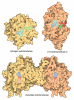

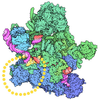
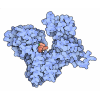
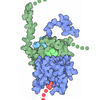
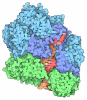
- Assembly
| Deposited unit | 
|
|---|---|
| 1 |
|
-Components
| #1: Protein | Mass: 24154.234 Da / Num. of mol.: 1 Source method: isolated from a genetically manipulated source Source: (gene. exp.) Homo sapiens (human) / Gene: GSPT1, ERF3A / Production host:   Escherichia coli (E. coli) Escherichia coli (E. coli)References: UniProt: P15170, Hydrolases; Acting on acid anhydrides; Acting on GTP to facilitate cellular and subcellular movement |
|---|---|
| #2: Protein | Mass: 46653.617 Da / Num. of mol.: 1 Source method: isolated from a genetically manipulated source Source: (gene. exp.) Homo sapiens (human) / Gene: CRBN, AD-006 / Production host:  Trichoplusia ni (cabbage looper) / References: UniProt: Q96SW2 Trichoplusia ni (cabbage looper) / References: UniProt: Q96SW2 |
| #3: Protein | Mass: 93347.078 Da / Num. of mol.: 1 Fragment: UNP residues 1-395,706-1140,UNP residues 1-395,706-1140 Source method: isolated from a genetically manipulated source Source: (gene. exp.) Homo sapiens (human) / Gene: DDB1, XAP1 / Production host: Trichoplusia ni (cabbage looper) / References: UniProt: Q16531 |
| #4: Chemical | ChemComp-A1DBR / Mass: 614.650 Da / Num. of mol.: 1 / Source method: obtained synthetically / Formula: C35H30N6O5 / Feature type: SUBJECT OF INVESTIGATION |
| #5: Chemical | ChemComp-ZN /   Mass: 65.409 Da / Num. of mol.: 1 / Source method: obtained synthetically / Formula: Zn Mass: 65.409 Da / Num. of mol.: 1 / Source method: obtained synthetically / Formula: Zn |
| Has ligand of interest | Y |
| Has protein modification | N |
-Experimental details
-Experiment
| Experiment | Method: ELECTRON MICROSCOPY |
|---|---|
| EM experiment | Aggregation state: PARTICLE / 3D reconstruction method: single particle reconstruction |
- Sample preparation
| Component | Name: Ternary complex of DDB1-CRBN with GSPT1 / Type: COMPLEX / Entity ID: #3, #1-#2 / Source: RECOMBINANT |
|---|---|
| Source (natural) | Organism: Homo sapiens (human) |
| Source (recombinant) | Organism: Trichoplusia ni (cabbage looper) |
| Buffer solution | pH: 8 |
| Specimen | Embedding applied: NO / Shadowing applied: NO / Staining applied: NO / Vitrification applied: YES |
| Vitrification | Cryogen name: ETHANE |
- Electron microscopy imaging
| Experimental equipment |  Model: Titan Krios / Image courtesy: FEI Company |
|---|---|
| Microscopy | Model: TFS KRIOS |
| Electron gun | Electron source:  FIELD EMISSION GUN / Accelerating voltage: 300 kV / Illumination mode: FLOOD BEAM FIELD EMISSION GUN / Accelerating voltage: 300 kV / Illumination mode: FLOOD BEAM |
| Electron lens | Mode: BRIGHT FIELD / Nominal defocus max: 2000 nm / Nominal defocus min: 1500 nm |
| Image recording | Electron dose: 58 e/Å2 / Film or detector model: GATAN K3 (6k x 4k) |
- Processing
| EM software |
| ||||||||||||||||||||||||
|---|---|---|---|---|---|---|---|---|---|---|---|---|---|---|---|---|---|---|---|---|---|---|---|---|---|
| CTF correction | Type: PHASE FLIPPING AND AMPLITUDE CORRECTION | ||||||||||||||||||||||||
| 3D reconstruction | Resolution: 2.9 Å / Resolution method: FSC 0.143 CUT-OFF / Num. of particles: 291647 / Symmetry type: POINT | ||||||||||||||||||||||||
| Refinement | Highest resolution: 2.9 Å Stereochemistry target values: REAL-SPACE (WEIGHTED MAP SUM AT ATOM CENTERS) | ||||||||||||||||||||||||
| Refine LS restraints |
|
