National Institutes of Health/National Institute Of Allergy and Infectious Diseases (NIH/NIAID)
米国
引用
ジャーナル: bioRxiv / 年: 2026 タイトル: Biophysical trade-offs in antibody evolution are resolved by conformation-mediated epistasis. 著者: Cole R Tharp / Claudio Catalano / Anthony Khalifeh / Sam Ghaffari-Kashani / Ruimin Huang / Gyunghoon Kang / Giovanna Scapin / Angela M Phillips / 要旨: Protein evolution is constrained by multidimensional biophysical factors, in which mutations that enhance one property often compromise another. Antibodies represent an extreme case: they evolve ...Protein evolution is constrained by multidimensional biophysical factors, in which mutations that enhance one property often compromise another. Antibodies represent an extreme case: they evolve rapidly to bind diverse antigens, yet mutations that improve affinity can disrupt folding, reduce cell-surface trafficking, or promote self-reactivity, and are typically selected against during affinity maturation. Though biophysical characterization of individual antibodies suggests that such trade-offs are pervasive, their impact on antibody evolutionary trajectories remains unclear, in part because existing high-throughput biophysical methods rely on heterologous systems that are often poorly suited for human proteins. Here, we develop a high-throughput platform to quantify multiple biophysical parameters of large libraries of full-length proteins that are natively synthesized, processed, and displayed on human cells. We apply this approach to a human antibody lineage that matures to recognize divergent SARS-CoV-2 variants by measuring the surface expression, antigen affinity, and self-reactivity for all 2 possible evolutionary intermediates between the unmutated and mature sequences. These measurements reveal that mutations differentially affect these biophysical properties - in some cases, improving one property at the expense of another. We leverage these data to compute the likelihood of all possible evolutionary paths, finding that very few paths can navigate these multidimensional requirements. The few accessible paths acquire mutations in a specific order that either circumvent trade-offs between biophysical properties or offset deleterious effects on one property with beneficial effects on another. By determining the structures of the ancestral and evolved antibodies, we find that these coordinated mutational effects arise from a conformational rearrangement that alleviates steric clashes and reshapes the biophysical landscape, enabling otherwise inaccessible mutational paths. Together, this work defines the multidimensional biophysical constraints and structural mechanisms that govern antibody evolution and establishes a general framework for mapping and predicting the biophysical effects of mutations in human proteins.
履歴
登録
2026年3月6日
登録サイト: RCSB / 処理サイト: RCSB
改定 1.0
2026年4月8日
Provider: repository / タイプ: Initial release
改定 1.0
2026年4月8日
Data content type: EM metadata / Data content type: EM metadata / Provider: repository / タイプ: Initial release
改定 1.0
2026年4月8日
Data content type: Additional map / Part number: 1 / Data content type: Additional map / Provider: repository / タイプ: Initial release
改定 1.0
2026年4月8日
Data content type: FSC / Data content type: FSC / Provider: repository / タイプ: Initial release
改定 1.0
2026年4月8日
Data content type: Half map / Part number: 1 / Data content type: Half map / Provider: repository / タイプ: Initial release
改定 1.0
2026年4月8日
Data content type: Half map / Part number: 2 / Data content type: Half map / Provider: repository / タイプ: Initial release
改定 1.0
2026年4月8日
Data content type: Image / Data content type: Image / Provider: repository / タイプ: Initial release
改定 1.0
2026年4月8日
Data content type: Primary map / Data content type: Primary map / Provider: repository / タイプ: Initial release
 ムービー
ムービー コントローラー


 データを開く
 基本情報
基本情報 要素
要素 キーワード
キーワード Severe acute respiratory syndrome coronavirus (SARS コロナウイルス)
 Homo sapiens (ヒト)
 Lama glama (ラマ)
 データ登録者
 米国, 2件
  引用
引用 構造の表示
構造の表示 Molmil
 ダウンロードとリンク
 その他のダウンロード


 PDBj
PDBj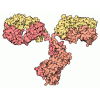
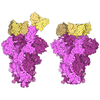
 集合体
集合体

 Saccharomyces cerevisiae (パン酵母)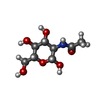
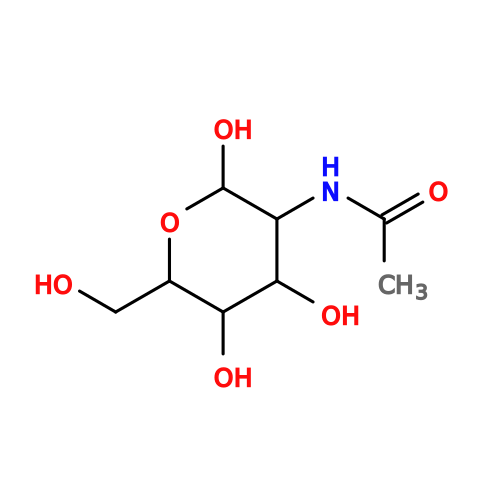 タイプ: D-saccharide, beta linking / 分子量: 221.208 Da / 分子数: 1 / 由来タイプ: 合成 / 式: C8H15NO6
 試料調製
試料調製 電子顕微鏡撮影
 FIELD EMISSION GUN / 加速電圧: 200 kV / 照射モード: SPOT SCAN
 解析
解析