 Movie
Movie Controller


+ Open data

- Basic information
| Entry | Database: PDB / ID: 11ou | |||||||||||||||||||||||||||
|---|---|---|---|---|---|---|---|---|---|---|---|---|---|---|---|---|---|---|---|---|---|---|---|---|---|---|---|---|
| Title | Omi32 germline Fab in complex with LC-Kappa VHH | |||||||||||||||||||||||||||
 Components Components |
| |||||||||||||||||||||||||||
 Keywords Keywords | IMMUNE SYSTEM / antibody / fab / germline / ancestor | |||||||||||||||||||||||||||
| Biological species |   Lama glama (llama) Lama glama (llama) Homo sapiens (human) Homo sapiens (human) | |||||||||||||||||||||||||||
| Method | ELECTRON MICROSCOPY / single particle reconstruction / cryo EM / Resolution: 3.2 Å | |||||||||||||||||||||||||||
 Authors Authors | Kang, G. / Phillips, A.M. / Catalano, C. / Scapin, G. | |||||||||||||||||||||||||||
| Funding support |  United States, 2items United States, 2items
| |||||||||||||||||||||||||||
 Citation Citation | Journal: bioRxiv / Year: 2026 Title: Biophysical trade-offs in antibody evolution are resolved by conformation-mediated epistasis. Authors: Cole R Tharp / Claudio Catalano / Anthony Khalifeh / Sam Ghaffari-Kashani / Ruimin Huang / Gyunghoon Kang / Giovanna Scapin / Angela M Phillips / Abstract: Protein evolution is constrained by multidimensional biophysical factors, in which mutations that enhance one property often compromise another. Antibodies represent an extreme case: they evolve ...Protein evolution is constrained by multidimensional biophysical factors, in which mutations that enhance one property often compromise another. Antibodies represent an extreme case: they evolve rapidly to bind diverse antigens, yet mutations that improve affinity can disrupt folding, reduce cell-surface trafficking, or promote self-reactivity, and are typically selected against during affinity maturation. Though biophysical characterization of individual antibodies suggests that such trade-offs are pervasive, their impact on antibody evolutionary trajectories remains unclear, in part because existing high-throughput biophysical methods rely on heterologous systems that are often poorly suited for human proteins. Here, we develop a high-throughput platform to quantify multiple biophysical parameters of large libraries of full-length proteins that are natively synthesized, processed, and displayed on human cells. We apply this approach to a human antibody lineage that matures to recognize divergent SARS-CoV-2 variants by measuring the surface expression, antigen affinity, and self-reactivity for all 2 possible evolutionary intermediates between the unmutated and mature sequences. These measurements reveal that mutations differentially affect these biophysical properties - in some cases, improving one property at the expense of another. We leverage these data to compute the likelihood of all possible evolutionary paths, finding that very few paths can navigate these multidimensional requirements. The few accessible paths acquire mutations in a specific order that either circumvent trade-offs between biophysical properties or offset deleterious effects on one property with beneficial effects on another. By determining the structures of the ancestral and evolved antibodies, we find that these coordinated mutational effects arise from a conformational rearrangement that alleviates steric clashes and reshapes the biophysical landscape, enabling otherwise inaccessible mutational paths. Together, this work defines the multidimensional biophysical constraints and structural mechanisms that govern antibody evolution and establishes a general framework for mapping and predicting the biophysical effects of mutations in human proteins. | |||||||||||||||||||||||||||
| History |
|
- Structure visualization
| Structure viewer | Molecule:  MolmilJmol/JSmol MolmilJmol/JSmol |
|---|
- Downloads & links
-Download
| PDBx/mmCIF format | 11ou.cif.gz | 116.1 KB | Display | PDBx/mmCIF format |
|---|---|---|---|---|
| PDB format | pdb11ou.ent.gz | 87 KB | Display | PDB format |
| PDBx/mmJSON format | 11ou.json.gz | Tree view | PDBx/mmJSON format | |
| Others |  Other downloads Other downloads |
-Validation report
| Arichive directory | https://data.pdbj.org/pub/pdb/validation_reports/1o/11ouftp://data.pdbj.org/pub/pdb/validation_reports/1o/11ou | HTTPS FTP |
|---|
-Related structure data
| Related structure data |  75893MC  11olC  11ooC  11oqC  11orC M: map data used to model this data C: citing same article ( |
|---|


-Links
 PDBj
PDBj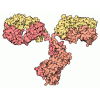
- Assembly
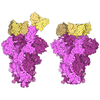
| Deposited unit | 
|
|---|---|
| 1 |
|
-Components
| #1: Antibody | Mass: 13162.396 Da / Num. of mol.: 1 Source method: isolated from a genetically manipulated source Source: (gene. exp.) Lama glama (llama) / Production host:   Saccharomyces cerevisiae (brewer's yeast) Saccharomyces cerevisiae (brewer's yeast) |
|---|---|
| #2: Antibody | Mass: 23227.760 Da / Num. of mol.: 1 Source method: isolated from a genetically manipulated source Source: (gene. exp.) Homo sapiens (human) / Production host: Homo sapiens (human) |
| #3: Antibody | Mass: 23379.189 Da / Num. of mol.: 1 Source method: isolated from a genetically manipulated source Source: (gene. exp.) Homo sapiens (human) / Production host: Homo sapiens (human) |
| Has protein modification | Y |
-Experimental details
-Experiment
| Experiment | Method: ELECTRON MICROSCOPY |
|---|---|
| EM experiment | Aggregation state: PARTICLE / 3D reconstruction method: single particle reconstruction |
- Sample preparation
| Component | Name: Omi32 germline Fab in complex with LC-Kappa VHH / Type: COMPLEX / Entity ID: all / Source: RECOMBINANT |
|---|---|
| Source (natural) | Organism: Homo sapiens (human) |
| Source (recombinant) | Organism: Homo sapiens (human) |
| Buffer solution | pH: 7.6 |
| Specimen | Embedding applied: NO / Shadowing applied: NO / Staining applied: NO / Vitrification applied: YES |
| Vitrification | Cryogen name: ETHANE |
- Electron microscopy imaging
| Experimental equipment |  Model: Titan Krios / Image courtesy: FEI Company |
|---|---|
| Microscopy | Model: TFS KRIOS |
| Electron gun | Electron source:  FIELD EMISSION GUN / Accelerating voltage: 300 kV / Illumination mode: SPOT SCAN FIELD EMISSION GUN / Accelerating voltage: 300 kV / Illumination mode: SPOT SCAN |
| Electron lens | Mode: OTHER / Nominal defocus max: 2000 nm / Nominal defocus min: 500 nm |
| Image recording | Electron dose: 50.13 e/Å2 / Film or detector model: GATAN K3 (6k x 4k) |
- Processing
| EM software |
| ||||||||||||||||||||||||
|---|---|---|---|---|---|---|---|---|---|---|---|---|---|---|---|---|---|---|---|---|---|---|---|---|---|
| CTF correction | Type: NONE | ||||||||||||||||||||||||
| 3D reconstruction | Resolution: 3.2 Å / Resolution method: FSC 0.143 CUT-OFF / Num. of particles: 73477 / Symmetry type: POINT | ||||||||||||||||||||||||
| Refinement | Highest resolution: 3.2 Å Stereochemistry target values: REAL-SPACE (WEIGHTED MAP SUM AT ATOM CENTERS) | ||||||||||||||||||||||||
| Refine LS restraints |
|
