[English] 日本語
Yorodumi
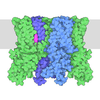
- PDB-11ie: 2-APB bound rat TRPV2, H651S/D654T/N655D -

+
Open data


ID or keywords:

Loading...

-
Basic information

Entry
Database: PDB / ID: 11ie
Title2-APB bound rat TRPV2, H651S/D654T/N655D
ComponentsTransient receptor potential cation channel subfamily V member 2
KeywordsMEMBRANE PROTEIN / TRPV2 / ion channel / TRP channel
Function / homology
Function and homology information


growth cone membrane / TRP channels / response to temperature stimulus / positive regulation of calcium ion import / calcium ion import across plasma membrane / positive regulation of axon extension / axonal growth cone / monoatomic cation channel activity / endomembrane system / calcium channel activity ...growth cone membrane / TRP channels / response to temperature stimulus / positive regulation of calcium ion import / calcium ion import across plasma membrane / positive regulation of axon extension / axonal growth cone / monoatomic cation channel activity / endomembrane system / calcium channel activity / melanosome / lamellipodium / positive regulation of cold-induced thermogenesis / cell body / negative regulation of cell population proliferation / axon / neuronal cell body / cell surface / plasma membrane
Similarity search - Function
Transient receptor potential cation channel subfamily V member 1-4 / Transient receptor potential cation channel subfamily V / Ankyrin repeat profile. / Ankyrin repeats (3 copies) / Ankyrin repeat region circular profile. / ankyrin repeats / Ankyrin repeat / Ankyrin repeat-containing domain superfamily / Ion transport domain / Ion transport protein
Similarity search - Domain/homology
2-aminoethyl diphenylborinate / 1,2-DIDECANOYL-SN-GLYCERO-3-PHOSPHOETHANOLAMINE / Transient receptor potential cation channel subfamily V member 2
Similarity search - Component
Biological speciesRattus norvegicus (Norway rat)
MethodELECTRON MICROSCOPY / single particle reconstruction / cryo EM / Resolution: 3.07 Å
AuthorsPumroy, R.P. / Rocereta, J.A. / Moiseenkova-Bell, V.Y.
Funding support United States, 1items
OrganizationGrant numberCountry
National Institutes of Health/National Institute of General Medical Sciences (NIH/NIGMS)R35GM144120 United States
CitationJournal: Nat Commun / Year: 2026
Title: Structural origins of species-specific differences in TRPV2 activation.
Authors: Tabea C Fricke / Ruth A Pumroy / Julia A Rocereta / José J De Jesús-Pérez / George Oprita / Marvin J A Meyer / Christine Herzog / Frank G Echtermeyer / Kerstin Hill / Andreas Leffler / ...Authors: Tabea C Fricke / Ruth A Pumroy / Julia A Rocereta / José J De Jesús-Pérez / George Oprita / Marvin J A Meyer / Christine Herzog / Frank G Echtermeyer / Kerstin Hill / Andreas Leffler / Vera Y Moiseenkova-Bell /
Abstract: Transient receptor potential vanilloid 2 (TRPV2) is a broadly expressed ion channel implicated in diverse physiological and pathological processes. Despite strong conservation, human TRPV2 (hTRPV2) ...Transient receptor potential vanilloid 2 (TRPV2) is a broadly expressed ion channel implicated in diverse physiological and pathological processes. Despite strong conservation, human TRPV2 (hTRPV2) displays markedly reduced sensitivity to stimuli such as 2-aminoethoxydiphenyl borate (2-APB) and heat compared to rodent orthologs. Here we combine electrophysiology and cryo electron microscopy to define the basis of this species-dependent divergence. The structure of hTRPV2 is remarkably different at the voltage sensor-like domain (VSLD) compared to rodent channels and functional analyses show a graded activity profile between human, mouse and rat TRPV2 to a broad range of chemical and physical stimuli. Three residues located between S6 and the TRP domain tune this functional difference, as reciprocal substitutions exchange current phenotypes. hTRPV2 structures of this mutant reveal coupling between the mutation site and the VSLD as well as an additional binding site for 2-APB. Together, these findings define structural determinants of species-specific TRPV2 function.
History
DepositionFeb 25, 2026Deposition site: RCSB / Processing site: RCSB
Revision 1.0Sep 2, 2026Provider: repository / Type: Initial release
Revision 1.0Sep 2, 2026Data content type: EM metadata / Data content type: EM metadata / Provider: repository / Type: Initial release

-
Structure visualization

Structure viewerMolecule:
MolmilJmol/JSmol

Downloads & links

-
Assembly

Deposited unit
A: Transient receptor potential cation channel subfamily V member 2
B: Transient receptor potential cation channel subfamily V member 2
C: Transient receptor potential cation channel subfamily V member 2
D: Transient receptor potential cation channel subfamily V member 2
hetero molecules


Theoretical massNumber of molelcules
Total (without water)353,40612
Polymers350,4154
Non-polymers2,9918
Water00
1


  • Idetical with deposited unit
  • defined by author
  • Evidence: electron microscopy, not applicable
TypeNameSymmetry operationNumber
identity operation1_5551
Noncrystallographic symmetry (NCS)NCS domain:
IDEns-IDDetails (eV)
d_1ens_1chain "C"
d_2ens_1chain "B"
d_3ens_1chain "D"
d_4ens_1chain "A"

NCS domain segments:

Ens-ID: ens_1

Dom-IDComponent-IDBeg auth comp-IDBeg label comp-IDEnd auth comp-IDEnd label comp-IDAuth asym-IDLabel asym-IDAuth seq-IDLabel seq-ID
d_11GLUGLULEULEUCC31 - 71931 - 719
d_12PEXPEXPEXPEXCI801
d_13FZ4FZ4FZ4FZ4CJ802
d_21GLUGLULEULEUBB31 - 71931 - 719
d_22PEXPEXPEXPEXBG801
d_23FZ4FZ4FZ4FZ4BH802
d_31GLUGLULEULEUDD31 - 71931 - 719
d_32PEXPEXPEXPEXDK801
d_33FZ4FZ4FZ4FZ4DL802
d_41GLUGLULEULEUAA31 - 71931 - 719
d_42PEXPEXPEXPEXAE801
d_43FZ4FZ4FZ4FZ4AF802

NCS oper:
IDCodeMatrixVector
1given(-0.000423438994792, -0.999999900398, 0.000141080269426), (0.999999885811, -0.000423470234529, -0.000221476123106), (0.000221535844342, 0.000140986471689, 0.999999965522)255.499007909, 0.0934372952893, -0.0544531987695
2given(5.93844918853E-5, 0.999999996205, 6.37517904042E-5), (-0.999999988182, 5.93754506137E-5, 0.000141812411699), (0.000141808625869, -6.37602111087E-5, 0.999999987912)-0.0128409480312, 255.430509985, -0.0121804692265
3given(-0.999999997122, 1.64892260153E-5, -7.40531250796E-5), (-1.64691158991E-5, -0.999999962993, -0.000271555769304), (-7.40576000836E-5, -0.000271554548933, 0.999999960387)255.457662019, 255.488715453, 0.0482264763956

-
Components

#1: Protein
Transient receptor potential cation channel subfamily V member 2 / TrpV2 / Osm-9-like TRP channel 2 / OTRPC2 / Stretch-activated channel 2B / Vanilloid receptor-like ...TrpV2 / Osm-9-like TRP channel 2 / OTRPC2 / Stretch-activated channel 2B / Vanilloid receptor-like protein 1 / VRL-1


Mass: 87603.719 Da / Num. of mol.: 4
Source method: isolated from a genetically manipulated source
Source: (gene. exp.) Rattus norvegicus (Norway rat) / Gene: Trpv2, Sac2b, Vrl1 / Production host: Saccharomyces cerevisiae (brewer's yeast) / Strain (production host): BJ5457 / References: UniProt: Q9WUD2
#2: Chemical
ChemComp-PEX / 1,2-DIDECANOYL-SN-GLYCERO-3-PHOSPHOETHANOLAMINE


Mass: 522.632 Da / Num. of mol.: 4 / Source method: obtained synthetically / Formula: C25H49NO8P
#3: Chemical
ChemComp-FZ4 / 2-aminoethyl diphenylborinate


Mass: 225.094 Da / Num. of mol.: 4 / Source method: obtained synthetically / Formula: C14H16BNO / Feature type: SUBJECT OF INVESTIGATION
Has ligand of interestY
Has protein modificationN

-
Experimental details

-
Experiment

ExperimentMethod: ELECTRON MICROSCOPY
EM experimentAggregation state: PARTICLE / 3D reconstruction method: single particle reconstruction

-
Sample preparation

ComponentName: homo tetramer of rat TRPV2, H541S/D654T/N655D / Type: COMPLEX / Entity ID: #1 / Source: RECOMBINANT
Molecular weightExperimental value: NO
Source (natural)Organism: Homo sapiens (human)
Source (recombinant)Organism: Homo sapiens (human) / Strain: HEK293
Buffer solutionpH: 8
SpecimenEmbedding applied: NO / Shadowing applied: NO / Staining applied: NO / Vitrification applied: YES
VitrificationCryogen name: ETHANE

-
Electron microscopy imaging

MicroscopyModel: TFS GLACIOS
Electron gunElectron source: FIELD EMISSION GUN / Accelerating voltage: 200 kV / Illumination mode: FLOOD BEAM
Electron lensMode: BRIGHT FIELD / Nominal defocus max: 2000 nm / Nominal defocus min: 800 nm
Image recordingElectron dose: 40 e/Å2 / Film or detector model: FEI FALCON IV (4k x 4k)

-
Processing

EM software
IDNameVersionCategory
1cryoSPARCparticle selection
2PHENIX1.21.1_5286model refinement
13cryoSPARC3D reconstruction
CTF correctionType: PHASE FLIPPING AND AMPLITUDE CORRECTION
SymmetryPoint symmetry: C4 (4 fold cyclic)
3D reconstructionResolution: 3.07 Å / Resolution method: FSC 0.143 CUT-OFF / Num. of particles: 35386 / Symmetry type: POINT
RefinementCross valid method: NONE
Stereochemistry target values: GeoStd + Monomer Library + CDL v1.2
Displacement parametersBiso mean: 65.28 Å2
Refine LS restraints
Refine-IDTypeDev idealNumber
ELECTRON MICROSCOPYf_bond_d0.003420400
ELECTRON MICROSCOPYf_angle_d0.459127624
ELECTRON MICROSCOPYf_chiral_restr0.03673096
ELECTRON MICROSCOPYf_plane_restr0.0043400
ELECTRON MICROSCOPYf_dihedral_angle_d6.48922788
Refine LS restraints NCS
Ens-IDDom-IDAsym-IDAuth asym-IDRefine-IDTypeRms dev position (Å)
ens_1d_2CCELECTRON MICROSCOPYNCS constraints8.38445048051E-13
ens_1d_3CCELECTRON MICROSCOPYNCS constraints1.40699486111E-12
ens_1d_4CCELECTRON MICROSCOPYNCS constraints9.22501873554E-12

+
About Yorodumi

-
News

-
Feb 9, 2022. New format data for meta-information of EMDB entries

New format data for meta-information of EMDB entries

  • Version 3 of the EMDB header file is now the official format.
  • The previous official version 1.9 will be removed from the archive.

Related info.:EMDB header

External links:wwPDB to switch to version 3 of the EMDB data model

-
Aug 12, 2020. Covid-19 info

Covid-19 info

URL: https://pdbj.org/emnavi/covid19.php

New page: Covid-19 featured information page in EM Navigator.

Related info.:Covid-19 info / Mar 5, 2020. Novel coronavirus structure data

+
Mar 5, 2020. Novel coronavirus structure data

Novel coronavirus structure data

Related info.:Yorodumi Speices / Aug 12, 2020. Covid-19 info

External links:COVID-19 featured content - PDBj / Molecule of the Month (242):Coronavirus Proteases

+
Jan 31, 2019. EMDB accession codes are about to change! (news from PDBe EMDB page)

EMDB accession codes are about to change! (news from PDBe EMDB page)

  • The allocation of 4 digits for EMDB accession codes will soon come to an end. Whilst these codes will remain in use, new EMDB accession codes will include an additional digit and will expand incrementally as the available range of codes is exhausted. The current 4-digit format prefixed with “EMD-” (i.e. EMD-XXXX) will advance to a 5-digit format (i.e. EMD-XXXXX), and so on. It is currently estimated that the 4-digit codes will be depleted around Spring 2019, at which point the 5-digit format will come into force.
  • The EM Navigator/Yorodumi systems omit the EMD- prefix.

Related info.:Q: What is EMD? / ID/Accession-code notation in Yorodumi/EM Navigator

External links:EMDB Accession Codes are Changing Soon! / Contact to PDBj

+
Jul 12, 2017. Major update of PDB

Major update of PDB

  • wwPDB released updated PDB data conforming to the new PDBx/mmCIF dictionary.
  • This is a major update changing the version number from 4 to 5, and with Remediation, in which all the entries are updated.
  • In this update, many items about electron microscopy experimental information are reorganized (e.g. em_software).
  • Now, EM Navigator and Yorodumi are based on the updated data.

External links:wwPDB Remediation / Enriched Model Files Conforming to OneDep Data Standards Now Available in the PDB FTP Archive

-
Yorodumi

Thousand views of thousand structures

  • Yorodumi is a browser for structure data from EMDB, PDB, SASBDB, etc.
  • This page is also the successor to EM Navigator detail page, and also detail information page/front-end page for Omokage search.
  • The word "yorodu" (or yorozu) is an old Japanese word meaning "ten thousand". "mi" (miru) is to see.

Related info.:EMDB / PDB / SASBDB / Comparison of 3 databanks / Yorodumi Search / Aug 31, 2016. New EM Navigator & Yorodumi / Yorodumi Papers / Jmol/JSmol / Function and homology information / Changes in new EM Navigator and Yorodumi

Read more