 Movie
Movie Controller


+ Open data

- Basic information
| Entry | Database: PDB / ID: 11id | |||||||||
|---|---|---|---|---|---|---|---|---|---|---|
| Title | apo rat TRPV2, H651S/D654T/N655D | |||||||||
 Components Components | Transient receptor potential cation channel subfamily V member 2 | |||||||||
 Keywords Keywords | MEMBRANE PROTEIN / TRPV2 / ion channel / TRP channel | |||||||||
| Function / homology |  Function and homology information Function and homology informationgrowth cone membrane / TRP channels / response to temperature stimulus / positive regulation of calcium ion import / calcium ion import across plasma membrane / positive regulation of axon extension / axonal growth cone / monoatomic cation channel activity / endomembrane system / calcium channel activity ...growth cone membrane / TRP channels / response to temperature stimulus / positive regulation of calcium ion import / calcium ion import across plasma membrane / positive regulation of axon extension / axonal growth cone / monoatomic cation channel activity / endomembrane system / calcium channel activity / melanosome / lamellipodium / positive regulation of cold-induced thermogenesis / cell body / negative regulation of cell population proliferation / axon / neuronal cell body / cell surface / plasma membrane Similarity search - Function | |||||||||
| Biological species |   Rattus norvegicus (Norway rat) Rattus norvegicus (Norway rat) | |||||||||
| Method | ELECTRON MICROSCOPY / single particle reconstruction / cryo EM / Resolution: 2.95 Å | |||||||||
 Authors Authors | Pumroy, R.P. / Rocereta, J.A. / Moiseenkova-Bell, V.Y. | |||||||||
| Funding support |  United States, 1items United States, 1items
| |||||||||
 Citation Citation | Journal: Nat Commun / Year: 2026 Title: Structural origins of species-specific differences in TRPV2 activation. Authors: Tabea C Fricke / Ruth A Pumroy / Julia A Rocereta / José J De Jesús-Pérez / George Oprita / Marvin J A Meyer / Christine Herzog / Frank G Echtermeyer / Kerstin Hill / Andreas Leffler / ...Authors: Tabea C Fricke / Ruth A Pumroy / Julia A Rocereta / José J De Jesús-Pérez / George Oprita / Marvin J A Meyer / Christine Herzog / Frank G Echtermeyer / Kerstin Hill / Andreas Leffler / Vera Y Moiseenkova-Bell /   Abstract: Transient receptor potential vanilloid 2 (TRPV2) is a broadly expressed ion channel implicated in diverse physiological and pathological processes. Despite strong conservation, human TRPV2 (hTRPV2) ...Transient receptor potential vanilloid 2 (TRPV2) is a broadly expressed ion channel implicated in diverse physiological and pathological processes. Despite strong conservation, human TRPV2 (hTRPV2) displays markedly reduced sensitivity to stimuli such as 2-aminoethoxydiphenyl borate (2-APB) and heat compared to rodent orthologs. Here we combine electrophysiology and cryo electron microscopy to define the basis of this species-dependent divergence. The structure of hTRPV2 is remarkably different at the voltage sensor-like domain (VSLD) compared to rodent channels and functional analyses show a graded activity profile between human, mouse and rat TRPV2 to a broad range of chemical and physical stimuli. Three residues located between S6 and the TRP domain tune this functional difference, as reciprocal substitutions exchange current phenotypes. hTRPV2 structures of this mutant reveal coupling between the mutation site and the VSLD as well as an additional binding site for 2-APB. Together, these findings define structural determinants of species-specific TRPV2 function. | |||||||||
| History |
|
- Structure visualization
| Structure viewer | Molecule: MolmilJmol/JSmol |
|---|
- Downloads & links
-Download
| PDBx/mmCIF format | 11id.cif.gz | 610.2 KB | Display | PDBx/mmCIF format |
|---|---|---|---|---|
| PDB format | pdb11id.ent.gz | 403.6 KB | Display | PDB format |
| PDBx/mmJSON format | 11id.json.gz | Tree view | PDBx/mmJSON format | |
| Others |  Other downloads Other downloads |
-Validation report
| Arichive directory | https://data.pdbj.org/pub/pdb/validation_reports/1i/11idftp://data.pdbj.org/pub/pdb/validation_reports/1i/11id | HTTPS FTP |
|---|
-Related structure data
| Related structure data |  75711MC  11hzC  11iaC  11ibC  11ieC M: map data used to model this data C: citing same article ( |
|---|---|
| Similar structure data |


-Links
 PDBj
PDBj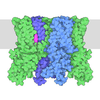
- Assembly
| Deposited unit | 
|
|---|---|
| 1 |
|
-Components
| #1: Protein | Mass: 87603.719 Da / Num. of mol.: 4 Source method: isolated from a genetically manipulated source Source: (gene. exp.) Rattus norvegicus (Norway rat) / Gene: Trpv2, Sac2b, Vrl1 / Production host:   Saccharomyces cerevisiae (brewer's yeast) / Strain (production host): BJ5457 / References: UniProt: Q9WUD2 Saccharomyces cerevisiae (brewer's yeast) / Strain (production host): BJ5457 / References: UniProt: Q9WUD2#2: Chemical | ChemComp-PEX /  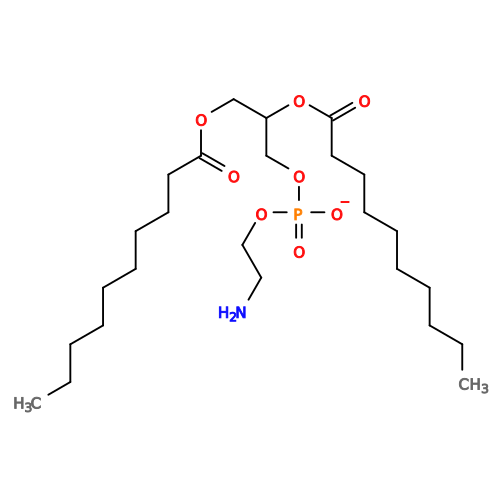 Mass: 522.632 Da / Num. of mol.: 6 / Source method: obtained synthetically / Formula: C25H49NO8P Mass: 522.632 Da / Num. of mol.: 6 / Source method: obtained synthetically / Formula: C25H49NO8PHas ligand of interest | N | Has protein modification | N | |
|---|
-Experimental details
-Experiment
| Experiment | Method: ELECTRON MICROSCOPY |
|---|---|
| EM experiment | Aggregation state: PARTICLE / 3D reconstruction method: single particle reconstruction |
- Sample preparation
| Component | Name: homo tetramer of rat TRPV2, H541S/D654T/N655D / Type: COMPLEX / Entity ID: #1 / Source: RECOMBINANT |
|---|---|
| Molecular weight | Experimental value: NO |
| Source (natural) | Organism:  Homo sapiens (human) Homo sapiens (human) |
| Source (recombinant) | Organism: Homo sapiens (human) / Strain: HEK293 |
| Buffer solution | pH: 8 |
| Specimen | Embedding applied: NO / Shadowing applied: NO / Staining applied: NO / Vitrification applied: YES |
| Vitrification | Cryogen name: ETHANE |
- Electron microscopy imaging
| Microscopy | Model: TFS GLACIOS |
|---|---|
| Electron gun | Electron source:  FIELD EMISSION GUN / Accelerating voltage: 200 kV / Illumination mode: FLOOD BEAM FIELD EMISSION GUN / Accelerating voltage: 200 kV / Illumination mode: FLOOD BEAM |
| Electron lens | Mode: BRIGHT FIELD / Nominal defocus max: 2000 nm / Nominal defocus min: 800 nm |
| Image recording | Electron dose: 40 e/Å2 / Film or detector model: FEI FALCON IV (4k x 4k) |
- Processing
| EM software |
| ||||||||||||||||||||||||
|---|---|---|---|---|---|---|---|---|---|---|---|---|---|---|---|---|---|---|---|---|---|---|---|---|---|
| CTF correction | Type: PHASE FLIPPING AND AMPLITUDE CORRECTION | ||||||||||||||||||||||||
| 3D reconstruction | Resolution: 2.95 Å / Resolution method: FSC 0.143 CUT-OFF / Num. of particles: 40799 / Symmetry type: POINT | ||||||||||||||||||||||||
| Refinement | Cross valid method: NONE Stereochemistry target values: GeoStd + Monomer Library + CDL v1.2 | ||||||||||||||||||||||||
| Displacement parameters | Biso mean: 97.25 Å2 | ||||||||||||||||||||||||
| Refine LS restraints |
|
