 Movie
Movie Controller

[English] 日本語
 Yorodumi
- PDB-10kf: Cryo-EM structure of a chemically treated Cyanobacterial Photosys... -
+ Open data

- Basic information
| Entry | Database: PDB / ID: 10kf | |||||||||
|---|---|---|---|---|---|---|---|---|---|---|
| Title | Cryo-EM structure of a chemically treated Cyanobacterial Photosystem I core with bound platinum nanoparticles | |||||||||
 Components Components |
| |||||||||
 Keywords Keywords | PHOTOSYNTHESIS / Photosystem / Platinum / Nanoparticles / Biohybrid | |||||||||
| Function / homology |  Function and homology information Function and homology informationphotosystem I reaction center / photosystem I / photosystem I / plasma membrane-derived thylakoid membrane / chlorophyll binding / photosynthesis / 4 iron, 4 sulfur cluster binding / electron transfer activity / oxidoreductase activity / magnesium ion binding Similarity search - Function | |||||||||
| Biological species |  Synechococcus elongatus PCC 6301 (bacteria) Synechococcus elongatus PCC 6301 (bacteria) | |||||||||
| Method | ELECTRON MICROSCOPY / single particle reconstruction / cryo EM / Resolution: 3.57 Å | |||||||||
 Authors Authors | Emerson, M.D. / Gisriel, C.J. | |||||||||
| Funding support |  United States, 1items United States, 1items
| |||||||||
 Citation Citation | Journal: bioRxiv / Year: 2026 Title: Molecular design principles for Photosystem I-based biohybrid solar fuel catalysts. Authors: Maximino D Emerson / Siva Naga Sai Damaraju / Audrey H Short / Zachary B Alvord / Zsolt A Palmer / Himanshu S Mehra / Christian M Brininger / Josh V Vermaas / Lisa M Utschig / Christopher J Gisriel / Abstract: Direct solar-to-chemical conversion offers a compelling route to clean, dispatchable energy. Photosystem I (PSI), an evolutionarily optimized light-driven oxidoreductase central to oxygenic ...Direct solar-to-chemical conversion offers a compelling route to clean, dispatchable energy. Photosystem I (PSI), an evolutionarily optimized light-driven oxidoreductase central to oxygenic photosynthesis, can be repurposed for direct solar-fuel production by efficiently coupling its photochemistry to catalysts, thereby storing sunlight as chemical energy in the H-H bond of H2. One promising architecture integrates PSI with Pt nanoparticle (PtNP) catalysts to create photocatalytic PSI-PtNP biohybrids. Advancing these systems requires molecular-level insight into protein-nanoparticle interactions and the bio-nano electron transfer pathways that govern activity; however, progress has been constrained by limited structural data to guide rational design. Here, we present two molecular structures of active PSI-PtNP assemblies that (a) compare thermophilic and mesophilic PSI scaffolds and (b) probe how removal of the terminal [4Fe-4S] clusters and stromal subunits in PSI reshapes protein-nanoparticle interfaces and photocatalysis. Structural analyses and molecular dynamics simulations define the interface topology, electrostatics, and cofactor-to-nanoparticle distances, revealing key molecular features that control biohybrid formation and electron transfer efficiency. These data establish mechanistic links between scaffold composition, bio-nano interface geometry, and catalytic performance, yielding design principles for optimizing PSI-PtNP architectures. The resulting structure-function insights provide a blueprint for engineering PSI-based solar-fuels systems and, more broadly, inform the design of protein-nanomaterial interfaces for light-driven catalysis. | |||||||||
| History |
|
- Structure visualization
| Structure viewer | Molecule: MolmilJmol/JSmol |
|---|
- Downloads & links
-Download
| PDBx/mmCIF format | 10kf.cif.gz | 423.5 KB | Display | PDBx/mmCIF format |
|---|---|---|---|---|
| PDB format | pdb10kf.ent.gz | 356.3 KB | Display | PDB format |
| PDBx/mmJSON format | 10kf.json.gz | Tree view | PDBx/mmJSON format | |
| Others |  Other downloads Other downloads |
-Validation report
| Arichive directory | https://data.pdbj.org/pub/pdb/validation_reports/0k/10kfftp://data.pdbj.org/pub/pdb/validation_reports/0k/10kf | HTTPS FTP |
|---|
-Related structure data
| Related structure data |  75232MC  10egC M: map data used to model this data C: citing same article ( |
|---|---|
| Similar structure data |

-Links
 PDBj
PDBj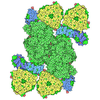
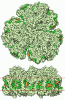
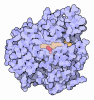
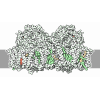
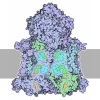
- Assembly
| Deposited unit | 
|
|---|---|
| 1 |
|
-Components
-Photosystem I P700 chlorophyll a apoprotein ... , 2 types, 2 molecules AB
| #1: Protein | Mass: 83994.336 Da / Num. of mol.: 1 / Source method: isolated from a natural source Source: (natural) Synechococcus elongatus PCC 6301 (bacteria)References: UniProt: Q5N0D6, photosystem I |
|---|---|
| #2: Protein | Mass: 81554.742 Da / Num. of mol.: 1 / Source method: isolated from a natural source Source: (natural) Synechococcus elongatus PCC 6301 (bacteria)References: UniProt: Q5N0D5, photosystem I |
-Photosystem I reaction center subunit ... , 5 types, 5 molecules FIJKM
| #3: Protein | Mass: 17125.742 Da / Num. of mol.: 1 / Source method: isolated from a natural source Source: (natural) Synechococcus elongatus PCC 6301 (bacteria)References: UniProt: P31083 |
|---|---|
| #4: Protein/peptide | Mass: 4002.733 Da / Num. of mol.: 1 / Source method: isolated from a natural source Source: (natural) Synechococcus elongatus PCC 6301 (bacteria)References: UniProt: A0A0H3K775 |
| #5: Protein/peptide | Mass: 5029.017 Da / Num. of mol.: 1 / Source method: isolated from a natural source Source: (natural) Synechococcus elongatus PCC 6301 (bacteria)References: UniProt: Q5N5C7 |
| #6: Protein | Mass: 8181.596 Da / Num. of mol.: 1 / Source method: isolated from a natural source Source: (natural) Synechococcus elongatus PCC 6301 (bacteria)References: UniProt: A0A0H3K593 |
| #7: Protein/peptide | Mass: 3239.867 Da / Num. of mol.: 1 / Source method: isolated from a natural source Source: (natural) Synechococcus elongatus PCC 6301 (bacteria)References: UniProt: Q5MZZ8 |
-Non-polymers , 7 types, 105 molecules 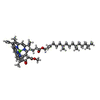
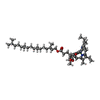
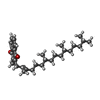
| #8: Chemical | ChemComp-CL0 / 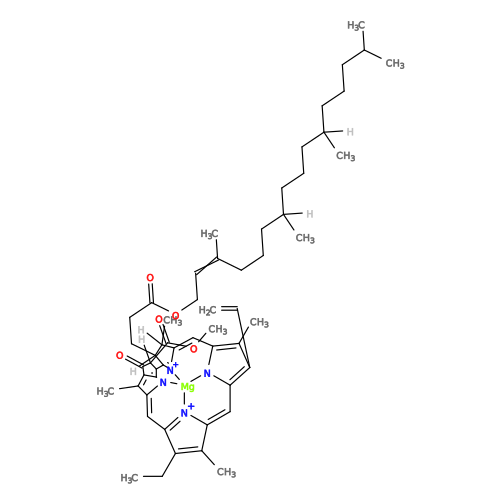 Mass: 893.489 Da / Num. of mol.: 1 / Source method: obtained synthetically / Formula: C55H72MgN4O5 Mass: 893.489 Da / Num. of mol.: 1 / Source method: obtained synthetically / Formula: C55H72MgN4O5 | ||||||||||
|---|---|---|---|---|---|---|---|---|---|---|---|
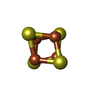
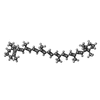
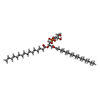
| #9: Chemical | ChemComp-CLA / 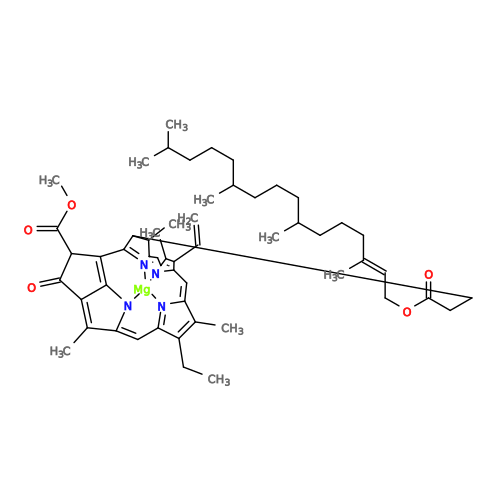 Mass: 893.489 Da / Num. of mol.: 85 / Source method: obtained synthetically / Formula: C55H72MgN4O5 / Feature type: SUBJECT OF INVESTIGATION Mass: 893.489 Da / Num. of mol.: 85 / Source method: obtained synthetically / Formula: C55H72MgN4O5 / Feature type: SUBJECT OF INVESTIGATION#10: Chemical | 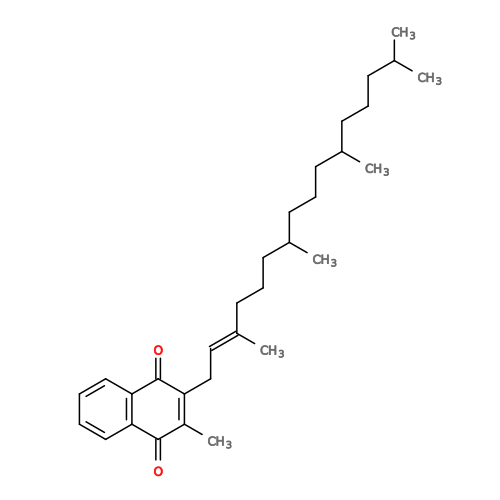 Mass: 450.696 Da / Num. of mol.: 2 / Source method: obtained synthetically / Formula: C31H46O2 Mass: 450.696 Da / Num. of mol.: 2 / Source method: obtained synthetically / Formula: C31H46O2#11: Chemical | ChemComp-SF4 / | 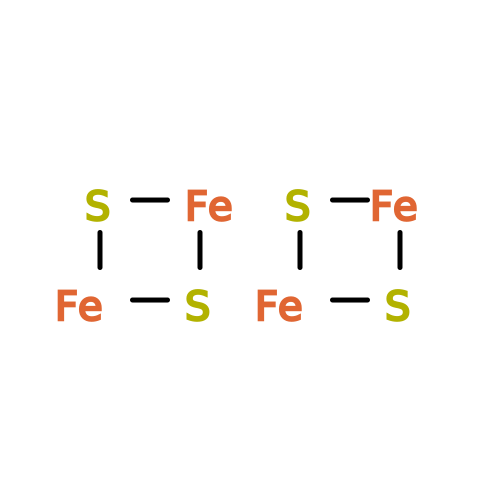 Mass: 351.640 Da / Num. of mol.: 1 / Source method: obtained synthetically / Formula: Fe4S4 Mass: 351.640 Da / Num. of mol.: 1 / Source method: obtained synthetically / Formula: Fe4S4#12: Chemical | ChemComp-BCR / 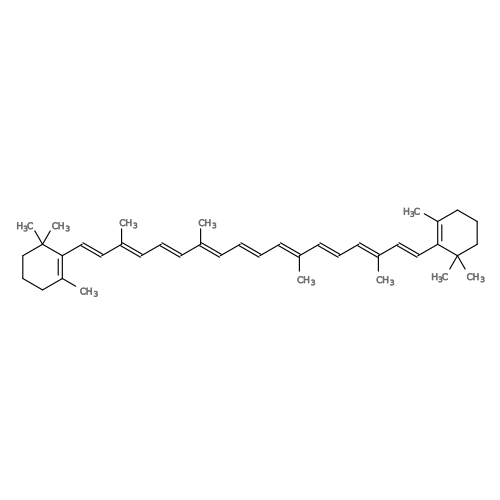 Mass: 536.873 Da / Num. of mol.: 13 / Source method: obtained synthetically / Formula: C40H56 Mass: 536.873 Da / Num. of mol.: 13 / Source method: obtained synthetically / Formula: C40H56#13: Chemical | 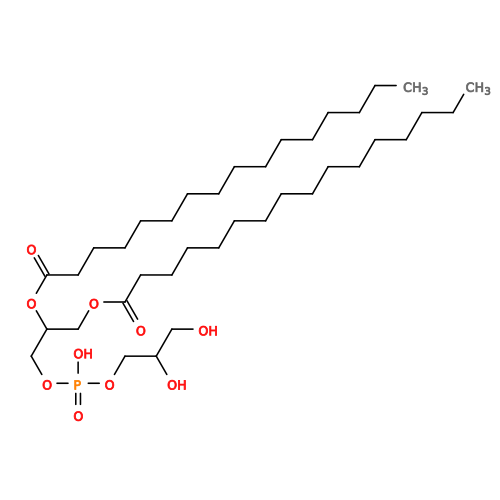 Mass: 722.970 Da / Num. of mol.: 2 / Source method: obtained synthetically / Formula: C38H75O10P / Comment: phospholipid*YM Mass: 722.970 Da / Num. of mol.: 2 / Source method: obtained synthetically / Formula: C38H75O10P / Comment: phospholipid*YM#14: Chemical | ChemComp-LMG / | 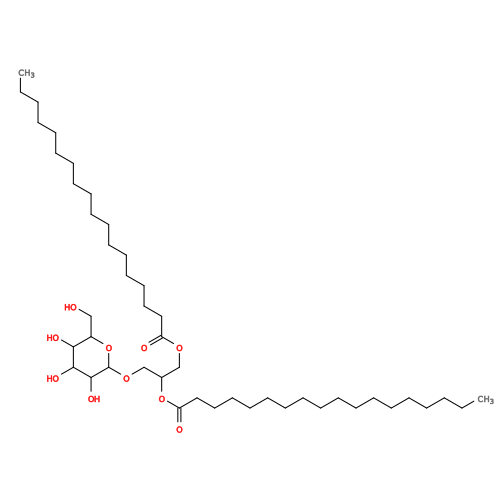 Mass: 787.158 Da / Num. of mol.: 1 / Source method: obtained synthetically / Formula: C45H86O10 Mass: 787.158 Da / Num. of mol.: 1 / Source method: obtained synthetically / Formula: C45H86O10 |
-Details
| Has ligand of interest | Y |
|---|---|
| Has protein modification | Y |
-Experimental details
-Experiment
| Experiment | Method: ELECTRON MICROSCOPY |
|---|---|
| EM experiment | Aggregation state: PARTICLE / 3D reconstruction method: single particle reconstruction |
- Sample preparation
| Component | Name: Chemically treated cyanobacterial photosystem I core with bound platinum nanoparticles. Type: COMPLEX / Entity ID: #7, #1-#6 / Source: NATURAL |
|---|---|
| Source (natural) | Organism: Synechococcus elongatus PCC 6301 (bacteria) |
| Buffer solution | pH: 7.4 |
| Specimen | Embedding applied: NO / Shadowing applied: NO / Staining applied: NO / Vitrification applied: YES |
| Vitrification | Cryogen name: ETHANE |
- Electron microscopy imaging
| Experimental equipment | 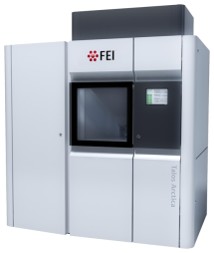 Model: Talos Arctica / Image courtesy: FEI Company |
|---|---|
| Microscopy | Model: FEI TALOS ARCTICA |
| Electron gun | Electron source:  FIELD EMISSION GUN / Accelerating voltage: 200 kV / Illumination mode: FLOOD BEAM FIELD EMISSION GUN / Accelerating voltage: 200 kV / Illumination mode: FLOOD BEAM |
| Electron lens | Mode: BRIGHT FIELD / Nominal defocus max: 2200 nm / Nominal defocus min: 800 nm |
| Image recording | Electron dose: 1 e/Å2 / Film or detector model: GATAN K3 (6k x 4k) |
- Processing
| EM software |
| ||||||||||||||||
|---|---|---|---|---|---|---|---|---|---|---|---|---|---|---|---|---|---|
| CTF correction | Type: PHASE FLIPPING AND AMPLITUDE CORRECTION | ||||||||||||||||
| 3D reconstruction | Resolution: 3.57 Å / Resolution method: FSC 0.143 CUT-OFF / Num. of particles: 53098 / Symmetry type: POINT |
