 Movie
Movie Controller


+ Open data

- Basic information
| Entry |  | ||||||||||||
|---|---|---|---|---|---|---|---|---|---|---|---|---|---|
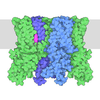
| Title | Structure of human TRPV1 in Apo state | ||||||||||||
 Map data Map data | |||||||||||||
 Sample Sample |
| ||||||||||||
 Keywords Keywords | Membrane Protein / Ion Channel / TRPV1 / Mavatrep / Asivatrep / JNJ-17203212 / CAY10448 / Small Molecule / Pain / Thermosensing / GDN / Antagonist | ||||||||||||
| Function / homology |  Function and homology information Function and homology informationchemosensory behavior / response to capsazepine / temperature-gated ion channel activity / thermoception / excitatory extracellular ligand-gated monoatomic ion channel activity / dendritic spine membrane / cellular response to alkaloid / TRP channels / intracellularly gated calcium channel activity / cellular response to ATP ...chemosensory behavior / response to capsazepine / temperature-gated ion channel activity / thermoception / excitatory extracellular ligand-gated monoatomic ion channel activity / dendritic spine membrane / cellular response to alkaloid / TRP channels / intracellularly gated calcium channel activity / cellular response to ATP / detection of temperature stimulus involved in sensory perception of pain / calcium ion import across plasma membrane / voltage-gated calcium channel activity / cellular response to acidic pH / extracellular ligand-gated monoatomic ion channel activity / phosphatidylinositol binding / phosphoprotein binding / GABA-ergic synapse / calcium ion transmembrane transport / calcium channel activity / transmembrane signaling receptor activity / cellular response to heat / protein homotetramerization / calmodulin binding / cell surface receptor signaling pathway / postsynaptic membrane / negative regulation of transcription by RNA polymerase II / ATP binding / membrane / metal ion binding / plasma membrane Similarity search - Function | ||||||||||||
| Biological species |  Homo sapiens (human) Homo sapiens (human) | ||||||||||||
| Method | single particle reconstruction / cryo EM / Resolution: 2.52 Å | ||||||||||||
 Authors Authors | Lopez KE / Van Horn WD | ||||||||||||
| Funding support |  United States, 3 items United States, 3 items
| ||||||||||||
 Citation Citation | Journal: bioRxiv / Year: 2026 Title: TRPV1 antagonism occurs through diverse structural mechanisms. Authors: Kyle E Lopez / Audrey S Paduda / Matthew J Derrick / Wade D Van Horn / Abstract: Transient receptor potential vanilloid 1 (TRPV1) ion channel mediates thermosensation and pain and is a target for non-addictive analgesics; however, clinical candidates have failed due to ...Transient receptor potential vanilloid 1 (TRPV1) ion channel mediates thermosensation and pain and is a target for non-addictive analgesics; however, clinical candidates have failed due to thermoregulatory side effects. Limited structural data for human TRPV1 (hTRPV1) bound to clinically relevant antagonists has constrained mechanistic insight. Using chemoinformatics-informed cryo-EM and BRET assays, we define the structural basis of antagonism across diverse chemotypes, including failed clinical compounds. A structure of hTRPV1 bound to 6-iodo-dihydrocapsaicin shows how a single substitution converts an agonist into an antagonist. Additional structures with Asivatrep, Mavatrep, and JNJ-17203212 reveal vanilloid pocket plasticity and divergent interaction networks, including lipid co-binding. Despite this diversity, antagonists converge on a conserved inhibited state, showing high potency is maintained across flexible binding modes. These findings redefine our understanding of hTRPV1 antagonism and illustrate how chemically diverse ligands stabilize an inhibited state in polymodal ion channels, laying groundwork for next-generation analgesics with improved safety. | ||||||||||||
| History |
|
- Structure visualization
| Supplemental images |
|---|

- Downloads & links
-EMDB archive
| Map data | emd_75616.map.gz | 398.6 MB | EMDB map data format | |
|---|---|---|---|---|
| Header (meta data) | emd-75616-v30.xmlemd-75616.xml | 21.4 KB 21.4 KB | Display Display | EMDB header |
| FSC (resolution estimation) | emd_75616_fsc.xml | 15.8 KB | Display | FSC data file |
| Images |  emd_75616.png emd_75616.png | 35.6 KB | ||
| Masks | emd_75616_msk_1.map | 421.9 MB | Mask map | |
| Filedesc metadata | emd-75616.cif.gz | 7.3 KB | ||
| Others | emd_75616_half_map_1.map.gzemd_75616_half_map_2.map.gz | 390.9 MB 390.9 MB | ||
| Archive directory |  http://ftp.pdbj.org/pub/emdb/structures/EMD-75616ftp://ftp.pdbj.org/pub/emdb/structures/EMD-75616 http://ftp.pdbj.org/pub/emdb/structures/EMD-75616ftp://ftp.pdbj.org/pub/emdb/structures/EMD-75616 | HTTPS FTP |
-Related structure data
| Related structure data |  11cjMC  11ckC  11clC  11cnC  11coC M: atomic model generated by this map C: citing same article ( |
|---|---|
| Similar structure data |


-Links
| EMDB pages | EMDB (EBI/PDBe) / EMDataResource |
|---|---|
| Related items in Molecule of the Month |
-Map
| File | Download / File: emd_75616.map.gz / Format: CCP4 / Size: 421.9 MB / Type: IMAGE STORED AS FLOATING POINT NUMBER (4 BYTES) | ||||||||||||||||||||||||||||||||||||
|---|---|---|---|---|---|---|---|---|---|---|---|---|---|---|---|---|---|---|---|---|---|---|---|---|---|---|---|---|---|---|---|---|---|---|---|---|---|
| Projections & slices | Image control
Images are generated by Spider. | ||||||||||||||||||||||||||||||||||||
| Voxel size | X=Y=Z: 0.7296 Å | ||||||||||||||||||||||||||||||||||||
| Density |
| ||||||||||||||||||||||||||||||||||||
| Symmetry | Space group: 1 | ||||||||||||||||||||||||||||||||||||
| Details | EMDB XML:
|
 Z (Sec.)
 Y (Row.)
 X (Col.)


-Supplemental data
-Mask #1
| File | emd_75616_msk_1.map | ||||||||||||
|---|---|---|---|---|---|---|---|---|---|---|---|---|---|
| Projections & Slices |
| ||||||||||||
| Density Histograms |


-Half map: #1
| File | emd_75616_half_map_1.map | ||||||||||||
|---|---|---|---|---|---|---|---|---|---|---|---|---|---|
| Projections & Slices |
| ||||||||||||
| Density Histograms |


-Half map: #2
| File | emd_75616_half_map_2.map | ||||||||||||
|---|---|---|---|---|---|---|---|---|---|---|---|---|---|
| Projections & Slices |
| ||||||||||||
| Density Histograms |


- Sample components
-Entire : Tetrameric hTRPV1 in the apo state
| Entire | Name: Tetrameric hTRPV1 in the apo state |
|---|---|
| Components |
|
-Supramolecule #1: Tetrameric hTRPV1 in the apo state
| Supramolecule | Name: Tetrameric hTRPV1 in the apo state / type: complex / ID: 1 / Parent: 0 / Macromolecule list: #1 |
|---|---|
| Source (natural) | Organism: Homo sapiens (human) |
| Molecular weight | Theoretical: 496.528 KDa |
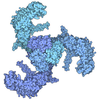
-Macromolecule #1: Transient receptor potential cation channel subfamily V member 1
| Macromolecule | Name: Transient receptor potential cation channel subfamily V member 1 type: protein_or_peptide / ID: 1 / Number of copies: 4 / Enantiomer: LEVO |
|---|---|
| Source (natural) | Organism: Homo sapiens (human) |
| Molecular weight | Theoretical: 124.281469 KDa |
| Recombinant expression | Organism: Homo sapiens (human) |
| Sequence | String: MKKWSSTDLG AAADPLQKDT CPDPLDGDPN SRPPPAKPQL STAKSRTRLF GKGDSEEAFP VDCPHEEGEL DSCPTITVSP VITIQRPGD GPTGARLLSQ DSVAASTEKT LRLYDRRSIF EAVAQNNCQD LESLLLFLQK SKKHLTDNEF KDPETGKTCL L KAMLNLHD ...String: MKKWSSTDLG AAADPLQKDT CPDPLDGDPN SRPPPAKPQL STAKSRTRLF GKGDSEEAFP VDCPHEEGEL DSCPTITVSP VITIQRPGD GPTGARLLSQ DSVAASTEKT LRLYDRRSIF EAVAQNNCQD LESLLLFLQK SKKHLTDNEF KDPETGKTCL L KAMLNLHD GQNTTIPLLL EIARQTDSLK ELVNASYTDS YYKGQTALHI AIERRNMALV TLLVENGADV QAAAHGDFFK KT KGRPGFY FGELPLSLAA CTNQLGIVKF LLQNSWQTAD ISARDSVGNT VLHALVEVAD NTADNTKFVT SMYNEILILG AKL HPTLKL EELTNKKGMT PLALAAGTGK IGVLAYILQR EIQEPECRHL SRKFTEWAYG PVHSSLYDLS CIDTCEKNSV LEVI AYSSS ETPNRHDMLL VEPLNRLLQD KWDRFVKRIF YFNFLVYCLY MIIFTMAAYY RPVDGLPPFK MEKTGDYFRV TGEIL SVLG GVYFFFRGIQ YFLQRRPSMK TLFVDSYSEM LFFLQSLFML ATVVLYFSHL KEYVASMVFS LALGWTNMLY YTRGFQ QMG IYAVMIEKMI LRDLCRFMFV YIVFLFGFST AVVTLIEDGK NDSLPSESTS HRWRGPACRP PDSSYNSLYS TCLELFK FT IGMGDLEFTE NYDFKAVFII LLLAYVILTY ILLLNMLIAL MGETVNKIAQ ESKNIWKLQR AITILDTEKS FLKCMRKA F RSGKLLQVGY TPDGKDDYRW CFRVDEVNWT TWNTNVGIIN EDPGNCEGVK RTLSFSLRSS RVSGRHWKNF ALVPLLREA SARDRQSAQP EEVYLRQFSG SLKPEDAEVF KSPAASGEKG TLEVLFQGPG GSGGSASVIK PEMKIKLRME GAVNGHKFVI EGEGIGKPY EGTQTLDLTV EEGAPLPFSY DILTPAFQYG NRAFTKYPED IPDYFKQAFP EGYSWERSMT YEDQGICIAT S DITMEGDC FFYEIRFDGT NFPPNGPVMQ KKTLKWEPST EKMYVEDGVL KGDVEMALLL EGGGHYRCDF KTTYKAKKDV RL PDAHEVD HRIEILSHDK DYNKVRLYEH AEARYSGGGS GGGHHHHHHH GGSGGWSHPQ FEK UniProtKB: Transient receptor potential cation channel subfamily V member 1 |
-Macromolecule #2: (2R)-3-{[(R)-hydroxy{[(1S,2R,3R,4S,5S,6R)-2,3,4,5,6-pentahydroxyc...
| Macromolecule | Name: (2R)-3-{[(R)-hydroxy{[(1S,2R,3R,4S,5S,6R)-2,3,4,5,6-pentahydroxycyclohexyl]oxy}phosphoryl]oxy}propane-1,2-diyl dioctadecanoate type: ligand / ID: 2 / Number of copies: 4 / Formula: 8IJ |
|---|---|
| Molecular weight | Theoretical: 867.138 Da |
| Chemical component information | 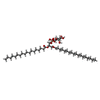 ChemComp-8IJ: |
-Macromolecule #3: (2S)-3-(hexadecanoyloxy)-2-[(9Z)-octadec-9-enoyloxy]propyl 2-(tri...
| Macromolecule | Name: (2S)-3-(hexadecanoyloxy)-2-[(9Z)-octadec-9-enoyloxy]propyl 2-(trimethylammonio)ethyl phosphate type: ligand / ID: 3 / Number of copies: 4 / Formula: POV |
|---|---|
| Molecular weight | Theoretical: 760.076 Da |
| Chemical component information | 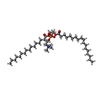 ChemComp-POV: |
-Experimental details
-Structure determination
| Method | cryo EM |
|---|---|
 Processing Processing | single particle reconstruction |
| Aggregation state | particle |
-Sample preparation
| Concentration | 0.75 mg/mL | ||||||||||
|---|---|---|---|---|---|---|---|---|---|---|---|
| Buffer | pH: 8 Component:
| ||||||||||
| Grid | Model: Quantifoil R1.2/1.3 / Material: GOLD / Mesh: 300 / Support film - Material: GOLD / Support film - topology: HOLEY / Pretreatment - Type: GLOW DISCHARGE / Pretreatment - Time: 30 sec. | ||||||||||
| Vitrification | Cryogen name: ETHANE / Chamber humidity: 100 % / Chamber temperature: 277 K / Instrument: FEI VITROBOT MARK IV |
- Electron microscopy
| Microscope | TFS KRIOS |
|---|---|
| Specialist optics | Energy filter - Name: TFS Selectris X / Energy filter - Slit width: 10 eV |
| Image recording | Film or detector model: TFS FALCON 4i (4k x 4k) / Number grids imaged: 1 / Number real images: 15756 / Average exposure time: 4.1 sec. / Average electron dose: 50.0 e/Å2 |
| Electron beam | Acceleration voltage: 300 kV / Electron source:  FIELD EMISSION GUN FIELD EMISSION GUN |
| Electron optics | Illumination mode: FLOOD BEAM / Imaging mode: BRIGHT FIELD / Cs: 2.7 mm / Nominal defocus max: 2.5 µm / Nominal defocus min: 1.5 µm / Nominal magnification: 105000 |
| Sample stage | Specimen holder model: FEI TITAN KRIOS AUTOGRID HOLDER / Cooling holder cryogen: NITROGEN |
| Experimental equipment |  Model: Titan Krios / Image courtesy: FEI Company |


