National Institutes of Health/National Institute of Neurological Disorders and Stroke (NIH/NINDS)
R01NS119505
United States
National Institutes of Health/National Institute of General Medical Sciences (NIH/NIGMS)
R35GM141933
United States
American Heart Association
23POST1029540
United States
Citation
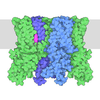
Journal: bioRxiv / Year: 2026 Title: TRPV1 antagonism occurs through diverse structural mechanisms. Authors: Kyle E Lopez / Audrey S Paduda / Matthew J Derrick / Wade D Van Horn / Abstract: Transient receptor potential vanilloid 1 (TRPV1) ion channel mediates thermosensation and pain and is a target for non-addictive analgesics; however, clinical candidates have failed due to ...Transient receptor potential vanilloid 1 (TRPV1) ion channel mediates thermosensation and pain and is a target for non-addictive analgesics; however, clinical candidates have failed due to thermoregulatory side effects. Limited structural data for human TRPV1 (hTRPV1) bound to clinically relevant antagonists has constrained mechanistic insight. Using chemoinformatics-informed cryo-EM and BRET assays, we define the structural basis of antagonism across diverse chemotypes, including failed clinical compounds. A structure of hTRPV1 bound to 6-iodo-dihydrocapsaicin shows how a single substitution converts an agonist into an antagonist. Additional structures with Asivatrep, Mavatrep, and JNJ-17203212 reveal vanilloid pocket plasticity and divergent interaction networks, including lipid co-binding. Despite this diversity, antagonists converge on a conserved inhibited state, showing high potency is maintained across flexible binding modes. These findings redefine our understanding of hTRPV1 antagonism and illustrate how chemically diverse ligands stabilize an inhibited state in polymodal ion channels, laying groundwork for next-generation analgesics with improved safety.
Name: 4-[3-(trifluoromethyl)pyridin-2-yl]-N-[5-(trifluoromethyl)pyridin-2-yl]piperazine-1-carboxamide type: ligand / ID: 2 / Number of copies: 4 / Formula: A1C8H
Molecular weight
Theoretical: 419.324 Da
-
Experimental details
-
Structure determination
Method
cryo EM
Processing
single particle reconstruction
Aggregation state
particle
-
Sample preparation
Concentration
0.75 mg/mL
Buffer
pH: 8 Component:
Concentration
Name
20.0 mM
Tris-HCl
150.0 mM
Sodium Chloride
1.0 mM
2-Mercaptoethanol
0.01 %
Glyco-diosgeenin
Grid
Model: UltrAuFoil R1.2/1.3 / Material: GOLD / Mesh: 300 / Support film - Material: GOLD / Support film - topology: HOLEY
Vitrification
Cryogen name: ETHANE / Chamber humidity: 100 % / Chamber temperature: 277 K / Instrument: FEI VITROBOT MARK IV
-
Electron microscopy
Microscope
TFS KRIOS
Specialist optics
Energy filter - Name: TFS Selectris X / Energy filter - Slit width: 10 eV
Image recording
Film or detector model: TFS FALCON 4i (4k x 4k) / Number grids imaged: 1 / Number real images: 4288 / Average exposure time: 2.1 sec. / Average electron dose: 50.0 e/Å2
Electron beam
Acceleration voltage: 300 kV / Electron source: FIELD EMISSION GUN
In the structure databanks used in Yorodumi, some data are registered as the other names, "COVID-19 virus" and "2019-nCoV". Here are the details of the virus and the list of structure data.
Jan 31, 2019. EMDB accession codes are about to change! (news from PDBe EMDB page)
EMDB accession codes are about to change! (news from PDBe EMDB page)
The allocation of 4 digits for EMDB accession codes will soon come to an end. Whilst these codes will remain in use, new EMDB accession codes will include an additional digit and will expand incrementally as the available range of codes is exhausted. The current 4-digit format prefixed with “EMD-” (i.e. EMD-XXXX) will advance to a 5-digit format (i.e. EMD-XXXXX), and so on. It is currently estimated that the 4-digit codes will be depleted around Spring 2019, at which point the 5-digit format will come into force.
The EM Navigator/Yorodumi systems omit the EMD- prefix.
Related info.:Q: What is EMD? / ID/Accession-code notation in Yorodumi/EM Navigator
Yorodumi is a browser for structure data from EMDB, PDB, SASBDB, etc.
This page is also the successor to EM Navigator detail page, and also detail information page/front-end page for Omokage search.
The word "yorodu" (or yorozu) is an old Japanese word meaning "ten thousand". "mi" (miru) is to see.
Related info.:EMDB / PDB / SASBDB / Comparison of 3 databanks / Yorodumi Search / Aug 31, 2016. New EM Navigator & Yorodumi / Yorodumi Papers / Jmol/JSmol / Function and homology information / Changes in new EM Navigator and Yorodumi
 Movie
Movie Controller


 Open data
 Basic information
 Map data
 Sample
 Keywords
 Function and homology information
 Homo sapiens (human)
 Authors
 United States, 3 items
  Citation
 Structure visualization
 Downloads & links
 emd_75620.png
 https://data.pdbj.org/pub/emdb/structures/EMD-75620


 Z (Sec.)
 Y (Row.)
 X (Col.)


 Sample components
 Processing
 Electron microscopy
 FIELD EMISSION GUN

