Protein or peptide: Microtubule-associated protein tau
Keywords
tau / MAPT / FTD / FTLD / amyloid / neurodegeneration / PROTEIN FIBRIL
Function / homology
Function and homology information
plus-end-directed organelle transport along microtubule / histone-dependent DNA binding / negative regulation of protein localization to mitochondrion / neurofibrillary tangle / microtubule lateral binding / axonal transport / tubulin complex / positive regulation of protein localization to synapse / phosphatidylinositol bisphosphate binding / generation of neurons ...plus-end-directed organelle transport along microtubule / histone-dependent DNA binding / negative regulation of protein localization to mitochondrion / neurofibrillary tangle / microtubule lateral binding / axonal transport / tubulin complex / positive regulation of protein localization to synapse / phosphatidylinositol bisphosphate binding / generation of neurons / axon development / axonal transport of mitochondrion / rRNA metabolic process / central nervous system neuron development / regulation of mitochondrial fission / regulation of microtubule-based movement / intracellular distribution of mitochondria / regulation of chromosome organization / minor groove of adenine-thymine-rich DNA binding / lipoprotein particle binding / microtubule polymerization / negative regulation of mitochondrial membrane potential / regulation of microtubule polymerization / dynactin binding / apolipoprotein binding / main axon / Caspase-mediated cleavage of cytoskeletal proteins / glial cell projection / regulation of microtubule polymerization or depolymerization / negative regulation of mitochondrial fission / axolemma / positive regulation of axon extension / neurofibrillary tangle assembly / protein polymerization / positive regulation of microtubule polymerization / regulation of cellular response to heat / positive regulation of protein localization / Activation of AMPK downstream of NMDARs / positive regulation of superoxide anion generation / regulation of calcium-mediated signaling / cytoplasmic microtubule organization / cellular response to brain-derived neurotrophic factor stimulus / regulation of long-term synaptic depression / axon cytoplasm / supramolecular fiber organization / synapse assembly / somatodendritic compartment / astrocyte activation / nuclear periphery / phosphatidylinositol binding / protein phosphatase 2A binding / stress granule assembly / enzyme inhibitor activity / regulation of autophagy / regulation of microtubule cytoskeleton organization / cellular response to reactive oxygen species / microglial cell activation / cellular response to nerve growth factor stimulus / Hsp90 protein binding / regulation of synaptic plasticity / memory / SH3 domain binding / synapse organization / protein homooligomerization / microtubule cytoskeleton organization / PKR-mediated signaling / response to lead ion / neuron projection development / cytoplasmic ribonucleoprotein granule / microtubule cytoskeleton / cell-cell signaling / cellular response to heat / single-stranded DNA binding / growth cone / protein-folding chaperone binding / actin binding / cell body / double-stranded DNA binding / sequence-specific DNA binding / microtubule binding / amyloid fibril formation / dendritic spine / microtubule / learning or memory / protein-macromolecule adaptor activity / neuron projection / membrane raft / negative regulation of gene expression / axon / neuronal cell body / DNA damage response / dendrite / protein kinase binding / enzyme binding / mitochondrion / DNA binding / RNA binding / extracellular region / identical protein binding / nucleus Similarity search - Function
Microtubule-associated protein Tau / Microtubule associated protein, tubulin-binding repeat / Tau and MAP protein, tubulin-binding repeat / Tau and MAP proteins tubulin-binding repeat signature. / Tau and MAP proteins tubulin-binding repeat profile. / : Similarity search - Domain/homology
National Institutes of Health/National Institute on Aging (NIH/NIA)
P01AG002132
United States
National Institutes of Health/National Institute on Aging (NIH/NIA)
P30AG062422
United States
National Institutes of Health/National Institute on Aging (NIH/NIA)
P01AG019724
United States
National Institutes of Health/National Institute on Aging (NIH/NIA)
U01AG057195
United States
National Institutes of Health/National Institute on Aging (NIH/NIA)
U19AG063911
United States
Other private
Other private
National Institutes of Health/National Institute on Aging (NIH/NIA)
U19: AG063911
United States
Other private
U54 NS092089
Other private
U01 AG045390
National Institutes of Health/National Institute on Aging (NIH/NIA)
P01 AG019724
United States
Other private
P30 AG062422
National Institutes of Health/National Institute on Aging (NIH/NIA)
U24 AG21886
United States
Other private
A141860
Citation
Journal: bioRxiv / Year: 2026 Title: Distinct tau filament folds in familial frontotemporal dementia due to the S305I mutation. Authors: Henry S Pan / Gregory E Merz / Alissa Nana Li / Minh Quan Le / Hyunil Jo / Athena Quddus / Anthony Yung / Rian C Kormos / Arthur A Melo / Eliana Marisa Ramos / Argentina Lario Lago / ...Authors: Henry S Pan / Gregory E Merz / Alissa Nana Li / Minh Quan Le / Hyunil Jo / Athena Quddus / Anthony Yung / Rian C Kormos / Arthur A Melo / Eliana Marisa Ramos / Argentina Lario Lago / Salvatore Spina / Lea T Grinberg / Howard J Rosen / Eric Tse / Maria Luisa Gorno-Tempini / William F DeGrado / William W Seeley / Daniel R Southworth / Abstract: Frontotemporal lobar degeneration with tau inclusions (FTLD-tau) comprise a class of fatal heterogeneous neurodegenerative diseases. Approximately 10% arise from pathogenic MAPT mutations and often ...Frontotemporal lobar degeneration with tau inclusions (FTLD-tau) comprise a class of fatal heterogeneous neurodegenerative diseases. Approximately 10% arise from pathogenic MAPT mutations and often cause severe, early-onset disease with pathology that is distinct yet partially overlapping with sporadic cases. Here, we evaluated post-mortem tissue from a patient with FTLD-tau due to S305I showing neuropathology most consistent with argyrophilic grain disease (AGD), a prevalent limbic tauopathy of aging. Structures determined by cryo-electron microscopy reveal tau filament folds that differ from those found in sporadic AGD or other tauopathies and feature a 4-layer architecture stabilized by the Ile substitution within its core. Comparative structural analysis reveals conserved motifs are shared among AGD, corticobasal degeneration, and P301T. A well-defined density stacks along a cationic cleft, indicative of a bound RNA-like polyanion or small-molecule. analysis shows the S305I mutation promotes fibrilization relative to normal tau. These results demonstrate that stabilizes a distinct aggregation-prone tau fold that likely contributes to disease pathology and heterogeneity beyond its known splicing defects, and underscore potential limitations of using the most pathologically similar genetic form as a model for sporadic FTLD-tau.
Model: Quantifoil R1.2/1.3 / Material: GOLD / Mesh: 200 / Support film - Material: CARBON / Support film - topology: HOLEY / Support film - Film thickness: 12
Vitrification
Cryogen name: ETHANE
-
Electron microscopy
Microscope
TFS KRIOS
Image recording
Film or detector model: GATAN K3 (6k x 4k) / Number grids imaged: 1 / Number real images: 7393 / Average exposure time: 5.4 sec. / Average electron dose: 46.0 e/Å2
Electron beam
Acceleration voltage: 300 kV / Electron source: FIELD EMISSION GUN
In the structure databanks used in Yorodumi, some data are registered as the other names, "COVID-19 virus" and "2019-nCoV". Here are the details of the virus and the list of structure data.
Jan 31, 2019. EMDB accession codes are about to change! (news from PDBe EMDB page)
EMDB accession codes are about to change! (news from PDBe EMDB page)
The allocation of 4 digits for EMDB accession codes will soon come to an end. Whilst these codes will remain in use, new EMDB accession codes will include an additional digit and will expand incrementally as the available range of codes is exhausted. The current 4-digit format prefixed with “EMD-” (i.e. EMD-XXXX) will advance to a 5-digit format (i.e. EMD-XXXXX), and so on. It is currently estimated that the 4-digit codes will be depleted around Spring 2019, at which point the 5-digit format will come into force.
The EM Navigator/Yorodumi systems omit the EMD- prefix.
Related info.:Q: What is EMD? / ID/Accession-code notation in Yorodumi/EM Navigator
Yorodumi is a browser for structure data from EMDB, PDB, SASBDB, etc.
This page is also the successor to EM Navigator detail page, and also detail information page/front-end page for Omokage search.
The word "yorodu" (or yorozu) is an old Japanese word meaning "ten thousand". "mi" (miru) is to see.
Related info.:EMDB / PDB / SASBDB / Comparison of 3 databanks / Yorodumi Search / Aug 31, 2016. New EM Navigator & Yorodumi / Yorodumi Papers / Jmol/JSmol / Function and homology information / Changes in new EM Navigator and Yorodumi
 Movie
Movie Controller

 Yorodumi
 Open data
 Basic information
 Map data
 Sample
 Keywords
 Function and homology information
 Homo sapiens (human)
 Authors
 United States, 14 items
  Citation
 Structure visualization
 Downloads & links
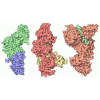
 emd_75196.png
 http://ftp.pdbj.org/pub/emdb/structures/EMD-75196


 Z (Sec.)
 Y (Row.)
 X (Col.)


 Sample components
 Escherichia coli (E. coli)
 Processing
 Electron microscopy
 FIELD EMISSION GUN

