 Movie
Movie Controller

[English] 日本語
 Yorodumi
- EMDB-73786: HCoV-NL63 S2' peptide bound to TMPRSS2 S441A (complexed with the ... -
+ Open data

- Basic information
| Entry |  | |||||||||
|---|---|---|---|---|---|---|---|---|---|---|
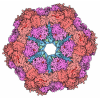
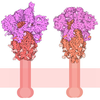
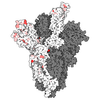
| Title | HCoV-NL63 S2' peptide bound to TMPRSS2 S441A (complexed with the H1H7 Fab and an anti-kappa-nanobody) | |||||||||
 Map data Map data | sharpened map | |||||||||
 Sample Sample |
| |||||||||
 Keywords Keywords | TMPRSS2 / NL63 / S2prime / coronavirus / cleavage / SARS-CoV-2 / spike / fusion / protease / entry / antiviral / Structural Genomics / Seattle Structural Genomics Center for Infectious Disease / SSGCID / VIRAL PROTEIN / VIRAL PROTEIN-Immune System complex | |||||||||
| Function / homology |  Function and homology information Function and homology informationtransmembrane protease serine 2 / protein autoprocessing / Attachment and Entry / serine-type peptidase activity / Induction of Cell-Cell Fusion / positive regulation of viral entry into host cell / host cell endoplasmic reticulum-Golgi intermediate compartment membrane / Attachment and Entry / entry receptor-mediated virion attachment to host cell / receptor-mediated virion attachment to host cell ...transmembrane protease serine 2 / protein autoprocessing / Attachment and Entry / serine-type peptidase activity / Induction of Cell-Cell Fusion / positive regulation of viral entry into host cell / host cell endoplasmic reticulum-Golgi intermediate compartment membrane / Attachment and Entry / entry receptor-mediated virion attachment to host cell / receptor-mediated virion attachment to host cell / host cell surface receptor binding / endocytosis involved in viral entry into host cell / serine-type endopeptidase activity / fusion of virus membrane with host plasma membrane / fusion of virus membrane with host endosome membrane / viral envelope / virion membrane / proteolysis / extracellular exosome / extracellular region / membrane / plasma membrane Similarity search - Function | |||||||||
| Biological species |  Homo sapiens (human) / Homo sapiens (human) /  Human coronavirus NL63 / Human coronavirus NL63 /   Lama glama (llama) Lama glama (llama) | |||||||||
| Method | single particle reconstruction / cryo EM / Resolution: 2.8 Å | |||||||||
 Authors Authors | McCallum M / Seattle Structural Genomics Center for Infectious Disease (SSGCID) / Veesler D | |||||||||
| Funding support |  United States, 1 items United States, 1 items
| |||||||||
 Citation Citation | Journal: Nat Struct Mol Biol / Year: 2026 Title: TMPRSS2-mediated coronavirus spike activation and inhibition. Authors: Matthew McCallum / James Brett Case / Jack T Brown / Young-Jun Park / Jimin Lee / Emmajay Sutherland / Anupriya Aggarwal / Cecily Gibson / Florian A Lempp / Cameron Stewart / M Alejandra ...Authors: Matthew McCallum / James Brett Case / Jack T Brown / Young-Jun Park / Jimin Lee / Emmajay Sutherland / Anupriya Aggarwal / Cecily Gibson / Florian A Lempp / Cameron Stewart / M Alejandra Tortorici / Shilpa Sanapala / Jun Siong Low / Daniel Asarnow / Dana Bohan / Exequiel Dellota / Benjamin Merz / Bhavna Chawla / Swagata Kar / Antonio Lanzavecchia / Federica Sallusto / Nicholas M Riley / Stuart Turville / Lisa Purcell / Michael S Diamond / David Veesler /      Abstract: The protease TMPRSS2 facilitates coronavirus infections, yet its mechanism of viral glycoprotein recognition remains unclear. Here we show that, following ACE2 engagement of the SARS-CoV-2 spike (S) ...The protease TMPRSS2 facilitates coronavirus infections, yet its mechanism of viral glycoprotein recognition remains unclear. Here we show that, following ACE2 engagement of the SARS-CoV-2 spike (S) inducing the early fusion intermediate conformation (E-FIC), TMPRSS2 cleaves the R815 S' site and promotes fusogenic conformational changes leading to viral entry. We unveil TMPRSS2 recognition of S', identify key residues modulating binding specificity and demonstrate that S' site-directed broadly neutralizing antibodies target E-FIC and inhibit viral entry by blocking TMPRSS2 access. We computationally designed stabilized E-FIC as a vaccine candidate, overcoming the transient nature of this state. We describe a TMPRSS2-directed monoclonal antibody inhibiting several coronaviruses, including SARS-CoV-2 variants and protecting mice against SARS-CoV-2 challenge. These results outline the mechanistic role of TMPRSS2 and S' site-directed antibodies in coronavirus entry. | |||||||||
| History |
|
- Structure visualization
| Supplemental images |
|---|

- Downloads & links
-EMDB archive
| Map data | emd_73786.map.gz | 483.6 MB | EMDB map data format | |
|---|---|---|---|---|
| Header (meta data) | emd-73786-v30.xmlemd-73786.xml | 26.3 KB 26.3 KB | Display Display | EMDB header |
| Images |  emd_73786.png emd_73786.png | 111.1 KB | ||
| Filedesc metadata | emd-73786.cif.gz | 7.7 KB | ||
| Others | emd_73786_additional_1.map.gzemd_73786_half_map_1.map.gzemd_73786_half_map_2.map.gz | 256.8 MB 474.8 MB 474.8 MB | ||
| Archive directory |  https://data.pdbj.org/pub/emdb/structures/EMD-73786ftp://data.pdbj.org/pub/emdb/structures/EMD-73786 https://data.pdbj.org/pub/emdb/structures/EMD-73786ftp://data.pdbj.org/pub/emdb/structures/EMD-73786 | HTTPS FTP |
-Related structure data
| Related structure data |  9z3jMC  11hkC  11hlC  11hnC  11hwC  9opqC  9oprC  9yyuC  9yyvC  9z3kC M: atomic model generated by this map C: citing same article ( |
|---|---|
| Similar structure data |


-Links
| EMDB pages | EMDB (EBI/PDBe) / EMDataResource |
|---|---|
| Related items in Molecule of the Month |
-Map
| File | Download / File: emd_73786.map.gz / Format: CCP4 / Size: 512 MB / Type: IMAGE STORED AS FLOATING POINT NUMBER (4 BYTES) | ||||||||||||||||||||||||||||||||||||
|---|---|---|---|---|---|---|---|---|---|---|---|---|---|---|---|---|---|---|---|---|---|---|---|---|---|---|---|---|---|---|---|---|---|---|---|---|---|
| Annotation | sharpened map | ||||||||||||||||||||||||||||||||||||
| Projections & slices | Image control
Images are generated by Spider. | ||||||||||||||||||||||||||||||||||||
| Voxel size | X=Y=Z: 0.829 Å | ||||||||||||||||||||||||||||||||||||
| Density |
| ||||||||||||||||||||||||||||||||||||
| Symmetry | Space group: 1 | ||||||||||||||||||||||||||||||||||||
| Details | EMDB XML:
|
 Z (Sec.)
 Y (Row.)
 X (Col.)


-Supplemental data
-Additional map: unsharpened map
| File | emd_73786_additional_1.map | ||||||||||||
|---|---|---|---|---|---|---|---|---|---|---|---|---|---|
| Annotation | unsharpened map | ||||||||||||
| Projections & Slices |
| ||||||||||||
| Density Histograms |


-Half map: half map A
| File | emd_73786_half_map_1.map | ||||||||||||
|---|---|---|---|---|---|---|---|---|---|---|---|---|---|
| Annotation | half map A | ||||||||||||
| Projections & Slices |
| ||||||||||||
| Density Histograms |


-Half map: half map B
| File | emd_73786_half_map_2.map | ||||||||||||
|---|---|---|---|---|---|---|---|---|---|---|---|---|---|
| Annotation | half map B | ||||||||||||
| Projections & Slices |
| ||||||||||||
| Density Histograms |


- Sample components
-Entire : HCoV-NL63 S2' peptide bound to TMPRSS2 S441A (complexed with the ...
| Entire | Name: HCoV-NL63 S2' peptide bound to TMPRSS2 S441A (complexed with the H1H7 Fab and an anti-kappa-nanobody) |
|---|---|
| Components |
|
-Supramolecule #1: HCoV-NL63 S2' peptide bound to TMPRSS2 S441A (complexed with the ...
| Supramolecule | Name: HCoV-NL63 S2' peptide bound to TMPRSS2 S441A (complexed with the H1H7 Fab and an anti-kappa-nanobody) type: complex / ID: 1 / Parent: 0 / Macromolecule list: #1-#5 |
|---|---|
| Source (natural) | Organism: Homo sapiens (human) |
-Macromolecule #1: HCoV-NL63 S2' peptide
| Macromolecule | Name: HCoV-NL63 S2' peptide / type: protein_or_peptide / ID: 1 / Number of copies: 1 / Enantiomer: LEVO |
|---|---|
| Source (natural) | Organism: Human coronavirus NL63 |
| Molecular weight | Theoretical: 1.678952 KDa |
| Recombinant expression | Organism: Homo sapiens (human) |
| Sequence | String: RIAGRSALED LLFSK UniProtKB: Spike glycoprotein |
-Macromolecule #2: Inactive TMPRSS2 construct
| Macromolecule | Name: Inactive TMPRSS2 construct / type: protein_or_peptide / ID: 2 Details: The inactive TMPRSS2 construct comprises an azurocidin signal peptide (MTRLTVLALLAGLLASSRA), a serine residue, a SUMO tag (UniProt Q12306; 1-94, ...Details: The inactive TMPRSS2 construct comprises an azurocidin signal peptide (MTRLTVLALLAGLLASSRA), a serine residue, a SUMO tag (UniProt Q12306; 1-94, MSDSEVNQEAKPEVKPEVKPETHINLKVSDGSSEIFFKIKKTTPLRRLMEAFAKRQGKEMDSLRFLYDGIRIQADQTPEDLDMEDNDIIEAHREN), an enteropeptidase cleavage site (NDDDDK), a TT linker, residues 109-492 of TMPRSS2 (UniProt O15393; numbering without start methionine), a C-terminal enteropeptidase site (DDDDK), an SG linker and an octahistidine tag. TMPRSS2 harbors the following substitutions: an internal enteropeptidase site introduced by substituting R251QSR254 to DDDDK, the S441A substitution to make it catalytically inactive and the T447C stabilizing substitution Number of copies: 1 / Enantiomer: LEVO |
|---|---|
| Source (natural) | Organism: Homo sapiens (human) |
| Molecular weight | Theoretical: 57.81682 KDa |
| Recombinant expression | Organism: Homo sapiens (human) |
| Sequence | String: MTRLTVLALL AGLLASSRAS MSDSEVNQEA KPEVKPEVKP ETHINLKVSD GSSEIFFKIK KTTPLRRLME AFAKRQGKEM DSLRFLYDG IRIQADQTPE DLDMEDNDII EAHRENDDDD KTTGSKCSNS GIECDSSGTC INPSNWCDGV SHCPGGEDEN R CVRLYGPN ...String: MTRLTVLALL AGLLASSRAS MSDSEVNQEA KPEVKPEVKP ETHINLKVSD GSSEIFFKIK KTTPLRRLME AFAKRQGKEM DSLRFLYDG IRIQADQTPE DLDMEDNDII EAHRENDDDD KTTGSKCSNS GIECDSSGTC INPSNWCDGV SHCPGGEDEN R CVRLYGPN FILQVYSSQR KSWHPVCQDD WNENYGRAAC RDMGYKNNFY SSQGIVDDSG STSFMKLNTS AGNVDIYKKL YH SDACSSK AVVSLRCIAC GVNLNDDDDK IVGGESALPG AWPWQVSLHV QNVHVCGGSI ITPEWIVTAA HCVEKPLNNP WHW TAFAGI LRQSFMFYGA GYQVEKVISH PNYDSKTKNN DIALMKLQKP LTFNDLVKPV CLPNPGMMLQ PEQLCWISGW GATE EKGKT SEVLNAAKVL LIETQRCNSR YVYDNLITPA MICAGFLQGN VDSCQGDAGG PLVCSKNNIW WLIGDTSWGS GCAKA YRPG VYGNVMVFTD WIYRQMRADG DDDDKSGHHH HHHHH UniProtKB: Transmembrane protease serine 2, Transmembrane protease serine 2 |
-Macromolecule #3: H1H7 heavy chain
| Macromolecule | Name: H1H7 heavy chain / type: protein_or_peptide / ID: 3 / Number of copies: 1 / Enantiomer: LEVO |
|---|---|
| Source (natural) | Organism: Homo sapiens (human) |
| Molecular weight | Theoretical: 24.054004 KDa |
| Recombinant expression | Organism: Homo sapiens (human) |
| Sequence | String: QVQLVESGGG VVQPGRSLRL SCAASGFTFS SYGMHWVRQS PGKGLEWVAV IWNDGSYVYY ADSVKGRFTI SRDISKNTLF LQMNSLRAE DTAVYYCARE GEWVLYYFDY WGQGTLVTVS SASTKGPSVF PLAPSSKSTS GGTAALGCLV KDYFPEPVTV S WNSGALTS ...String: QVQLVESGGG VVQPGRSLRL SCAASGFTFS SYGMHWVRQS PGKGLEWVAV IWNDGSYVYY ADSVKGRFTI SRDISKNTLF LQMNSLRAE DTAVYYCARE GEWVLYYFDY WGQGTLVTVS SASTKGPSVF PLAPSSKSTS GGTAALGCLV KDYFPEPVTV S WNSGALTS GVHTFPAVLQ SSGLYSLSSV VTVPSSSLGT QTYICNVNHK PSNTKVDKKV EPKSC |
-Macromolecule #4: H1H7 light chain
| Macromolecule | Name: H1H7 light chain / type: protein_or_peptide / ID: 4 / Number of copies: 1 / Enantiomer: LEVO |
|---|---|
| Source (natural) | Organism: Homo sapiens (human) |
| Molecular weight | Theoretical: 23.510062 KDa |
| Recombinant expression | Organism: Homo sapiens (human) |
| Sequence | String: DIQMTQSPST LSASVGDRVT ITCRASQSIS SWLAWYQQKP GKAPKLLIYK ASTLESGVPS RFSGSGSGTE FTLTISSLQP DDFATYYCQ QYNSYSYTFG QGTKLEIKRT VAAPSVFIFP PSDEQLKSGT ASVVCLLNNF YPREAKVQWK VDNALQSGNS Q ESVTEQDS ...String: DIQMTQSPST LSASVGDRVT ITCRASQSIS SWLAWYQQKP GKAPKLLIYK ASTLESGVPS RFSGSGSGTE FTLTISSLQP DDFATYYCQ QYNSYSYTFG QGTKLEIKRT VAAPSVFIFP PSDEQLKSGT ASVVCLLNNF YPREAKVQWK VDNALQSGNS Q ESVTEQDS KDSTYSLSST LTLSKADYEK HKVYACEVTH QGLSSPVTKS FNRGEC |
-Macromolecule #5: anti-kappa nanobody
| Macromolecule | Name: anti-kappa nanobody / type: protein_or_peptide / ID: 5 / Number of copies: 1 / Enantiomer: LEVO |
|---|---|
| Source (natural) | Organism: Lama glama (llama) |
| Molecular weight | Theoretical: 17.252107 KDa |
| Recombinant expression | Organism:   Escherichia coli (E. coli) Escherichia coli (E. coli) |
| Sequence | String: MKKTAIAIAV ALAGFATVAQ AAPMGSQVQL QESGGGLVQP GGSLRLSCAA SGRTISRYAM SWFRQAPGKE REFVAVARRS GDGAFYADS VQGRFTVSRD DAKNTVYLQM NSLKPEDTAV YYCAIDSDTF YSGSYDYWGQ GTQVTVSSHH HHHHHHEPEA |
-Macromolecule #7: water
| Macromolecule | Name: water / type: ligand / ID: 7 / Number of copies: 89 / Formula: HOH |
|---|---|
| Molecular weight | Theoretical: 18.015 Da |
| Chemical component information |  ChemComp-HOH: |
-Experimental details
-Structure determination
| Method | cryo EM |
|---|---|
 Processing Processing | single particle reconstruction |
| Aggregation state | particle |
-Sample preparation
| Buffer | pH: 7.5 |
|---|---|
| Vitrification | Cryogen name: ETHANE |
- Electron microscopy
| Microscope | TFS KRIOS |
|---|---|
| Image recording | Film or detector model: GATAN K3 (6k x 4k) / Average electron dose: 50.0 e/Å2 |
| Electron beam | Acceleration voltage: 300 kV / Electron source:  FIELD EMISSION GUN FIELD EMISSION GUN |
| Electron optics | Illumination mode: FLOOD BEAM / Imaging mode: BRIGHT FIELD / Nominal defocus max: 2.7 µm / Nominal defocus min: 0.2 µm |
| Experimental equipment |  Model: Titan Krios / Image courtesy: FEI Company |
