[English] 日本語
Yorodumi
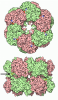
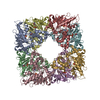
- EMDB-73767: Mitochondrial Creatine Kinase in complex with ADP and uncompetiti... -

+
Open data


ID or keywords:

Loading...

-
Basic information

Entry
Database: EMDB / ID: EMD-73767
TitleMitochondrial Creatine Kinase in complex with ADP and uncompetitive inhibitor uci
Map data
Sample
  • Complex: Mitochondrial Creatine Kinase
    • Protein or peptide: Creatine kinase U-type, mitochondrial
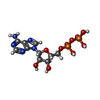
  • Ligand: ADENOSINE-5'-DIPHOSPHATE
  • Ligand: [4-(2-amino-6-methylpyrimidin-4-yl)piperazin-1-yl](3,5,7-trimethyl-1H-indol-2-yl)methanone
  • Ligand: MAGNESIUM ION
KeywordsKinase / inhibitor / TRANSFERASE-INHIBITOR complex
Function / homology
Function and homology information


creatine kinase / Creatine metabolism / phosphocreatine biosynthetic process / creatine kinase activity / mitochondrial inner membrane / mitochondrion / ATP binding
Similarity search - Function
ATP:guanido phosphotransferase, N-terminal / ATP:guanido phosphotransferase, N-terminal domain superfamily / ATP:guanido phosphotransferase, N-terminal domain / Phosphagen kinase N-terminal domain profile. / ATP:guanido phosphotransferase active site / Phosphagen kinase active site signature. / ATP:guanido phosphotransferase / ATP:guanido phosphotransferase, catalytic domain / ATP:guanido phosphotransferase, C-terminal catalytic domain / Phosphagen kinase C-terminal domain profile. / Glutamine synthetase/guanido kinase, catalytic domain
Similarity search - Domain/homology
Creatine kinase U-type, mitochondrial
Similarity search - Component
Biological speciesHomo sapiens (human)
Methodsingle particle reconstruction / cryo EM / Resolution: 2.59 Å
AuthorsDemir M / Zhao J / Sergienko E
Funding support United States, 1 items
OrganizationGrant numberCountry
National Institutes of Health/National Cancer Institute (NIH/NCI)R01 CA251910 United States
CitationJournal: bioRxiv / Year: 2026
Title: Uncompetitive Allosteric Inhibitor of Mitochondrial Creatine Kinase Prevents Binding and Release of Creatine by Stabilization of Loop Closure.
Abstract: Mitochondrial creatine kinase (MtCK) is a key enzyme in energy buffering and homeostasis in cells. It catalyzes transfer of phosphoryl group from ATP to creatine. Overexpression of MtCK occurs in ...Mitochondrial creatine kinase (MtCK) is a key enzyme in energy buffering and homeostasis in cells. It catalyzes transfer of phosphoryl group from ATP to creatine. Overexpression of MtCK occurs in many cancer cells to meet elevated energy demands, which is associated with poor prognosis. This suggests that MtCK may be a promising target for cancer therapeutics. We sought to discover first-in-class selective inhibitors of MtCK with diverse mechanisms of action using high-throughput screening, biochemical characterization and cryo-EM studies. Through these studies, we identified diverse types of compounds that modulate activity of MtCK , including fast-equilibrium and time-dependent orthosteric and allosteric inhibitors. Select hits were subjected to enzymatic and binding assays to assess MtCK inhibition and binding. A subset of inhibitors was advanced into structural studies using cryo-EM resulting in the molecular structure of MtCK with and without bound substrates in complex with an allosteric uncompetitive inhibitor that we discovered. These studies identified compound's unique binding pocket on MtCK and established the molecular steps manifesting in the apparent uncompetitive mode of inhibition. We demonstrate that the compound stabilizes an active site loop in a closed conformation restricting access of the creatine substrate to and the release of phosphocreatine product from its binding pocket. These findings establish chemical tools suitable for validation of MtCK as a promising breast cancer target with high therapeutic potential and build a foundation for future structure-guided optimization of the hit compounds of MtCK we identified and de novo rational design of novel MtCK inhibitors.
History
DepositionNov 5, 2025-
Header (metadata) releaseJan 28, 2026-
Map releaseJan 28, 2026-
UpdateJan 28, 2026-
Current statusJan 28, 2026Processing site: RCSB / Status: Released

-
Structure visualization

Supplemental images

Downloads & links

-
Map

FileDownload / File: emd_73767.map.gz / Format: CCP4 / Size: 64 MB / Type: IMAGE STORED AS FLOATING POINT NUMBER (4 BYTES)
Projections & slices

Image control

Size
Brightness
Contrast
Others
AxesZ (Sec.)Y (Row.)X (Col.)
1.06 Å/pix.
x 256 pix.
= 272.384 Å
1.06 Å/pix.
x 256 pix.
= 272.384 Å
1.06 Å/pix.
x 256 pix.
= 272.384 Å

Surface

Projections

Slices (1/3)

Slices (1/2)

Slices (2/3)

Images are generated by Spider.

Voxel sizeX=Y=Z: 1.064 Å
Density
Contour LevelBy AUTHOR: 0.1
Minimum - Maximum-0.26149666 - 0.63319343
Average (Standard dev.)-0.0004261337 (±0.023238715)
SymmetrySpace group: 1
Details

EMDB XML:

Map geometry
Axis orderXYZ
Origin000
Dimensions256256256
Spacing256256256
CellA=B=C: 272.384 Å
α=β=γ: 90.0 °

-
Supplemental data

-
Half map: #2

Fileemd_73767_half_map_1.map
Projections & Slices
AxesZYX

Projections

Slices (1/2)
Density Histograms

-
Half map: #1

Fileemd_73767_half_map_2.map
Projections & Slices
AxesZYX

Projections

Slices (1/2)
Density Histograms

-
Sample components

-
Entire : Mitochondrial Creatine Kinase

EntireName: Mitochondrial Creatine Kinase
Components
  • Complex: Mitochondrial Creatine Kinase
    • Protein or peptide: Creatine kinase U-type, mitochondrial
  • Ligand: ADENOSINE-5'-DIPHOSPHATE
  • Ligand: [4-(2-amino-6-methylpyrimidin-4-yl)piperazin-1-yl](3,5,7-trimethyl-1H-indol-2-yl)methanone
  • Ligand: MAGNESIUM ION

-
Supramolecule #1: Mitochondrial Creatine Kinase

SupramoleculeName: Mitochondrial Creatine Kinase / type: complex / ID: 1 / Parent: 0 / Macromolecule list: #1
Source (natural)Organism: Homo sapiens (human)

-
Macromolecule #1: Creatine kinase U-type, mitochondrial

MacromoleculeName: Creatine kinase U-type, mitochondrial / type: protein_or_peptide / ID: 1 / Number of copies: 8 / Enantiomer: LEVO / EC number: creatine kinase
Source (natural)Organism: Homo sapiens (human)
Molecular weightTheoretical: 47.598719 KDa
Recombinant expressionOrganism: Escherichia coli BL21(DE3) (bacteria)
SequenceString: MGSSHHHHHH SSGLVPRGSH MENLYFQGAA SERRRLYPPS AEYPDLRKHN NCMASHLTPA VYARLCDKTT PTGWTLDQCI QTGVDNPGH PFIKTVGMVA GDEETYEVFA DLFDPVIQER HNGYDPRTMK HTTDLDASKI RSGYFDERYV LSSRVRTGRS I RGLSLPPA ...String:
MGSSHHHHHH SSGLVPRGSH MENLYFQGAA SERRRLYPPS AEYPDLRKHN NCMASHLTPA VYARLCDKTT PTGWTLDQCI QTGVDNPGH PFIKTVGMVA GDEETYEVFA DLFDPVIQER HNGYDPRTMK HTTDLDASKI RSGYFDERYV LSSRVRTGRS I RGLSLPPA CTRAERREVE RVVVDALSGL KGDLAGRYYR LSEMTEAEQQ QLIDDHFLFD KPVSPLLTAA GMARDWPDAR GI WHNNEKS FLIWVNEEDH TRVISMEKGG NMKRVFERFC RGLKEVERLI QERGWEFMWN ERLGYILTCP SNLGTGLRAG VHI KLPLLS KDSRFPKILE NLRLQKRGTG GVDTAATGGV FDISNLDRLG KSEVELVQLV IDGVNYLIDC ERRLERGQDI RIPT PVIHT KHGSSDYKDD DDK

UniProtKB: Creatine kinase U-type, mitochondrial

-
Macromolecule #2: ADENOSINE-5'-DIPHOSPHATE

MacromoleculeName: ADENOSINE-5'-DIPHOSPHATE / type: ligand / ID: 2 / Number of copies: 8 / Formula: ADP
Molecular weightTheoretical: 427.201 Da
Chemical component information

ChemComp-ADP:
ADENOSINE-5'-DIPHOSPHATE / ADP, energy-carrying molecule*YM

-
Macromolecule #3: [4-(2-amino-6-methylpyrimidin-4-yl)piperazin-1-yl](3,5,7-trimethy...

MacromoleculeName: [4-(2-amino-6-methylpyrimidin-4-yl)piperazin-1-yl](3,5,7-trimethyl-1H-indol-2-yl)methanone
type: ligand / ID: 3 / Number of copies: 8 / Formula: A1CZQ
Molecular weightTheoretical: 378.471 Da

-
Macromolecule #4: MAGNESIUM ION

MacromoleculeName: MAGNESIUM ION / type: ligand / ID: 4 / Number of copies: 8 / Formula: MG
Molecular weightTheoretical: 24.305 Da

-
Experimental details

-
Structure determination

Methodcryo EM
Processingsingle particle reconstruction
Aggregation stateparticle

-
Sample preparation

BufferpH: 8
GridModel: Quantifoil R2/2 / Support film - Material: CARBON / Support film - topology: HOLEY
VitrificationCryogen name: ETHANE

-
Electron microscopy

MicroscopeTFS KRIOS
Image recordingFilm or detector model: GATAN K3 (6k x 4k) / Average electron dose: 34.0 e/Å2
Electron beamAcceleration voltage: 300 kV / Electron source: FIELD EMISSION GUN
Electron opticsIllumination mode: FLOOD BEAM / Imaging mode: BRIGHT FIELD / Nominal defocus max: 2.1 µm / Nominal defocus min: 0.9 µm
Experimental equipment
Model: Titan Krios / Image courtesy: FEI Company

+
Image processing

CTF correctionType: PHASE FLIPPING AND AMPLITUDE CORRECTION
Startup modelType of model: PDB ENTRY
PDB model - PDB ID:
Final reconstructionResolution.type: BY AUTHOR / Resolution: 2.59 Å / Resolution method: FSC 0.143 CUT-OFF / Software - Name: cryoSPARC / Number images used: 1213097
Initial angle assignmentType: MAXIMUM LIKELIHOOD
Final angle assignmentType: MAXIMUM LIKELIHOOD
FSC plot (resolution estimation)

+
About Yorodumi

-
News

-
Feb 9, 2022. New format data for meta-information of EMDB entries

New format data for meta-information of EMDB entries

  • Version 3 of the EMDB header file is now the official format.
  • The previous official version 1.9 will be removed from the archive.

Related info.:EMDB header

External links:wwPDB to switch to version 3 of the EMDB data model

-
Aug 12, 2020. Covid-19 info

Covid-19 info

URL: https://pdbj.org/emnavi/covid19.php

New page: Covid-19 featured information page in EM Navigator.

Related info.:Covid-19 info / Mar 5, 2020. Novel coronavirus structure data

+
Mar 5, 2020. Novel coronavirus structure data

Novel coronavirus structure data

Related info.:Yorodumi Speices / Aug 12, 2020. Covid-19 info

External links:COVID-19 featured content - PDBj / Molecule of the Month (242):Coronavirus Proteases

+
Jan 31, 2019. EMDB accession codes are about to change! (news from PDBe EMDB page)

EMDB accession codes are about to change! (news from PDBe EMDB page)

  • The allocation of 4 digits for EMDB accession codes will soon come to an end. Whilst these codes will remain in use, new EMDB accession codes will include an additional digit and will expand incrementally as the available range of codes is exhausted. The current 4-digit format prefixed with “EMD-” (i.e. EMD-XXXX) will advance to a 5-digit format (i.e. EMD-XXXXX), and so on. It is currently estimated that the 4-digit codes will be depleted around Spring 2019, at which point the 5-digit format will come into force.
  • The EM Navigator/Yorodumi systems omit the EMD- prefix.

Related info.:Q: What is EMD? / ID/Accession-code notation in Yorodumi/EM Navigator

External links:EMDB Accession Codes are Changing Soon! / Contact to PDBj

+
Jul 12, 2017. Major update of PDB

Major update of PDB

  • wwPDB released updated PDB data conforming to the new PDBx/mmCIF dictionary.
  • This is a major update changing the version number from 4 to 5, and with Remediation, in which all the entries are updated.
  • In this update, many items about electron microscopy experimental information are reorganized (e.g. em_software).
  • Now, EM Navigator and Yorodumi are based on the updated data.

External links:wwPDB Remediation / Enriched Model Files Conforming to OneDep Data Standards Now Available in the PDB FTP Archive

-
Yorodumi

Thousand views of thousand structures

  • Yorodumi is a browser for structure data from EMDB, PDB, SASBDB, etc.
  • This page is also the successor to EM Navigator detail page, and also detail information page/front-end page for Omokage search.
  • The word "yorodu" (or yorozu) is an old Japanese word meaning "ten thousand". "mi" (miru) is to see.

Related info.:EMDB / PDB / SASBDB / Comparison of 3 databanks / Yorodumi Search / Aug 31, 2016. New EM Navigator & Yorodumi / Yorodumi Papers / Jmol/JSmol / Function and homology information / Changes in new EM Navigator and Yorodumi

Read more