 Movie
Movie Controller


+ Open data

- Basic information
| Entry |  | |||||||||
|---|---|---|---|---|---|---|---|---|---|---|
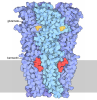
| Title | Human muscle nAChR FCCMS eP121L ACh, XG-590 bound | |||||||||
 Map data Map data | Human muscle nAChR FCCMS eP121L ACh, XG-590 bound | |||||||||
 Sample Sample |
| |||||||||
 Keywords Keywords | human muscle / nicotinic acetylcholine receptor / MEMBRANE PROTEIN | |||||||||
| Function / homology |  Function and homology information Function and homology informationpostsynaptic membrane organization / musculoskeletal movement / skeletal muscle tissue growth / Highly sodium permeable postsynaptic acetylcholine nicotinic receptors / Highly calcium permeable nicotinic acetylcholine receptors / neuromuscular synaptic transmission / Highly calcium permeable postsynaptic nicotinic acetylcholine receptors / acetylcholine receptor activity / acetylcholine-gated channel complex / behavioral response to nicotine ...postsynaptic membrane organization / musculoskeletal movement / skeletal muscle tissue growth / Highly sodium permeable postsynaptic acetylcholine nicotinic receptors / Highly calcium permeable nicotinic acetylcholine receptors / neuromuscular synaptic transmission / Highly calcium permeable postsynaptic nicotinic acetylcholine receptors / acetylcholine receptor activity / acetylcholine-gated channel complex / behavioral response to nicotine / acetylcholine-gated monoatomic cation-selective channel activity / muscle cell development / acetylcholine receptor signaling pathway / muscle cell cellular homeostasis / monoatomic cation transmembrane transporter activity / acetylcholine binding / neuromuscular process / nervous system process / neuron cellular homeostasis / postsynaptic specialization membrane / synaptic transmission, cholinergic / neuromuscular junction development / membrane depolarization / monoatomic cation transport / ligand-gated monoatomic ion channel activity / neuronal action potential / skeletal muscle contraction / muscle contraction / presynaptic modulation of chemical synaptic transmission / response to nicotine / neuromuscular junction / transmitter-gated monoatomic ion channel activity involved in regulation of postsynaptic membrane potential / regulation of membrane potential / transmembrane signaling receptor activity / presynapse / channel activity / chemical synaptic transmission / monoatomic ion transmembrane transport / postsynaptic membrane / neuron projection / synapse / cell surface / signal transduction / plasma membrane Similarity search - Function | |||||||||
| Biological species |  Homo sapiens (human) Homo sapiens (human) | |||||||||
| Method | single particle reconstruction / cryo EM / Resolution: 2.44 Å | |||||||||
 Authors Authors | Li H / Hibbs RE | |||||||||
| Funding support |  United States, 1 items United States, 1 items
| |||||||||
 Citation Citation | Journal: Nature / Year: 2026 Title: Correcting congenital myasthenia-associated acetylcholine receptor defects. Authors: Huanhuan Li / Nuriya Mukhtasimova / Jinfeng Teng / Elfie S Cavalli / Xilin Gu / Jason K Sello / Steven M Sine / Ryan E Hibbs / Abstract: Voluntary muscle contraction is triggered by the neurotransmitter acetylcholine binding its receptors on the postsynaptic membrane of the neuromuscular junction, opening ion channels that allow ...Voluntary muscle contraction is triggered by the neurotransmitter acetylcholine binding its receptors on the postsynaptic membrane of the neuromuscular junction, opening ion channels that allow cation influx and initiate depolarization. Mutations in muscle acetylcholine receptors disrupt this process by either impairing (fast-channel) or prolonging (slow-channel) channel openings. These defects cause congenital myasthenic syndromes (CMS), characterized by severe muscle weakness that is often present at birth and, in some cases, progresses to paralysis and death. The structural mechanisms underlying these pathogenic defects and their pharmacological correction remain unknown. Here, using cryogenic electron microscopy, chemical biology and electrophysiology, we determined the structures and functional consequences of representative CMS mutant receptors with and without drugs. In fast-channel disease-associated mutants, we discovered a cryptic allosteric site targeted by positive modulators that restore gating in a mutation-specific manner. In receptor mutants associated with slow-channel disease, quinidine, fluoxetine and reboxetine act as pore blockers; notably, the antidepressant reboxetine selectively blocks desensitized receptors in a mutation-independent fashion, suggesting repurposing potential. Mechanistically, fast-channel mutations uncouple agonist binding from gating, whereas slow-channel mutations stabilize an abnormally widened, desensitized-like pore. These findings reveal unifying principles of CMS pathogenesis and provide a framework for precision therapies. | |||||||||
| History |
|
- Structure visualization
| Supplemental images |
|---|

- Downloads & links
-EMDB archive
| Map data | emd_72845.map.gz | 230.3 MB | EMDB map data format | |
|---|---|---|---|---|
| Header (meta data) | emd-72845-v30.xmlemd-72845.xml | 21.7 KB 21.7 KB | Display Display | EMDB header |
| Images |  emd_72845.png emd_72845.png | 69.8 KB | ||
| Filedesc metadata | emd-72845.cif.gz | 7.2 KB | ||
| Others | emd_72845_half_map_1.map.gzemd_72845_half_map_2.map.gz | 226.9 MB 226.9 MB | ||
| Archive directory |  http://ftp.pdbj.org/pub/emdb/structures/EMD-72845ftp://ftp.pdbj.org/pub/emdb/structures/EMD-72845 http://ftp.pdbj.org/pub/emdb/structures/EMD-72845ftp://ftp.pdbj.org/pub/emdb/structures/EMD-72845 | HTTPS FTP |
-Related structure data
| Related structure data |  9ye7MC  9ye6C  9ye8C  9yehC  9yeiC  9yekC  9yelC  9yerC  9yetC  9yeuC  9yexC  9yf0C M: atomic model generated by this map C: citing same article ( |
|---|---|
| Similar structure data |


-Links
| EMDB pages | EMDB (EBI/PDBe) / EMDataResource |
|---|---|
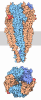
| Related items in Molecule of the Month |
-Map
| File | Download / File: emd_72845.map.gz / Format: CCP4 / Size: 244.1 MB / Type: IMAGE STORED AS FLOATING POINT NUMBER (4 BYTES) | ||||||||||||||||||||||||||||||||||||
|---|---|---|---|---|---|---|---|---|---|---|---|---|---|---|---|---|---|---|---|---|---|---|---|---|---|---|---|---|---|---|---|---|---|---|---|---|---|
| Annotation | Human muscle nAChR FCCMS eP121L ACh, XG-590 bound | ||||||||||||||||||||||||||||||||||||
| Projections & slices | Image control
Images are generated by Spider. | ||||||||||||||||||||||||||||||||||||
| Voxel size | X=Y=Z: 0.935 Å | ||||||||||||||||||||||||||||||||||||
| Density |
| ||||||||||||||||||||||||||||||||||||
| Symmetry | Space group: 1 | ||||||||||||||||||||||||||||||||||||
| Details | EMDB XML:
|
 Z (Sec.)
 Y (Row.)
 X (Col.)


-Supplemental data
-Half map: Half Map A
| File | emd_72845_half_map_1.map | ||||||||||||
|---|---|---|---|---|---|---|---|---|---|---|---|---|---|
| Annotation | Half Map A | ||||||||||||
| Projections & Slices |
| ||||||||||||
| Density Histograms |


-Half map: Half Map B
| File | emd_72845_half_map_2.map | ||||||||||||
|---|---|---|---|---|---|---|---|---|---|---|---|---|---|
| Annotation | Half Map B | ||||||||||||
| Projections & Slices |
| ||||||||||||
| Density Histograms |


- Sample components
-Entire : Human muscle nicotinic acetylcholine receptor CMS mutants
| Entire | Name: Human muscle nicotinic acetylcholine receptor CMS mutants |
|---|---|
| Components |
|
-Supramolecule #1: Human muscle nicotinic acetylcholine receptor CMS mutants
| Supramolecule | Name: Human muscle nicotinic acetylcholine receptor CMS mutants type: complex / ID: 1 / Parent: 0 / Macromolecule list: #1-#4 |
|---|---|
| Source (natural) | Organism: Homo sapiens (human) |
-Macromolecule #1: Acetylcholine receptor subunit alpha
| Macromolecule | Name: Acetylcholine receptor subunit alpha / type: protein_or_peptide / ID: 1 / Number of copies: 2 / Enantiomer: LEVO |
|---|---|
| Source (natural) | Organism: Homo sapiens (human) |
| Molecular weight | Theoretical: 49.747645 KDa |
| Recombinant expression | Organism: Homo sapiens (human) |
| Sequence | String: SEHETRLVAK LFKDYSSVVR PVEDHRQVVE VTVGLQLIQL INVDEVNQIV TTNVRLKQQW VDYNLKWNPD DYGGVKKIHI PSEKIWRPD LVLYNNADGD FAIVKFTKVL LQYTGHITWT PPAIFKSYCE IIVTHFPFDE QNCSMKLGTW TYDGSVVAIN P ESDQPDLS ...String: SEHETRLVAK LFKDYSSVVR PVEDHRQVVE VTVGLQLIQL INVDEVNQIV TTNVRLKQQW VDYNLKWNPD DYGGVKKIHI PSEKIWRPD LVLYNNADGD FAIVKFTKVL LQYTGHITWT PPAIFKSYCE IIVTHFPFDE QNCSMKLGTW TYDGSVVAIN P ESDQPDLS NFMESGEWVI KESRGWKHSV TYSCCPDTPY LDITYHFVMQ RLPLYFIVNV IIPCLLFSFL TGLVFYLPTD SG EKMTLSI SVLLSLTVFL LVIVELIPST SSAVPLIGKY MLFTMVFVIA SIIITVIVIN THHRSPSTHV MPNWVRKVFI DTI PNIMFF STMKRPSREK QDKKIFTEDI DISDISGKPG PPPMGFHSPL IKHPEVKSAI EGIKYIAETM KSDQESNNAA AEWK YVAMV MDHILLGVFM LVCIIGTLAV FAGRLIELNQ QG UniProtKB: Acetylcholine receptor subunit alpha |
-Macromolecule #2: Acetylcholine receptor subunit beta
| Macromolecule | Name: Acetylcholine receptor subunit beta / type: protein_or_peptide / ID: 2 / Number of copies: 1 / Enantiomer: LEVO |
|---|---|
| Source (natural) | Organism: Homo sapiens (human) |
| Molecular weight | Theoretical: 54.84075 KDa |
| Recombinant expression | Organism: Homo sapiens (human) |
| Sequence | String: SEAEGRLREK LFSGYDSSVR PAREVGDRVR VSVGLILAQL ISLNEKDEEM STKVYLDLEW TDYRLSWDPA EHDGIDSLRI TAESVWLPD VVLLNNNDGN FDVALDISVV VSSDGSVRWQ PPGIYRSSCS IQVTYFPFDW QNCTMVFSSY SYDSSEVSLQ T GLGPDGQG ...String: SEAEGRLREK LFSGYDSSVR PAREVGDRVR VSVGLILAQL ISLNEKDEEM STKVYLDLEW TDYRLSWDPA EHDGIDSLRI TAESVWLPD VVLLNNNDGN FDVALDISVV VSSDGSVRWQ PPGIYRSSCS IQVTYFPFDW QNCTMVFSSY SYDSSEVSLQ T GLGPDGQG HQEIHIHEGT FIENGQWEII HKPSRLIQPP GDPRGGREGQ RQEVIFYLII RRKPLFYLVN VIAPCILITL LA IFVFYLP PDAGEKMGLS IFALLTLTVF LLLLADKVPE TSLSVPIIIK YLMFTMVLVT FSVILSVVVL NLHHRSPHTH QMP LWVRQI FIHKLPLYLR LKRPKPERDL MPEPPHCSSP GSGWGRGTDE YFIRKPPSDF LFPKPNRFQP ELSAPDLRRF IDGP NRAVA LLPELREVVS SISYIARQLQ EQEDHDALKE DWQFVAMVVD RLFLWTFIIF TSVGTLVIFL DATYHLPPPD PFPSR UniProtKB: Acetylcholine receptor subunit beta |
-Macromolecule #3: Acetylcholine receptor subunit delta
| Macromolecule | Name: Acetylcholine receptor subunit delta / type: protein_or_peptide / ID: 3 / Number of copies: 1 / Enantiomer: LEVO |
|---|---|
| Source (natural) | Organism: Homo sapiens (human) |
| Molecular weight | Theoretical: 56.915359 KDa |
| Recombinant expression | Organism: Homo sapiens (human) |
| Sequence | String: LNEEERLIRH LFQEKGYNKE LRPVAHKEES VDVALALTLS NLISLKEVEE TLTTNVWIEH GWTDNRLKWN AEEFGNISVL RLPPDMVWL PEIVLENNND GSFQISYSCN VLVYHYGFVY WLPPAIFRSS CPISVTYFPF DWQNCSLKFS SLKYTAKEIT L SLKQDAKE ...String: LNEEERLIRH LFQEKGYNKE LRPVAHKEES VDVALALTLS NLISLKEVEE TLTTNVWIEH GWTDNRLKWN AEEFGNISVL RLPPDMVWL PEIVLENNND GSFQISYSCN VLVYHYGFVY WLPPAIFRSS CPISVTYFPF DWQNCSLKFS SLKYTAKEIT L SLKQDAKE NRTYPVEWII IDPEGFTENG EWEIVHRPAR VNVDPRAPLD SPSRQDITFY LIIRRKPLFY IINILVPCVL IS FMVNLVF YLPADSGEKT SVAISVLLAQ SVFLLLISKR LPATSMAIPL IGKFLLFGMV LVTMVVVICV IVLNIHFRTP STH VLSEGV KKLFLETLPE LLHMSRPAED GPSPGALVRR SSSLGYISKA EEYFLLKSRS DLMFEKQSER HGLARRLTTA RRPP ASSEQ AQQELFNELK PAVDGANFIV NHMRDQNNYN EEKDSWNRVA RTVDRLCLFV VTPVMVVGTA WIFLQGVYNQ PPPQP FPGD PYSYNVQDKR FI UniProtKB: Acetylcholine receptor subunit delta |
-Macromolecule #4: Acetylcholine receptor subunit epsilon
| Macromolecule | Name: Acetylcholine receptor subunit epsilon / type: protein_or_peptide / ID: 4 / Number of copies: 1 / Enantiomer: LEVO |
|---|---|
| Source (natural) | Organism: Homo sapiens (human) |
| Molecular weight | Theoretical: 52.799336 KDa |
| Recombinant expression | Organism: Homo sapiens (human) |
| Sequence | String: KNEELRLYHH LFNNYDPGSR PVREPEDTVT ISLKVTLTNL ISLNEKEETL TTSVWIGIDW QDYRLNYSKD DFGGIETLRV PSELVWLPE IVLENNIDGQ FGVAYDANVL VYEGGSVTWL PLAIYRSVCA VEVTYFPFDW QNCSLIFRSQ TYNAEEVEFT F AVDNDGKT ...String: KNEELRLYHH LFNNYDPGSR PVREPEDTVT ISLKVTLTNL ISLNEKEETL TTSVWIGIDW QDYRLNYSKD DFGGIETLRV PSELVWLPE IVLENNIDGQ FGVAYDANVL VYEGGSVTWL PLAIYRSVCA VEVTYFPFDW QNCSLIFRSQ TYNAEEVEFT F AVDNDGKT INKIDIDTEA YTENGEWAID FCPGVIRRHH GGATDGPGET DVIYSLIIRR KPLFYVINII VPCVLISGLV LL AYFLPAQ AGGQKCTVSI NVLLAQTVFL FLIAQKIPET SLSVPLLGRF LIFVMVVATL IVMNCVIVLN VSQRTPTTHA MSP RLRHVL LELLPRLLGS PPPPEAPRAA SPPRRASSVG LLLRAEELIL KKPRSELVFE GQRHRQGTWT AAFCQSLGAA APEV RCCVD AVNFVAESTR DQEATGEEVS DWVRMGNALD NICFWAALVL FSVGSSLIFL GAYFNRVPDL PYAPCIQP UniProtKB: Acetylcholine receptor subunit epsilon |
-Macromolecule #8: ACETYLCHOLINE
| Macromolecule | Name: ACETYLCHOLINE / type: ligand / ID: 8 / Number of copies: 2 / Formula: ACH |
|---|---|
| Molecular weight | Theoretical: 146.207 Da |
| Chemical component information | 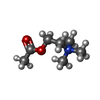 ChemComp-ACH: |
-Macromolecule #9: N-[(5M)-5-(2-fluoro[1,1'-biphenyl]-4-yl)-4-(trifluoromethyl)-1,3-...
| Macromolecule | Name: N-[(5M)-5-(2-fluoro[1,1'-biphenyl]-4-yl)-4-(trifluoromethyl)-1,3-thiazol-2-yl]-4-hydroxy-2-methyl-1,1-dioxo-1,2-dihydro-1lambda~6~,2-benzothiazine-3-carboxamide type: ligand / ID: 9 / Number of copies: 2 / Formula: A1CVU |
|---|---|
| Molecular weight | Theoretical: 575.554 Da |
-Macromolecule #10: 2-acetamido-2-deoxy-beta-D-glucopyranose
| Macromolecule | Name: 2-acetamido-2-deoxy-beta-D-glucopyranose / type: ligand / ID: 10 / Number of copies: 1 / Formula: NAG |
|---|---|
| Molecular weight | Theoretical: 221.208 Da |
| Chemical component information | 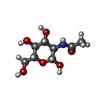 ChemComp-NAG: |
-Macromolecule #11: water
| Macromolecule | Name: water / type: ligand / ID: 11 / Number of copies: 3 / Formula: HOH |
|---|---|
| Molecular weight | Theoretical: 18.015 Da |
| Chemical component information |  ChemComp-HOH: |
-Experimental details
-Structure determination
| Method | cryo EM |
|---|---|
 Processing Processing | single particle reconstruction |
| Aggregation state | particle |
-Sample preparation
| Buffer | pH: 7.4 |
|---|---|
| Vitrification | Cryogen name: ETHANE |
- Electron microscopy
| Microscope | TFS KRIOS |
|---|---|
| Image recording | Film or detector model: FEI FALCON III (4k x 4k) / Average electron dose: 50.0 e/Å2 |
| Electron beam | Acceleration voltage: 300 kV / Electron source:  FIELD EMISSION GUN FIELD EMISSION GUN |
| Electron optics | Illumination mode: OTHER / Imaging mode: BRIGHT FIELD / Nominal defocus max: 1.8 µm / Nominal defocus min: 1.0 µm |
| Experimental equipment |  Model: Titan Krios / Image courtesy: FEI Company |
