 Movie
Movie Controller


+ Open data

- Basic information
| Entry | Database: PDB / ID: 9yel | |||||||||||||||||||||
|---|---|---|---|---|---|---|---|---|---|---|---|---|---|---|---|---|---|---|---|---|---|---|
| Title | Human muscle nAChR SCCMS eL269F ACh, Fluoxetine bound | |||||||||||||||||||||
 Components Components | (Acetylcholine receptor subunit ...) x 4 | |||||||||||||||||||||
 Keywords Keywords | MEMBRANE PROTEIN / human muscle / nicotinic acetylcholine receptor | |||||||||||||||||||||
| Function / homology |  Function and homology information Function and homology informationpostsynaptic membrane organization / musculoskeletal movement / skeletal muscle tissue growth / Highly sodium permeable postsynaptic acetylcholine nicotinic receptors / Highly calcium permeable nicotinic acetylcholine receptors / neuromuscular synaptic transmission / Highly calcium permeable postsynaptic nicotinic acetylcholine receptors / acetylcholine receptor activity / acetylcholine-gated channel complex / behavioral response to nicotine ...postsynaptic membrane organization / musculoskeletal movement / skeletal muscle tissue growth / Highly sodium permeable postsynaptic acetylcholine nicotinic receptors / Highly calcium permeable nicotinic acetylcholine receptors / neuromuscular synaptic transmission / Highly calcium permeable postsynaptic nicotinic acetylcholine receptors / acetylcholine receptor activity / acetylcholine-gated channel complex / behavioral response to nicotine / acetylcholine-gated monoatomic cation-selective channel activity / muscle cell development / acetylcholine receptor signaling pathway / muscle cell cellular homeostasis / monoatomic cation transmembrane transporter activity / acetylcholine binding / neuron cellular homeostasis / nervous system process / neurotransmitter receptor activity / neuromuscular process / synaptic transmission, cholinergic / postsynaptic specialization membrane / ligand-gated monoatomic ion channel activity / neuronal action potential / neuromuscular junction development / membrane depolarization / monoatomic cation transport / skeletal muscle contraction / muscle contraction / presynaptic modulation of chemical synaptic transmission / response to nicotine / neuromuscular junction / transmitter-gated monoatomic ion channel activity involved in regulation of postsynaptic membrane potential / regulation of membrane potential / calcium ion transport / transmembrane signaling receptor activity / presynapse / channel activity / monoatomic ion transmembrane transport / neuron projection / postsynaptic membrane / synapse / signal transduction / cell surface / plasma membrane Similarity search - Function | |||||||||||||||||||||
| Biological species |  Homo sapiens (human) Homo sapiens (human) | |||||||||||||||||||||
| Method | ELECTRON MICROSCOPY / single particle reconstruction / cryo EM / Resolution: 2.48 Å | |||||||||||||||||||||
 Authors Authors | Li, H. / Hibbs, R.E. | |||||||||||||||||||||
| Funding support |  United States, 1items United States, 1items
| |||||||||||||||||||||
 Citation Citation | Journal: Nature / Year: 2026 Title: Correcting congenital myasthenia-associated acetylcholine receptor defects. Authors: Huanhuan Li / Nuriya Mukhtasimova / Jinfeng Teng / Elfie S Cavalli / Xilin Gu / Jason K Sello / Steven M Sine / Ryan E Hibbs / Abstract: Voluntary muscle contraction is triggered by the neurotransmitter acetylcholine binding its receptors on the postsynaptic membrane of the neuromuscular junction, opening ion channels that allow ...Voluntary muscle contraction is triggered by the neurotransmitter acetylcholine binding its receptors on the postsynaptic membrane of the neuromuscular junction, opening ion channels that allow cation influx and initiate depolarization. Mutations in muscle acetylcholine receptors disrupt this process by either impairing (fast-channel) or prolonging (slow-channel) channel openings. These defects cause congenital myasthenic syndromes (CMS), characterized by severe muscle weakness that is often present at birth and, in some cases, progresses to paralysis and death. The structural mechanisms underlying these pathogenic defects and their pharmacological correction remain unknown. Here, using cryogenic electron microscopy, chemical biology and electrophysiology, we determined the structures and functional consequences of representative CMS mutant receptors with and without drugs. In fast-channel disease-associated mutants, we discovered a cryptic allosteric site targeted by positive modulators that restore gating in a mutation-specific manner. In receptor mutants associated with slow-channel disease, quinidine, fluoxetine and reboxetine act as pore blockers; notably, the antidepressant reboxetine selectively blocks desensitized receptors in a mutation-independent fashion, suggesting repurposing potential. Mechanistically, fast-channel mutations uncouple agonist binding from gating, whereas slow-channel mutations stabilize an abnormally widened, desensitized-like pore. These findings reveal unifying principles of CMS pathogenesis and provide a framework for precision therapies. | |||||||||||||||||||||
| History |
|
- Structure visualization
| Structure viewer | Molecule: MolmilJmol/JSmol |
|---|
- Downloads & links
-Download
| PDBx/mmCIF format | 9yel.cif.gz | 751.3 KB | Display | PDBx/mmCIF format |
|---|---|---|---|---|
| PDB format | pdb9yel.ent.gz | 636.3 KB | Display | PDB format |
| PDBx/mmJSON format | 9yel.json.gz | Tree view | PDBx/mmJSON format | |
| Others |  Other downloads Other downloads |
-Validation report
| Arichive directory | https://data.pdbj.org/pub/pdb/validation_reports/ye/9yelftp://data.pdbj.org/pub/pdb/validation_reports/ye/9yel | HTTPS FTP |
|---|
-Related structure data
| Related structure data |  72854MC  9ye6C  9ye7C  9ye8C  9yehC  9yeiC  9yekC  9yerC  9yetC  9yeuC  9yexC  9yf0C M: map data used to model this data C: citing same article ( |
|---|---|
| Similar structure data |


-Links
 PDBj
PDBj
- Assembly
| Deposited unit | 
|
|---|---|
| 1 |
|
-Components
-Acetylcholine receptor subunit ... , 4 types, 5 molecules ACEDB
| #1: Protein | Mass: 49747.645 Da / Num. of mol.: 2 Source method: isolated from a genetically manipulated source Source: (gene. exp.) Homo sapiens (human) / Gene: CHRNA1, ACHRA, CHNRA / Production host: Homo sapiens (human) / References: UniProt: P02708#2: Protein | | Mass: 54840.750 Da / Num. of mol.: 1 Source method: isolated from a genetically manipulated source Source: (gene. exp.) Homo sapiens (human) / Gene: CHRNB1, ACHRB, CHRNB / Production host: Homo sapiens (human) / References: UniProt: P11230#3: Protein | | Mass: 56915.359 Da / Num. of mol.: 1 Source method: isolated from a genetically manipulated source Source: (gene. exp.) Homo sapiens (human) / Gene: CHRND, ACHRD / Production host: Homo sapiens (human) / References: UniProt: Q07001#4: Protein | | Mass: 52817.309 Da / Num. of mol.: 1 Source method: isolated from a genetically manipulated source Source: (gene. exp.) Homo sapiens (human) / Gene: CHRNE, ACHRE / Production host: Homo sapiens (human) / References: UniProt: Q04844 |
|---|
-Sugars , 3 types, 6 molecules 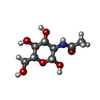
| #5: Polysaccharide | Source method: isolated from a genetically manipulated source #6: Polysaccharide | Source method: isolated from a genetically manipulated source #9: Sugar | ChemComp-NAG / | 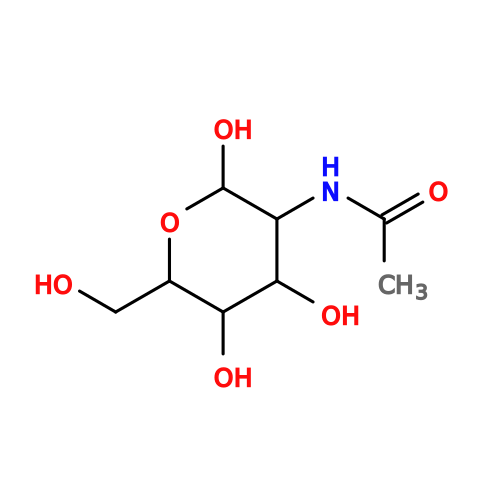 Type: D-saccharide, beta linking / Mass: 221.208 Da / Num. of mol.: 1 / Source method: obtained synthetically / Formula: C8H15NO6 Type: D-saccharide, beta linking / Mass: 221.208 Da / Num. of mol.: 1 / Source method: obtained synthetically / Formula: C8H15NO6 |
|---|
-Non-polymers , 3 types, 5 molecules 


| #7: Chemical | 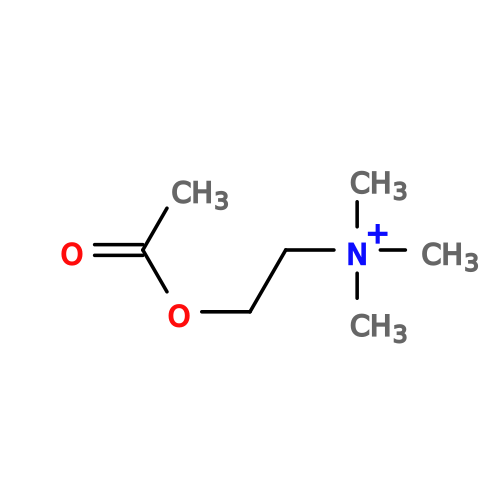 Mass: 146.207 Da / Num. of mol.: 2 / Source method: obtained synthetically / Formula: C7H16NO2 Mass: 146.207 Da / Num. of mol.: 2 / Source method: obtained synthetically / Formula: C7H16NO2#8: Chemical | ChemComp-RFX / ( |  Mass: 309.326 Da / Num. of mol.: 1 / Source method: obtained synthetically / Formula: C17H18F3NO / Feature type: SUBJECT OF INVESTIGATION Mass: 309.326 Da / Num. of mol.: 1 / Source method: obtained synthetically / Formula: C17H18F3NO / Feature type: SUBJECT OF INVESTIGATION#10: Water | ChemComp-HOH / | Mass: 18.015 Da / Num. of mol.: 2 / Source method: isolated from a natural source / Formula: H2O |
|---|
-Details
| Has ligand of interest | Y |
|---|---|
| Has protein modification | Y |
-Experimental details
-Experiment
| Experiment | Method: ELECTRON MICROSCOPY |
|---|---|
| EM experiment | Aggregation state: PARTICLE / 3D reconstruction method: single particle reconstruction |
- Sample preparation
| Component | Name: Human muscle nicotinic acetylcholine receptor CMS mutants Type: COMPLEX / Entity ID: #1-#4 / Source: RECOMBINANT |
|---|---|
| Source (natural) | Organism: Homo sapiens (human) |
| Source (recombinant) | Organism: Homo sapiens (human) |
| Buffer solution | pH: 7.4 |
| Specimen | Embedding applied: NO / Shadowing applied: NO / Staining applied: NO / Vitrification applied: YES |
| Vitrification | Cryogen name: ETHANE |
- Electron microscopy imaging
| Experimental equipment |  Model: Titan Krios / Image courtesy: FEI Company |
|---|---|
| Microscopy | Model: TFS KRIOS |
| Electron gun | Electron source:  FIELD EMISSION GUN / Accelerating voltage: 300 kV / Illumination mode: OTHER FIELD EMISSION GUN / Accelerating voltage: 300 kV / Illumination mode: OTHER |
| Electron lens | Mode: BRIGHT FIELD / Nominal defocus max: 1800 nm / Nominal defocus min: 1000 nm |
| Image recording | Electron dose: 50 e/Å2 / Film or detector model: FEI FALCON III (4k x 4k) |
- Processing
| EM software |
| ||||||||||||||||||||||||
|---|---|---|---|---|---|---|---|---|---|---|---|---|---|---|---|---|---|---|---|---|---|---|---|---|---|
| CTF correction | Type: PHASE FLIPPING AND AMPLITUDE CORRECTION | ||||||||||||||||||||||||
| 3D reconstruction | Resolution: 2.48 Å / Resolution method: FSC 0.143 CUT-OFF / Num. of particles: 211224 / Algorithm: FOURIER SPACE / Symmetry type: POINT | ||||||||||||||||||||||||
| Refinement | Highest resolution: 2.48 Å Stereochemistry target values: REAL-SPACE (WEIGHTED MAP SUM AT ATOM CENTERS) | ||||||||||||||||||||||||
| Refine LS restraints |
|
