National Institutes of Health/National Institute of General Medical Sciences (NIH/NIGMS)
5R01GM154832
United States
Citation
Journal: Nat Commun / Year: 2026 Title: Multivalent nanobodies for potent and broad neutralization of Staphylococcus aureus toxins. Authors: Yong Joon Jeffrey Kim / Nicholas R Walton / Wei Huang / Madison Lee / Yufei Xiang / Zhe Sang / Chaya Sussman / Sarah K L Moore / Derek J Taylor / Kong Chen / Jaime L Hook / John K McCormick / Yi Shi / Abstract: Staphylococcus aureus is a leading cause of lethal bacteremia and pneumonia, which are driven by potent virulence factors such as T-cell superantigens and alpha hemolysin. S. aureus has among the ...Staphylococcus aureus is a leading cause of lethal bacteremia and pneumonia, which are driven by potent virulence factors such as T-cell superantigens and alpha hemolysin. S. aureus has among the highest rates of antibiotic resistance, yet no vaccines or alternative therapies are available. Here, we developed a repertoire of potent, high-affinity nanobodies (Nbs) targeting key toxins in S. aureus infection, including Hla and superantigens SEB, SEC, and TSST-1. Comprehensive cryo-EM and AlphaFold3 analyses of these Nbs, which were elicited with clinical cocktail vaccines, revealed diverse neutralizing epitopes and mechanisms that provide insights for immunotherapy and vaccine strategies. Guided by these findings, we engineered stable, multivalent, and multifunctional Nb constructs. These constructs included an aerosolizable trimeric Nb with enhanced neutralization activity against Hla and SEC, and a decameric Nb-IgG-Fc fusion construct with pM or better potencies against a wide range of major toxins in S. aureus sepsis (SEB, SEC, TSST-1, and Hla). These multifunctional Nbs demonstrated protective activity in murine models of pneumonia and sepsis, underscoring their potential as versatile immunotherapies that address the complex virulence of S. aureus. Our work lays a foundation for precision immunotherapies beyond current treatment options to combat complex bacterial infections with multiple virulence mechanisms.
In the structure databanks used in Yorodumi, some data are registered as the other names, "COVID-19 virus" and "2019-nCoV". Here are the details of the virus and the list of structure data.
Jan 31, 2019. EMDB accession codes are about to change! (news from PDBe EMDB page)
EMDB accession codes are about to change! (news from PDBe EMDB page)
The allocation of 4 digits for EMDB accession codes will soon come to an end. Whilst these codes will remain in use, new EMDB accession codes will include an additional digit and will expand incrementally as the available range of codes is exhausted. The current 4-digit format prefixed with “EMD-” (i.e. EMD-XXXX) will advance to a 5-digit format (i.e. EMD-XXXXX), and so on. It is currently estimated that the 4-digit codes will be depleted around Spring 2019, at which point the 5-digit format will come into force.
The EM Navigator/Yorodumi systems omit the EMD- prefix.
Related info.:Q: What is EMD? / ID/Accession-code notation in Yorodumi/EM Navigator
Yorodumi is a browser for structure data from EMDB, PDB, SASBDB, etc.
This page is also the successor to EM Navigator detail page, and also detail information page/front-end page for Omokage search.
The word "yorodu" (or yorozu) is an old Japanese word meaning "ten thousand". "mi" (miru) is to see.
Related info.:EMDB / PDB / SASBDB / Comparison of 3 databanks / Yorodumi Search / Aug 31, 2016. New EM Navigator & Yorodumi / Yorodumi Papers / Jmol/JSmol / Function and homology information / Changes in new EM Navigator and Yorodumi
 Movie
Movie Controller

 Yorodumi
 Open data
 Basic information
 Map data
 Sample
 Keywords
 Function and homology information
 Homo sapiens (human) /
 Staphylococcus aureus (bacteria) /
 Lama glama (llama)
 Authors
 United States, 1 items
  Citation
 Structure visualization
 Downloads & links
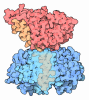
 emd_72377.png
 http://ftp.pdbj.org/pub/emdb/structures/EMD-72377
 Z (Sec.)
 Y (Row.)
 X (Col.)


 Sample components
 Escherichia coli (E. coli)
 Processing
 Electron microscopy
 FIELD EMISSION GUN