positive regulation of mitotic cell cycle phase transition / POZ domain binding / symbiont-mediated suppression of host cytoplasmic pattern recognition receptor signaling pathway via inhibition of IRF7 activity / host cytoskeleton / negative regulation of Rho protein signal transduction / embryonic cleavage / polar microtubule / anaphase-promoting complex-dependent catabolic process / nuclear protein quality control by the ubiquitin-proteasome system / regulation protein catabolic process at postsynapse ...positive regulation of mitotic cell cycle phase transition / POZ domain binding / symbiont-mediated suppression of host cytoplasmic pattern recognition receptor signaling pathway via inhibition of IRF7 activity / host cytoskeleton / negative regulation of Rho protein signal transduction / embryonic cleavage / polar microtubule / anaphase-promoting complex-dependent catabolic process / nuclear protein quality control by the ubiquitin-proteasome system / regulation protein catabolic process at postsynapse / COPII vesicle coat assembly / cell projection organization / RHOBTB3 ATPase cycle / stem cell division / target-directed miRNA degradation / positive regulation of mitotic metaphase/anaphase transition / elongin complex / Notch binding / stress fiber assembly / RHOBTB1 GTPase cycle / VCB complex / Cul5-RING ubiquitin ligase complex / ubiquitin-dependent protein catabolic process via the C-end degron rule pathway / Cul2-RING ubiquitin ligase complex / negative regulation of DNA-templated DNA replication / Cul3-RING ubiquitin ligase complex / negative regulation of type I interferon production / positive regulation of cytokinesis / ubiquitin ligase complex scaffold activity / Pausing and recovery of Tat-mediated HIV elongation / Tat-mediated HIV elongation arrest and recovery / HIV elongation arrest and recovery / Pausing and recovery of HIV elongation / protein monoubiquitination / mitotic metaphase chromosome alignment / endoplasmic reticulum to Golgi vesicle-mediated transport / Tat-mediated elongation of the HIV-1 transcript / RHOBTB2 GTPase cycle / Formation of HIV-1 elongation complex containing HIV-1 Tat / sperm flagellum / Formation of HIV elongation complex in the absence of HIV Tat / protein autoubiquitination / RNA Polymerase II Transcription Elongation / Formation of RNA Pol II elongation complex / kidney development / intrinsic apoptotic signaling pathway / ribosome-associated ubiquitin-dependent protein catabolic process / protein K48-linked ubiquitination / RNA Polymerase II Pre-transcription Events / regulation of cellular response to insulin stimulus / positive regulation of TORC1 signaling / gene expression / integrin-mediated signaling pathway / cellular response to amino acid stimulus / cyclin binding / positive regulation of protein ubiquitination / transcription corepressor binding / TP53 Regulates Transcription of DNA Repair Genes / G1/S transition of mitotic cell cycle / transcription initiation at RNA polymerase II promoter / protein destabilization / Degradation of DVL / transcription elongation by RNA polymerase II / Hedgehog 'on' state / Inactivation of CSF3 (G-CSF) signaling / Vif-mediated degradation of APOBEC3G / mitotic spindle / Evasion by RSV of host interferon responses / Oxygen-dependent proline hydroxylation of Hypoxia-inducible Factor Alpha / SPOP-mediated proteasomal degradation of PD-L1(CD274) / spindle pole / Regulation of expression of SLITs and ROBOs / protein polyubiquitination / microtubule cytoskeleton / Ribosome Quality Control (RQC) complex extracts and degrades nascent peptide / Regulation of RAS by GAPs / positive regulation of proteasomal ubiquitin-dependent protein catabolic process / ubiquitin protein ligase activity / KEAP1-NFE2L2 pathway / cell migration / Antigen processing: Ubiquitination & Proteasome degradation / Neddylation / protein-containing complex assembly / cellular response to oxidative stress / ubiquitin-dependent protein catabolic process / symbiont-mediated suppression of host cytoplasmic pattern recognition receptor signaling pathway via inhibition of IRF3 activity / Potential therapeutics for SARS / symbiont-mediated suppression of host NF-kappaB cascade / proteasome-mediated ubiquitin-dependent protein catabolic process / host cell cytoplasm / protein-macromolecule adaptor activity / postsynapse / protein ubiquitination / inflammatory response / ubiquitin protein ligase binding / centrosome / positive regulation of cell population proliferation / regulation of transcription by RNA polymerase II / negative regulation of transcription by RNA polymerase II / glutamatergic synapse Similarity search - Function
Rotavirus non-structural protein 1 / Rotavirus RNA-binding Protein 53 (NS53) / Elongin-C / Elongin B / Cullin protein neddylation domain / Cullin, conserved site / Cullin family signature. / Cullin, N-terminal / Cullin repeat-like-containing domain superfamily / Cullin protein, neddylation domain ...Rotavirus non-structural protein 1 / Rotavirus RNA-binding Protein 53 (NS53) / Elongin-C / Elongin B / Cullin protein neddylation domain / Cullin, conserved site / Cullin family signature. / Cullin, N-terminal / Cullin repeat-like-containing domain superfamily / Cullin protein, neddylation domain / Cullin / Cullin protein neddylation domain / Cullin alpha solenoid domain / Cullin / : / Cullin alpha+beta domain / Cullin homology domain / Cullin homology domain superfamily / Cullin family profile. / S-phase kinase-associated protein 1-like / SKP1 component, POZ domain / Skp1 family, tetramerisation domain / Found in Skp1 protein family / SKP1/BTB/POZ domain superfamily / Ubiquitin family / Ubiquitin homologues / Ubiquitin domain profile. / Ubiquitin-like domain / Ubiquitin-like domain superfamily / Winged helix DNA-binding domain superfamily / Winged helix-like DNA-binding domain superfamily Similarity search - Domain/homology
Journal: Science / Year: 2026 Title: Virome-wide ubiquitin ligase discovery reveals diverse mechanisms of immune evasion. Authors: Caleb R Glassman / Kheewoong Baek / Gaopeng Hou / Qiru Zeng / Christopher Nardone / Kate B Juergens / Eric Fujimura / Colin N O'Leary / Mamie Z Li / Joao A Paulo / Eric S Fischer / Siyuan ...Authors: Caleb R Glassman / Kheewoong Baek / Gaopeng Hou / Qiru Zeng / Christopher Nardone / Kate B Juergens / Eric Fujimura / Colin N O'Leary / Mamie Z Li / Joao A Paulo / Eric S Fischer / Siyuan Ding / J Wade Harper / Stephen J Elledge / Abstract: Viruses are intracellular parasites that reprogram the host proteome to promote replication and evade immune recognition. We applied a virome-wide library of ~10,000 open reading frames to discover ...Viruses are intracellular parasites that reprogram the host proteome to promote replication and evade immune recognition. We applied a virome-wide library of ~10,000 open reading frames to discover viral ubiquitin ligases, mapping their mechanisms of degradation and host substrates using targeted CRISPR screens and proteomics. These viral effectors could be classified as canonical ligases that mimic host E3s, hijackers that redirect host E3s, and non-canonical ligases that rewire Cullin-RING ligase machinery. These diverse strategies of virus-mediated degradation converged on immune-related substrates, including JAK1 and CUL1, underscoring immune evasion as a major driver of viral ubiquitin ligase evolution. Our findings elucidate viral strategies for exploiting the ubiquitin-proteasome system with potential for therapeutic targeting.
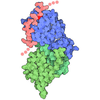
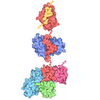
Name: Cullin-3 / type: protein_or_peptide / ID: 4 Details: N-terminal fraction of CUL3 used for local refinement based structure. Number of copies: 1 / Enantiomer: LEVO
In the structure databanks used in Yorodumi, some data are registered as the other names, "COVID-19 virus" and "2019-nCoV". Here are the details of the virus and the list of structure data.
Jan 31, 2019. EMDB accession codes are about to change! (news from PDBe EMDB page)
EMDB accession codes are about to change! (news from PDBe EMDB page)
The allocation of 4 digits for EMDB accession codes will soon come to an end. Whilst these codes will remain in use, new EMDB accession codes will include an additional digit and will expand incrementally as the available range of codes is exhausted. The current 4-digit format prefixed with “EMD-” (i.e. EMD-XXXX) will advance to a 5-digit format (i.e. EMD-XXXXX), and so on. It is currently estimated that the 4-digit codes will be depleted around Spring 2019, at which point the 5-digit format will come into force.
The EM Navigator/Yorodumi systems omit the EMD- prefix.
Related info.:Q: What is EMD? / ID/Accession-code notation in Yorodumi/EM Navigator
Yorodumi is a browser for structure data from EMDB, PDB, SASBDB, etc.
This page is also the successor to EM Navigator detail page, and also detail information page/front-end page for Omokage search.
The word "yorodu" (or yorozu) is an old Japanese word meaning "ten thousand". "mi" (miru) is to see.
Related info.:EMDB / PDB / SASBDB / Comparison of 3 databanks / Yorodumi Search / Aug 31, 2016. New EM Navigator & Yorodumi / Yorodumi Papers / Jmol/JSmol / Function and homology information / Changes in new EM Navigator and Yorodumi
 Movie
Movie Controller


 Open data
 Basic information
 Map data
 Sample
 Keywords
 Function and homology information
 Rotavirus A /
  Homo sapiens (human)
 Authors
 United States, 1 items
  Citation
 Structure visualization
 Downloads & links
 emd_72190.png
 http://ftp.pdbj.org/pub/emdb/structures/EMD-72190

 Z (Sec.)
 Y (Row.)
 X (Col.)


 Sample components
 Trichoplusia ni (cabbage looper)
 Processing
 Electron microscopy
 FIELD EMISSION GUN

