 Movie
Movie Controller


+ Open data

- Basic information
| Entry | Database: PDB / ID: 9q3e | |||||||||||||||||||||||||||||||||
|---|---|---|---|---|---|---|---|---|---|---|---|---|---|---|---|---|---|---|---|---|---|---|---|---|---|---|---|---|---|---|---|---|---|---|
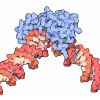
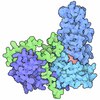
| Title | Cryo-EM structure of RotavirusA NSP1-ELOB-ELOC-CUL3 | |||||||||||||||||||||||||||||||||
 Components Components |
| |||||||||||||||||||||||||||||||||
 Keywords Keywords | VIRAL PROTEIN / Viral effector / E3 ligase / NSP1 / CUL3 | |||||||||||||||||||||||||||||||||
| Function / homology |  Function and homology information Function and homology informationpositive regulation of mitotic cell cycle phase transition / POZ domain binding / symbiont-mediated suppression of host cytoplasmic pattern recognition receptor signaling pathway via inhibition of IRF7 activity / host cytoskeleton / regulation protein catabolic process at postsynapse / negative regulation of Rho protein signal transduction / embryonic cleavage / polar microtubule / anaphase-promoting complex-dependent catabolic process / nuclear protein quality control by the ubiquitin-proteasome system ...positive regulation of mitotic cell cycle phase transition / POZ domain binding / symbiont-mediated suppression of host cytoplasmic pattern recognition receptor signaling pathway via inhibition of IRF7 activity / host cytoskeleton / regulation protein catabolic process at postsynapse / negative regulation of Rho protein signal transduction / embryonic cleavage / polar microtubule / anaphase-promoting complex-dependent catabolic process / nuclear protein quality control by the ubiquitin-proteasome system / COPII vesicle coat assembly / positive regulation of protein K63-linked ubiquitination / RHOBTB3 ATPase cycle / stem cell division / target-directed miRNA degradation / positive regulation of mitotic metaphase/anaphase transition / elongin complex / VCB complex / Notch binding / establishment of endothelial barrier / stress fiber assembly / RHOBTB1 GTPase cycle / positive regulation of cilium assembly / Cul5-RING ubiquitin ligase complex / ubiquitin-dependent protein catabolic process via the C-end degron rule pathway / Cul2-RING ubiquitin ligase complex / negative regulation of DNA-templated DNA replication / negative regulation of type I interferon production / Cul3-RING ubiquitin ligase complex / positive regulation of cytokinesis / ubiquitin ligase complex scaffold activity / Pausing and recovery of Tat-mediated HIV elongation / Tat-mediated HIV elongation arrest and recovery / HIV elongation arrest and recovery / Pausing and recovery of HIV elongation / protein monoubiquitination / mitotic metaphase chromosome alignment / endoplasmic reticulum to Golgi vesicle-mediated transport / Tat-mediated elongation of the HIV-1 transcript / Formation of HIV-1 elongation complex containing HIV-1 Tat / RHOBTB2 GTPase cycle / sperm flagellum / Formation of HIV elongation complex in the absence of HIV Tat / protein autoubiquitination / RNA Polymerase II Transcription Elongation / Formation of RNA Pol II elongation complex / kidney development / intrinsic apoptotic signaling pathway / ribosome-associated ubiquitin-dependent protein catabolic process / RNA Polymerase II Pre-transcription Events / regulation of cellular response to insulin stimulus / protein K48-linked ubiquitination / positive regulation of TORC1 signaling / integrin-mediated signaling pathway / gene expression / cyclin binding / positive regulation of protein ubiquitination / cellular response to amino acid stimulus / transcription corepressor binding / G1/S transition of mitotic cell cycle / TP53 Regulates Transcription of DNA Repair Genes / transcription initiation at RNA polymerase II promoter / protein destabilization / Degradation of DVL / transcription elongation by RNA polymerase II / Inactivation of CSF3 (G-CSF) signaling / Hedgehog 'on' state / Vif-mediated degradation of APOBEC3G / mitotic spindle / Evasion by RSV of host interferon responses / Oxygen-dependent proline hydroxylation of Hypoxia-inducible Factor Alpha / SPOP-mediated proteasomal degradation of PD-L1(CD274) / protein polyubiquitination / Regulation of expression of SLITs and ROBOs / Ribosome Quality Control (RQC) complex extracts and degrades nascent peptide / microtubule cytoskeleton / Regulation of RAS by GAPs / positive regulation of proteasomal ubiquitin-dependent protein catabolic process / ubiquitin protein ligase activity / KEAP1-NFE2L2 pathway / cell migration / Antigen processing: Ubiquitination & Proteasome degradation / spindle pole / Neddylation / protein-containing complex assembly / cellular response to oxidative stress / ubiquitin-dependent protein catabolic process / symbiont-mediated suppression of host cytoplasmic pattern recognition receptor signaling pathway via inhibition of IRF3 activity / Potential therapeutics for SARS / symbiont-mediated suppression of host NF-kappaB cascade / proteasome-mediated ubiquitin-dependent protein catabolic process / inflammatory response / postsynapse / protein-macromolecule adaptor activity / protein ubiquitination / ubiquitin protein ligase binding / centrosome / regulation of transcription by RNA polymerase II / positive regulation of cell population proliferation / host cell cytoplasm Similarity search - Function | |||||||||||||||||||||||||||||||||
| Biological species |  Rotavirus A Rotavirus A Homo sapiens (human) Homo sapiens (human) | |||||||||||||||||||||||||||||||||
| Method | ELECTRON MICROSCOPY / single particle reconstruction / cryo EM / Resolution: 3.3 Å | |||||||||||||||||||||||||||||||||
 Authors Authors | Baek, K. / Glassman, C.R. / Fischer, E.S. | |||||||||||||||||||||||||||||||||
| Funding support |  United States, 1items United States, 1items
| |||||||||||||||||||||||||||||||||
 Citation Citation | Journal: Science / Year: 2026 Title: Virome-wide ubiquitin ligase discovery reveals diverse mechanisms of immune evasion. Authors: Caleb R Glassman / Kheewoong Baek / Gaopeng Hou / Qiru Zeng / Christopher Nardone / Kate B Juergens / Eric Fujimura / Colin N O'Leary / Mamie Z Li / Joao A Paulo / Eric S Fischer / Siyuan ...Authors: Caleb R Glassman / Kheewoong Baek / Gaopeng Hou / Qiru Zeng / Christopher Nardone / Kate B Juergens / Eric Fujimura / Colin N O'Leary / Mamie Z Li / Joao A Paulo / Eric S Fischer / Siyuan Ding / J Wade Harper / Stephen J Elledge / Abstract: Viruses are intracellular parasites that reprogram the host proteome to promote replication and evade immune recognition. We applied a virome-wide library of ~10,000 open reading frames to discover ...Viruses are intracellular parasites that reprogram the host proteome to promote replication and evade immune recognition. We applied a virome-wide library of ~10,000 open reading frames to discover viral ubiquitin ligases, mapping their mechanisms of degradation and host substrates using targeted CRISPR screens and proteomics. These viral effectors could be classified as canonical ligases that mimic host E3s, hijackers that redirect host E3s, and noncanonical ligases that rewire cullin-RING ligase machinery. These diverse strategies of virus-mediated degradation converged on immune-related substrates, including JAK1 and CUL1, underscoring immune evasion as a major driver of viral ubiquitin ligase evolution. Our findings elucidate viral strategies for exploiting the ubiquitin-proteasome system with potential for therapeutic targeting. | |||||||||||||||||||||||||||||||||
| History |
|
- Structure visualization
| Structure viewer | Molecule: MolmilJmol/JSmol |
|---|
- Downloads & links
-Download
| PDBx/mmCIF format | 9q3e.cif.gz | 181 KB | Display | PDBx/mmCIF format |
|---|---|---|---|---|
| PDB format | pdb9q3e.ent.gz | 129.3 KB | Display | PDB format |
| PDBx/mmJSON format | 9q3e.json.gz | Tree view | PDBx/mmJSON format | |
| Others |  Other downloads Other downloads |
-Validation report
| Arichive directory | https://data.pdbj.org/pub/pdb/validation_reports/q3/9q3eftp://data.pdbj.org/pub/pdb/validation_reports/q3/9q3e | HTTPS FTP |
|---|
-Related structure data
| Related structure data |  72190MC M: map data used to model this data C: citing same article ( |
|---|---|
| Similar structure data |
-Links
 PDBj
PDBj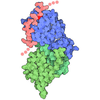


- Assembly
| Deposited unit | 
|
|---|---|
| 1 |
|
-Components
| #1: Protein | Mass: 57744.199 Da / Num. of mol.: 1 Source method: isolated from a genetically manipulated source Source: (gene. exp.) Rotavirus A / Production host:  Trichoplusia ni (cabbage looper) / References: UniProt: B3SRV2 Trichoplusia ni (cabbage looper) / References: UniProt: B3SRV2 | ||||
|---|---|---|---|---|---|
| #2: Protein | Mass: 13147.781 Da / Num. of mol.: 1 Source method: isolated from a genetically manipulated source Source: (gene. exp.) Homo sapiens (human) / Gene: ELOB, TCEB2 / Production host: Trichoplusia ni (cabbage looper) / References: UniProt: Q15370 | ||||
| #3: Protein | Mass: 12485.135 Da / Num. of mol.: 1 Source method: isolated from a genetically manipulated source Source: (gene. exp.) Homo sapiens (human) / Gene: ELOC, TCEB1 / Production host: Trichoplusia ni (cabbage looper) / References: UniProt: Q15369 | ||||
| #4: Protein | Mass: 89334.625 Da / Num. of mol.: 1 Source method: isolated from a genetically manipulated source Details: N-terminal fraction of CUL3 used for local refinement based structure. Source: (gene. exp.) Homo sapiens (human) / Gene: CUL3, KIAA0617 / Production host: Trichoplusia ni (cabbage looper) / References: UniProt: Q13618 | ||||
| #5: Chemical |   Mass: 65.409 Da / Num. of mol.: 3 / Source method: obtained synthetically / Formula: Zn / Feature type: SUBJECT OF INVESTIGATION Mass: 65.409 Da / Num. of mol.: 3 / Source method: obtained synthetically / Formula: Zn / Feature type: SUBJECT OF INVESTIGATIONHas ligand of interest | Y | Has protein modification | N | |
-Experimental details
-Experiment
| Experiment | Method: ELECTRON MICROSCOPY |
|---|---|
| EM experiment | Aggregation state: PARTICLE / 3D reconstruction method: single particle reconstruction |
- Sample preparation
| Component | Name: RotavirusA NSP1-ELOB-ELOC-CUL3 / Type: COMPLEX / Entity ID: #1-#4 / Source: RECOMBINANT |
|---|---|
| Source (natural) | Organism: Rotavirus A / Strain: B3SRV2.0.1 |
| Source (recombinant) | Organism: Trichoplusia ni (cabbage looper) |
| Buffer solution | pH: 7.5 |
| Specimen | Embedding applied: NO / Shadowing applied: NO / Staining applied: NO / Vitrification applied: YES |
| Vitrification | Cryogen name: ETHANE |
- Electron microscopy imaging
| Experimental equipment |  Model: Titan Krios / Image courtesy: FEI Company |
|---|---|
| Microscopy | Model: TFS KRIOS |
| Electron gun | Electron source:  FIELD EMISSION GUN / Accelerating voltage: 300 kV / Illumination mode: FLOOD BEAM FIELD EMISSION GUN / Accelerating voltage: 300 kV / Illumination mode: FLOOD BEAM |
| Electron lens | Mode: BRIGHT FIELD / Nominal defocus max: 2000 nm / Nominal defocus min: 800 nm |
| Image recording | Electron dose: 50.6 e/Å2 / Film or detector model: FEI FALCON IV (4k x 4k) |
- Processing
| EM software |
| |||||||||
|---|---|---|---|---|---|---|---|---|---|---|
| CTF correction | Type: PHASE FLIPPING AND AMPLITUDE CORRECTION | |||||||||
| 3D reconstruction | Resolution: 3.3 Å / Resolution method: FSC 0.143 CUT-OFF / Num. of particles: 173093 / Symmetry type: POINT |
