Massachusetts Consortium on Pathogen Readiness (MassCPR)
United States
Citation
Journal: Cell Rep / Year: 2026 Title: Affinity maturation and light-chain-mediated paratope diversification anticipates viral evolution. Authors: John Dingus / Duck-Kyun Yoo / Sachin Kumar / Yajuan Wang / Md Golam Kibria / Shahab Saghaei / Zahra Allahyari / Jessica W Chen / Natalie M Caputo / Jason Hwang / Bing Chen / Duane R Wesemann / Abstract: A key goal of vaccinology is to train the immune system to combat current pathogens while preparing it for future variants. Here, we investigate how Wuhan strain severe acute respiratory syndrome ...A key goal of vaccinology is to train the immune system to combat current pathogens while preparing it for future variants. Here, we investigate how Wuhan strain severe acute respiratory syndrome coronavirus 2 mRNA vaccination generates "anticipatory breadth" in an antibody family exhibiting germline complementarity to the ACE2 binding site on the receptor-binding-domain (RBD). IGHV3-53/66 antibodies from infection-naive vaccinees frequently neutralize Omicron variants and contain hallmark breadth-enhancing mutations. While Omicron breakthrough infection does not alter IGHV3-53/66 mutation frequencies, it modifies Ig light-chain pairing frequencies, suggesting variant-driven selection for favorable pairings. Structural analyses of IGHV3-53/66-RBD complexes show that hallmark heavy-chain mutations refine interactions with conserved RBD residues, while alternative Ig light-chain pairings modify contacts at Omicron mutation sites. Together, these findings support a cooperative model of anticipatory breadth involving targeting of a functionally constrained epitope, affinity maturation to establish an affinity buffer, and alternative Ig light-chain pairings to diversify paratopes-providing a mechanistic framework for anticipating viral evolution.
Organism: Mus musculus (house mouse) / Details: SP1-77 Fab is from a humanized murine antibody.
-
Macromolecule #1: Spike protein S1
Macromolecule
Name: Spike protein S1 / type: protein_or_peptide / ID: 1 Details: derived from the D614G variant, including signal sequence Number of copies: 1 / Enantiomer: LEVO
Source (natural)
Organism: Severe acute respiratory syndrome coronavirus 2
In the structure databanks used in Yorodumi, some data are registered as the other names, "COVID-19 virus" and "2019-nCoV". Here are the details of the virus and the list of structure data.
Jan 31, 2019. EMDB accession codes are about to change! (news from PDBe EMDB page)
EMDB accession codes are about to change! (news from PDBe EMDB page)
The allocation of 4 digits for EMDB accession codes will soon come to an end. Whilst these codes will remain in use, new EMDB accession codes will include an additional digit and will expand incrementally as the available range of codes is exhausted. The current 4-digit format prefixed with “EMD-” (i.e. EMD-XXXX) will advance to a 5-digit format (i.e. EMD-XXXXX), and so on. It is currently estimated that the 4-digit codes will be depleted around Spring 2019, at which point the 5-digit format will come into force.
The EM Navigator/Yorodumi systems omit the EMD- prefix.
Related info.:Q: What is EMD? / ID/Accession-code notation in Yorodumi/EM Navigator
Yorodumi is a browser for structure data from EMDB, PDB, SASBDB, etc.
This page is also the successor to EM Navigator detail page, and also detail information page/front-end page for Omokage search.
The word "yorodu" (or yorozu) is an old Japanese word meaning "ten thousand". "mi" (miru) is to see.
Related info.:EMDB / PDB / SASBDB / Comparison of 3 databanks / Yorodumi Search / Aug 31, 2016. New EM Navigator & Yorodumi / Yorodumi Papers / Jmol/JSmol / Function and homology information / Changes in new EM Navigator and Yorodumi
 Movie
Movie Controller


 Open data
 Basic information
 Map data
 Sample
 Keywords
 Function and homology information
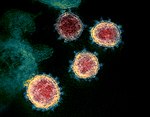 Severe acute respiratory syndrome coronavirus 2 /
  Homo sapiens (human) /
 Mus musculus (house mouse)
 Authors
 United States, 1 items
  Citation
 Structure visualization
 Downloads & links
 emd_71899.png
 http://ftp.pdbj.org/pub/emdb/structures/EMD-71899
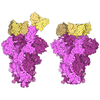
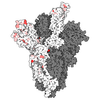
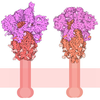
 Z (Sec.)
 Y (Row.)
 X (Col.)


 Sample components
 Processing
 Electron microscopy
 FIELD EMISSION GUN

