[English] 日本語
Yorodumi
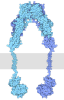
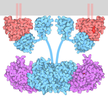
- EMDB-71877: Insulin receptor bound to S961 -

+
Open data


ID or keywords:

Loading...

-
Basic information

Entry
Database: EMDB / ID: EMD-71877
TitleInsulin receptor bound to S961
Map data
Sample
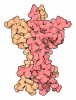
  • Complex: Insulin Receptor-A isoform complexed with two S961 molecules.
    • Protein or peptide: Isoform Long of Insulin receptor
    • Protein or peptide: S961 Insulin receptor antagonist
KeywordsAntagonist / receptor tyrosine kinase / MEMBRANE PROTEIN
Function / homology
Function and homology information


regulation of female gonad development / positive regulation of meiotic cell cycle / insulin-like growth factor II binding / positive regulation of developmental growth / male sex determination / insulin receptor complex / insulin-like growth factor I binding / insulin receptor activity / positive regulation of protein-containing complex disassembly / exocrine pancreas development ...regulation of female gonad development / positive regulation of meiotic cell cycle / insulin-like growth factor II binding / positive regulation of developmental growth / male sex determination / insulin receptor complex / insulin-like growth factor I binding / insulin receptor activity / positive regulation of protein-containing complex disassembly / exocrine pancreas development / dendritic spine maintenance / insulin binding / adrenal gland development / cargo receptor activity / PTB domain binding / Signaling by Insulin receptor / IRS activation / neuronal cell body membrane / positive regulation of respiratory burst / amyloid-beta clearance / regulation of embryonic development / insulin receptor substrate binding / positive regulation of receptor internalization / epidermis development / positive regulation of glycogen biosynthetic process / Signal attenuation / protein kinase activator activity / transport across blood-brain barrier / phosphatidylinositol 3-kinase binding / heart morphogenesis / Insulin receptor recycling / insulin-like growth factor receptor binding / neuron projection maintenance / positive regulation of mitotic nuclear division / Insulin receptor signalling cascade / receptor-mediated endocytosis / dendrite membrane / positive regulation of glycolytic process / positive regulation of D-glucose import across plasma membrane / learning / receptor protein-tyrosine kinase / caveola / receptor internalization / male gonad development / cellular response to growth factor stimulus / cellular response to insulin stimulus / memory / positive regulation of nitric oxide biosynthetic process / insulin receptor signaling pathway / protein autophosphorylation / late endosome / glucose homeostasis / amyloid-beta binding / PI5P, PP2A and IER3 Regulate PI3K/AKT Signaling / protein tyrosine kinase activity / positive regulation of canonical NF-kappaB signal transduction / positive regulation of MAPK cascade / lysosome / positive regulation of phosphatidylinositol 3-kinase/protein kinase B signal transduction / signaling receptor complex / endosome membrane / positive regulation of cell migration / G protein-coupled receptor signaling pathway / external side of plasma membrane / protein domain specific binding / axon / positive regulation of cell population proliferation / symbiont entry into host cell / regulation of DNA-templated transcription / positive regulation of DNA-templated transcription / GTP binding / protein-containing complex binding / extracellular exosome / ATP binding / membrane / identical protein binding / plasma membrane
Similarity search - Function
Insulin receptor, trans-membrane domain / Insulin receptor trans-membrane segment / Tyrosine-protein kinase, insulin-like receptor / Tyrosine-protein kinase, receptor class II, conserved site / Receptor tyrosine kinase class II signature. / Receptor L-domain / Furin-like cysteine-rich domain / Receptor L-domain superfamily / Furin-like cysteine rich region / Receptor L domain ...Insulin receptor, trans-membrane domain / Insulin receptor trans-membrane segment / Tyrosine-protein kinase, insulin-like receptor / Tyrosine-protein kinase, receptor class II, conserved site / Receptor tyrosine kinase class II signature. / Receptor L-domain / Furin-like cysteine-rich domain / Receptor L-domain superfamily / Furin-like cysteine rich region / Receptor L domain / Furin-like repeat / Furin-like repeats / Growth factor receptor cysteine-rich domain superfamily / : / Fibronectin type 3 domain / Fibronectin type-III domain profile. / Fibronectin type III / Fibronectin type III superfamily / Tyrosine-protein kinase, catalytic domain / Tyrosine kinase, catalytic domain / Tyrosine protein kinases specific active-site signature. / Tyrosine-protein kinase, active site / Protein tyrosine and serine/threonine kinase / Serine-threonine/tyrosine-protein kinase, catalytic domain / Protein kinase, ATP binding site / Protein kinases ATP-binding region signature. / Immunoglobulin-like fold / Protein kinase domain profile. / Protein kinase domain / Protein kinase-like domain superfamily
Similarity search - Domain/homology
Biological speciesHomo sapiens (human) / Phage #D (virus)
Methodsingle particle reconstruction / cryo EM / Resolution: 3.68 Å
AuthorsVogel A / Blakely A / Hill CP
Funding support United States, 1 items
OrganizationGrant numberCountry
National Institutes of Health/National Institute of Diabetes and Digestive and Kidney Disease (NIH/NIDDK)R01DK127268 United States
CitationJournal: Proc Natl Acad Sci U S A / Year: 2026
Title: Structural basis of transcription-coupled RNA damage by incorporation of oxidized ribonucleotides.
Authors: Peini Hou / Chanjoo Lee / Jenny Chong / Juntaek Oh / Dong Wang /
Abstract: Oxidative stress induces damage to DNA, RNA, and nucleotide pools. Unlike well-studied DNA damage, the formation of RNA damage and the impact of an oxidized ribonucleotide pool on transcription ...Oxidative stress induces damage to DNA, RNA, and nucleotide pools. Unlike well-studied DNA damage, the formation of RNA damage and the impact of an oxidized ribonucleotide pool on transcription fidelity are poorly understood. Here, we investigate the structural basis of transcription-coupled RNA damage and the effect of 8-oxo-guanosine triphosphate (8-oxo-rGTP) on RNA polymerase II (Pol II) transcription fidelity control steps. We revealed that the incorporation efficiency of 8-oxo-rGTP opposite a dC template is comparable to that of GTP. In contrast, the incorporation efficiency of 8-oxo-rGTP opposite a dA template is ~150-fold more efficient than that of GTP. For the extension step, Pol II extends substantially faster from a 3'-8-oxo-rG:dC base pair than from a 3'-8-oxo-rG:dA base pair. For the proofreading step, strikingly, Pol II EC with 3'-8-oxo-rG:dA base pair is much more resistant to backtracking and proofreading than Pol II EC with 3'-8-oxo-rG:dC base pair. Using X-ray crystallography, we revealed that 8-oxo-rGTP adopts different prechemistry binding sites depending on whether it is paired with a dC or a dA template. Upon incorporation, the nucleobase of 8-oxo-rG flips to the -conformation to form a Hoogsteen pair with a dA template, whereas it remains in the -conformation to form a Watson-Crick pair with a dC template. Collectively, our work demonstrates that nucleotide-pool oxidation can directly affect Pol II fidelity control steps and elongation dynamics and induce RNA damage in a transcription-coupled manner.
History
DepositionJul 31, 2025-
Header (metadata) releaseJun 10, 2026-
Map releaseJun 10, 2026-
UpdateJun 10, 2026-
Current statusJun 10, 2026Processing site: RCSB / Status: Released

-
Structure visualization

Supplemental images

Downloads & links

-
Map

FileDownload / File: emd_71877.map.gz / Format: CCP4 / Size: 125 MB / Type: IMAGE STORED AS FLOATING POINT NUMBER (4 BYTES)
Projections & slices

Image control

Size
Brightness
Contrast
Others
AxesZ (Sec.)Y (Row.)X (Col.)
1.06 Å/pix.
x 320 pix.
= 339.2 Å
1.06 Å/pix.
x 320 pix.
= 339.2 Å
1.06 Å/pix.
x 320 pix.
= 339.2 Å

Surface

Projections

Slices (1/3)

Slices (1/2)

Slices (2/3)

Images are generated by Spider.

Voxel sizeX=Y=Z: 1.06 Å
Density
Contour LevelBy AUTHOR: 0.0942
Minimum - Maximum-1.2527809 - 1.6309668
Average (Standard dev.)-0.00054153946 (±0.02122834)
SymmetrySpace group: 1
Details

EMDB XML:

Map geometry
Axis orderXYZ
Origin000
Dimensions320320320
Spacing320320320
CellA=B=C: 339.19998 Å
α=β=γ: 90.0 °

-
Supplemental data

-
Half map: #2

Fileemd_71877_half_map_1.map
Projections & Slices
AxesZYX

Projections

Slices (1/2)
Density Histograms

-
Half map: #1

Fileemd_71877_half_map_2.map
Projections & Slices
AxesZYX

Projections

Slices (1/2)
Density Histograms

-
Sample components

-
Entire : Insulin Receptor-A isoform complexed with two S961 molecules.

EntireName: Insulin Receptor-A isoform complexed with two S961 molecules.
Components
  • Complex: Insulin Receptor-A isoform complexed with two S961 molecules.
    • Protein or peptide: Isoform Long of Insulin receptor
    • Protein or peptide: S961 Insulin receptor antagonist

-
Supramolecule #1: Insulin Receptor-A isoform complexed with two S961 molecules.

SupramoleculeName: Insulin Receptor-A isoform complexed with two S961 molecules.
type: complex / ID: 1 / Parent: 0 / Macromolecule list: all
Source (natural)Organism: Homo sapiens (human)

-
Macromolecule #1: Isoform Long of Insulin receptor

MacromoleculeName: Isoform Long of Insulin receptor / type: protein_or_peptide / ID: 1 / Number of copies: 2 / Enantiomer: LEVO / EC number: receptor protein-tyrosine kinase
Source (natural)Organism: Homo sapiens (human)
Molecular weightTheoretical: 156.081453 KDa
Recombinant expressionOrganism: Homo sapiens (human)
SequenceString: HLYPGEVCPG MDIRNNLTRL HELENCSVIE GHLQILLMFK TRPEDFRDLS FPKLIMITDY LLLFRVYGLE SLKDLFPNLT VIRGSRLFF NYALVIFEMV HLKELGLYNL MNITRGSVRI EKNNELCYLA TIDWSRILDS VEDNYIVLNK DDNEECGDIC P GTAKGKTN ...String:
HLYPGEVCPG MDIRNNLTRL HELENCSVIE GHLQILLMFK TRPEDFRDLS FPKLIMITDY LLLFRVYGLE SLKDLFPNLT VIRGSRLFF NYALVIFEMV HLKELGLYNL MNITRGSVRI EKNNELCYLA TIDWSRILDS VEDNYIVLNK DDNEECGDIC P GTAKGKTN CPATVINGQF VERCWTHSHC QKVCPTICKS HGCTAEGLCC HSECLGNCSQ PDDPTKCVAC RNFYLDGRCV ET CPPPYYH FQDWRCVNFS FCQDLHHKCK NSRRQGCHQY VIHNNKCIPE CPSGYTMNSS NLLCTPCLGP CPKVCHLLEG EKT IDSVTS AQELRGCTVI NGSLIINIRG GNNLAAELEA NLGLIEEISG YLKIRRSYAL VSLSFFRKLR LIRGETLEIG NYSF YALDN QNLRQLWDWS KHNLTITQGK LFFHYNPKLC LSEIHKMEEV SGTKGRQERN DIALKTNGDQ ASCENELLKF SYIRT SFDK ILLRWEPYWP PDFRDLLGFM LFYKEAPYQN VTEFDGQDAC GSNSWTVVDI DPPLRSNDPK SQSHPGWLMR GLKPWT QYA IFVKTLVTFS DERRTYGAKS DIIYVQTDAT NPSVPLDPIS VSNSSSQIIL KWKPPSDPNG NITHYLVFWE RQAEDSE LF ELDYCLKGLK LPSRTWSPPF ESEDSQKHNQ SEYEDSAGEC CSCPKTDSQI LKELEESSFR KTFEDYLHNV VFVPRKTS S GTGAEDPRPS RKRRSLGDVG NVTVAVPTVA AFPNTSSTSV PTSPEEHRPF EKVVNKESLV ISGLRHFTGY RIELQACNQ DTPEERCSVA AYVSARTMPE AKADDIVGPV THEIFENNVV HLMWQEPKEP NGLIVLYEVS YRRYGDEELH LCVSRKHFAL ERGCRLRGL SPGNYSVRIR ATSLAGNGSW TEPTYFYVTD YLDVPSNIAK IIIGPLIFVF LFSVVIGSIY LFLRKRQPDG P LGPLYASS NPEYLSASDV FPCSVYVPDE WEVSREKITL LRELGQGSFG MVYEGNARDI IKGEAETRVA VKTVNESASL RE RIEFLNE ASVMKGFTCH HVVRLLGVVS KGQPTLVVME LMAHGDLKSY LRSLRPEAEN NPGRPPPTLQ EMIQMAAEIA DGM AYLNAK KFVHRDLAAR NCMVAHDFTV KIGDFGMTRD IYETDYYRKG GKGLLPVRWM APESLKDGVF TTSSDMWSFG VVLW EITSL AEQPYQGLSN EQVLKFVMDG GYLDQPDNCP ERVTDLMRMC WQFNPKMRPT FLEIVNLLKD DLHPSFPEVS FFHSE ENKA PESEELEMEF EDMENVPLDR SSHCQREEAG GRDGGSSLGF KRSYEEHIPY THMNGGKKNG RILTLPRSNP SDYKDD DDK DYKDDDDK

UniProtKB: Insulin receptor

-
Macromolecule #2: S961 Insulin receptor antagonist

MacromoleculeName: S961 Insulin receptor antagonist / type: protein_or_peptide / ID: 2 / Number of copies: 2 / Enantiomer: LEVO
Source (natural)Organism: Phage #D (virus)
Molecular weightTheoretical: 4.806093 KDa
SequenceString:
GSLDESFYDW FERQLGGGSG GSSLEEEWAQ IQCEVWGRGC PSY

-
Experimental details

-
Structure determination

Methodcryo EM
Processingsingle particle reconstruction
Aggregation stateparticle

-
Sample preparation

BufferpH: 7.5
VitrificationCryogen name: ETHANE

-
Electron microscopy

MicroscopeTFS KRIOS
Image recordingFilm or detector model: GATAN K3 BIOQUANTUM (6k x 4k) / Average electron dose: 50.0 e/Å2
Electron beamAcceleration voltage: 300 kV / Electron source: FIELD EMISSION GUN
Electron opticsIllumination mode: OTHER / Imaging mode: BRIGHT FIELD / Nominal defocus max: 2.2 µm / Nominal defocus min: 0.8 µm
Experimental equipment
Model: Titan Krios / Image courtesy: FEI Company

+
Image processing

CTF correctionType: NONE
Startup modelType of model: PDB ENTRY
PDB model - PDB ID:
Final reconstructionResolution.type: BY AUTHOR / Resolution: 3.68 Å / Resolution method: FSC 0.143 CUT-OFF / Software - Name: cryoSPARC / Number images used: 378182
Initial angle assignmentType: NOT APPLICABLE
Final angle assignmentType: NOT APPLICABLE
FSC plot (resolution estimation)

+
About Yorodumi

-
News

-
Feb 9, 2022. New format data for meta-information of EMDB entries

New format data for meta-information of EMDB entries

  • Version 3 of the EMDB header file is now the official format.
  • The previous official version 1.9 will be removed from the archive.

Related info.:EMDB header

External links:wwPDB to switch to version 3 of the EMDB data model

-
Aug 12, 2020. Covid-19 info

Covid-19 info

URL: https://pdbj.org/emnavi/covid19.php

New page: Covid-19 featured information page in EM Navigator.

Related info.:Covid-19 info / Mar 5, 2020. Novel coronavirus structure data

+
Mar 5, 2020. Novel coronavirus structure data

Novel coronavirus structure data

Related info.:Yorodumi Speices / Aug 12, 2020. Covid-19 info

External links:COVID-19 featured content - PDBj / Molecule of the Month (242):Coronavirus Proteases

+
Jan 31, 2019. EMDB accession codes are about to change! (news from PDBe EMDB page)

EMDB accession codes are about to change! (news from PDBe EMDB page)

  • The allocation of 4 digits for EMDB accession codes will soon come to an end. Whilst these codes will remain in use, new EMDB accession codes will include an additional digit and will expand incrementally as the available range of codes is exhausted. The current 4-digit format prefixed with “EMD-” (i.e. EMD-XXXX) will advance to a 5-digit format (i.e. EMD-XXXXX), and so on. It is currently estimated that the 4-digit codes will be depleted around Spring 2019, at which point the 5-digit format will come into force.
  • The EM Navigator/Yorodumi systems omit the EMD- prefix.

Related info.:Q: What is EMD? / ID/Accession-code notation in Yorodumi/EM Navigator

External links:EMDB Accession Codes are Changing Soon! / Contact to PDBj

+
Jul 12, 2017. Major update of PDB

Major update of PDB

  • wwPDB released updated PDB data conforming to the new PDBx/mmCIF dictionary.
  • This is a major update changing the version number from 4 to 5, and with Remediation, in which all the entries are updated.
  • In this update, many items about electron microscopy experimental information are reorganized (e.g. em_software).
  • Now, EM Navigator and Yorodumi are based on the updated data.

External links:wwPDB Remediation / Enriched Model Files Conforming to OneDep Data Standards Now Available in the PDB FTP Archive

-
Yorodumi

Thousand views of thousand structures

  • Yorodumi is a browser for structure data from EMDB, PDB, SASBDB, etc.
  • This page is also the successor to EM Navigator detail page, and also detail information page/front-end page for Omokage search.
  • The word "yorodu" (or yorozu) is an old Japanese word meaning "ten thousand". "mi" (miru) is to see.

Related info.:EMDB / PDB / SASBDB / Comparison of 3 databanks / Yorodumi Search / Aug 31, 2016. New EM Navigator & Yorodumi / Yorodumi Papers / Jmol/JSmol / Function and homology information / Changes in new EM Navigator and Yorodumi

Read more