National Institutes of Health/National Institute of General Medical Sciences (NIH/NIGMS)
United States
Citation
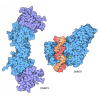
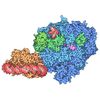
Journal: Nat Commun / Year: 2026 Title: Structural insight into hierarchical DNMT3A autoinhibition and its dysregulation in disease. Authors: Jiuwei Lu / Emily Vig / Jianbin Chen / Kristjan H Gretarsson / Nelli Khudaverdyan / Zengyu Shao / Chao Lu / Chia-En A Chang / Jikui Song / Abstract: DNA methyltransferase DNMT3A-mediated DNA methylation is important for genomic imprinting and transcriptional regulation. However, how the regulatory domains of DNMT3A cooperate with its ...DNA methyltransferase DNMT3A-mediated DNA methylation is important for genomic imprinting and transcriptional regulation. However, how the regulatory domains of DNMT3A cooperate with its methyltransferase domain and histone marks to orchestrate genomic methylation remains unclear. Here we report the cryo-EM structure of DNMT3A2 with regulatory factor DNMT3L, revealing an intricate domain interaction underlying multilayered autoinhibition. The PWWP domain interacts with the ADD and methyltransferase domains to block the target recognition domain and the H3K36me2-binding pocket, thereby coupling the H3K36me2 binding with DNMT3A activation, adding a layer of allosteric regulation distinct from the previously characterized ADD-H3K4me0 regulation. Molecular dynamics simulations of the DNMT3A-DNMT3L complex further reveals that relief of DNMT3A autoinhibition involves disengagement of the CpG-recognition loop of the target recognition domain from autoinhibitory interaction, leading to enhanced accessibility of the target recognition domain loop for DNA binding and DNMT3A activation. Importantly, our combined structural, biochemical and genomic methylation analysis demonstrates that disrupting the PWWP-ADD interaction by disease-associated DNMT3A mutations leads to impaired DNMT3A autoinhibition and substrate specificity, providing a potential explanation to aberrant DNA methylation in disease.
In the structure databanks used in Yorodumi, some data are registered as the other names, "COVID-19 virus" and "2019-nCoV". Here are the details of the virus and the list of structure data.
Jan 31, 2019. EMDB accession codes are about to change! (news from PDBe EMDB page)
EMDB accession codes are about to change! (news from PDBe EMDB page)
The allocation of 4 digits for EMDB accession codes will soon come to an end. Whilst these codes will remain in use, new EMDB accession codes will include an additional digit and will expand incrementally as the available range of codes is exhausted. The current 4-digit format prefixed with “EMD-” (i.e. EMD-XXXX) will advance to a 5-digit format (i.e. EMD-XXXXX), and so on. It is currently estimated that the 4-digit codes will be depleted around Spring 2019, at which point the 5-digit format will come into force.
The EM Navigator/Yorodumi systems omit the EMD- prefix.
Related info.:Q: What is EMD? / ID/Accession-code notation in Yorodumi/EM Navigator
Yorodumi is a browser for structure data from EMDB, PDB, SASBDB, etc.
This page is also the successor to EM Navigator detail page, and also detail information page/front-end page for Omokage search.
The word "yorodu" (or yorozu) is an old Japanese word meaning "ten thousand". "mi" (miru) is to see.
Related info.:EMDB / PDB / SASBDB / Comparison of 3 databanks / Yorodumi Search / Aug 31, 2016. New EM Navigator & Yorodumi / Yorodumi Papers / Jmol/JSmol / Function and homology information / Changes in new EM Navigator and Yorodumi
 Movie
Movie Controller


 Open data
 Basic information
 Map data
 Sample
 Keywords
 Function and homology information
 Homo sapiens (human)
 Authors
 United States, 1 items
  Citation
 Structure visualization
 Downloads & links
 emd_71814.png
 http://ftp.pdbj.org/pub/emdb/structures/EMD-71814
 Z (Sec.)
 Y (Row.)
 X (Col.)


 Sample components
 Escherichia coli BL21(DE3) (bacteria)
 Processing
 Electron microscopy
 FIELD EMISSION GUN
