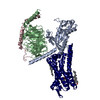
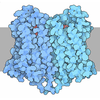
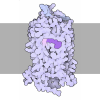
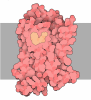
Journal: J Med Chem / Year: 2026 Title: Large Library Docking for Polypharmacology. Authors: Yujin Wu / Seth Vigneron / Joao Braz / Karthik Srinivasan / Elissa A Fink / Xi-Ping Huang / Xinyu Xu / Harald Huebner / Joseph Y Kim / Jing Wang / Tara Pfeiffer / Kensuke Sakamoto / Dmytro S ...Authors: Yujin Wu / Seth Vigneron / Joao Braz / Karthik Srinivasan / Elissa A Fink / Xi-Ping Huang / Xinyu Xu / Harald Huebner / Joseph Y Kim / Jing Wang / Tara Pfeiffer / Kensuke Sakamoto / Dmytro S Radchenko / Ramona M Rodriguiz / Yurii S Moroz / John J Irwin / Peter Gmeiner / Christian Billesboelle / Bryan L Roth / Allan I Basbaum / Aashish Manglik / William C Wetsel / Brian K Shoichet / Abstract: Polypharmacological molecules are attractive for complex illnesses. Here, we explored large library docking for joint activity against target pairs. Retrospectively, as libraries grew, so too did the ...Polypharmacological molecules are attractive for complex illnesses. Here, we explored large library docking for joint activity against target pairs. Retrospectively, as libraries grew, so too did the number of likely dual-activity molecules. In prospective docking of a 900-million molecule library against three target pairs (α/SERT, MOR/SERT, and α/MOR), we sought analgesic compounds. Both the α/SERT and SERT/MOR campaigns led to dual binders with low μM to high nM activities with high hit rates; tetrahydropyridines from the α/SERT campaign were also active against 5-HT. However, even though cryo-EM structures confirmed the docking-predicted poses, optimization struggled to improve potency. Still, in mouse behavioral assays, the most potent α/SERT compound (') was effective against pain without inducing conditioned place preference, and the molecule had potent antidepression and anxiolytic drug-like behavior, consistent with its SERT/5-HT activities. This study reveals both advantages and challenges of docking for polypharmacology.
In the structure databanks used in Yorodumi, some data are registered as the other names, "COVID-19 virus" and "2019-nCoV". Here are the details of the virus and the list of structure data.
Jan 31, 2019. EMDB accession codes are about to change! (news from PDBe EMDB page)
EMDB accession codes are about to change! (news from PDBe EMDB page)
The allocation of 4 digits for EMDB accession codes will soon come to an end. Whilst these codes will remain in use, new EMDB accession codes will include an additional digit and will expand incrementally as the available range of codes is exhausted. The current 4-digit format prefixed with “EMD-” (i.e. EMD-XXXX) will advance to a 5-digit format (i.e. EMD-XXXXX), and so on. It is currently estimated that the 4-digit codes will be depleted around Spring 2019, at which point the 5-digit format will come into force.
The EM Navigator/Yorodumi systems omit the EMD- prefix.
Related info.:Q: What is EMD? / ID/Accession-code notation in Yorodumi/EM Navigator
Yorodumi is a browser for structure data from EMDB, PDB, SASBDB, etc.
This page is also the successor to EM Navigator detail page, and also detail information page/front-end page for Omokage search.
The word "yorodu" (or yorozu) is an old Japanese word meaning "ten thousand". "mi" (miru) is to see.
Related info.:EMDB / PDB / SASBDB / Comparison of 3 databanks / Yorodumi Search / Aug 31, 2016. New EM Navigator & Yorodumi / Yorodumi Papers / Jmol/JSmol / Function and homology information / Changes in new EM Navigator and Yorodumi
 Movie
Movie Controller

 Yorodumi
 Open data
 Basic information
 Map data
 Sample
 Keywords
 Function and homology information
 Homo sapiens (human)
 Authors
 United States, 2 items
  Citation

 Structure visualization
 Downloads & links
 emd_71775.png
 http://ftp.pdbj.org/pub/emdb/structures/EMD-71775


 Z (Sec.)
 Y (Row.)
 X (Col.)


 Sample components
 Processing
 Electron microscopy
 FIELD EMISSION GUN